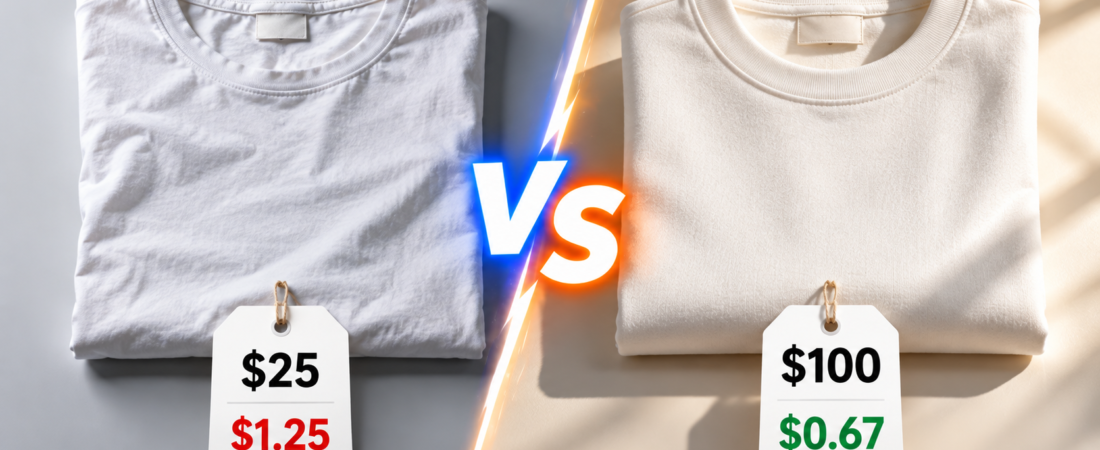
A $25 shirt seems like a better deal than a $100 shirt.
Four times cheaper.
Same basic purpose.
Both cover your body.
So why would anyone pay four times more?
But what if the $25 shirt loses its shape after ten washes, while the $100 shirt still looks good after three years?
Suddenly, the cheaper shirt might not be the cheaper purchase.
The debate over cheap clothes vs expensive clothes isn’t really about which price tag is better. It’s about how much value you get before the clothing needs to be replaced.
And here’s the twist: expensive clothes don’t always last longer.
Sometimes you’re paying for better materials and construction.
Other times, you’re paying for a logo.
So how can you tell the difference?
Cheap Clothes vs Expensive Clothes at a Glance
| Cheap Clothes | Expensive Clothes | |
|---|---|---|
| Upfront cost | Lower | Higher |
| Financial risk per purchase | Lower | Higher |
| Durability | Varies widely | Varies widely |
| Cost per wear | Can be excellent | Can be excellent |
| Fabric quality | Often basic | Sometimes better |
| Fashion experimentation | Easier | More expensive |
| Replacement frequency | Potentially higher | Potentially lower |
| Best for | Trends, limited budgets | Frequently worn staples |
The winner isn’t necessarily the item with the lower price.
It’s the one that delivers more useful wears for your money.
The $25 Shirt vs the $100 Shirt
Let’s compare two hypothetical purchases.

Budget shirt
$25
Lasts 20 wears
$1.25 / wear

Premium shirt
$100
Lasts 150 wears
$0.67 / wear
Illustrative example, not a claim about typical clothing lifespans.
The expensive shirt costs four times as much upfront.
But under these assumptions, it costs almost half as much each time you wear it.
This is the concept of cost per wear.
The formula is simple:
Cost per wear = Purchase price ÷ Number of times worn
It’s one of the most useful ways to evaluate clothing purchases.
But it also reveals something uncomfortable about expensive fashion.
A $300 Jacket Can Be Cheaper Than a $60 Jacket
Imagine you buy a $60 jacket every winter because the zipper breaks, the lining tears, or the material wears out.
Over five winters, you spend $300.
Now imagine buying one $300 jacket that lasts five winters.
The purchase price is identical over that period.
But the better jacket might also offer improved warmth, comfort, and fit.
And if it lasts seven or eight years, its cost per year becomes even lower.
Of course, there’s no guarantee a $300 jacket will last longer.
That’s why the important comparison isn’t cheap versus expensive.
It’s poor value versus lasting value.
Why Expensive Doesn’t Automatically Mean Better
Luxury fashion creates a major complication.
Price and quality aren’t the same thing.
A $500 designer T-shirt might use ordinary cotton.
A $70 shirt from a lesser-known manufacturer might have stronger stitching, better fabric weight, and a more durable collar.
Branding, advertising, celebrity partnerships, retail locations, and exclusivity can all contribute to the price.
None of those necessarily makes the garment last longer.
If your goal is saving money, paying more only makes sense when you’re receiving something valuable in return.
That might be durability.
It might be fit.
It might be comfort.
But a higher price alone isn’t evidence.
The Hidden Cost of Replacing Cheap Clothes
Buying inexpensive clothing repeatedly creates costs beyond the price tag.
There’s the time spent shopping again.
Shipping fees.
Returns.
Trips to stores.
And the frustration of replacing something you thought would last.
Consider a pair of inexpensive jeans that costs $35.
If you replace them three times over two years, you’ve spent $105.
A well-made $90 pair that lasts the entire period would have cost less.
But reverse the durability assumptions and the cheaper jeans win.
This is why evaluating how clothing actually performs matters more than making assumptions about price.
The Biggest Factor Is How Often You Wear It
A $200 sweater worn 100 times costs:
$2 per wear.
A $40 sweater worn twice costs:
$20 per wear.
The $40 sweater is ten times more expensive per use.
This explains why a closet full of inexpensive clothing can sometimes be more wasteful than a smaller wardrobe of carefully chosen pieces.
Buying something cheap doesn’t save money if you never wear it.
And buying something expensive doesn’t waste money if you use it constantly.
The purchase decision matters less than what happens afterward.
Cheap Trendy Clothes Can Make Perfect Sense
Not everything needs to last ten years.
Sometimes you want to experiment with a new style.
Maybe you’re trying a color you’ve never worn.
Maybe you need a specific outfit for one event.
Or perhaps you’re buying clothing for a child who will outgrow it in six months.
In those situations, spending heavily on durability may not be worthwhile.
A $20 shirt worn five times can be a perfectly reasonable purchase.
A $150 shirt worn five times may be harder to justify.
The important thing is matching the spending to the intended use.
Where Buying Better Usually Has the Most Potential
Some clothing categories benefit more from durability than others.
Everyday shoes
Shoes take repeated physical punishment.
Soles wear down.
Cushioning compresses.
Seams separate.
A well-fitting, durable pair may provide better value than repeatedly replacing poorly constructed shoes.
However, expensive fashion sneakers aren’t automatically more durable than affordable everyday shoes.
Winter coats
A coat worn throughout several winters can justify a higher upfront investment.
Warmth, weather resistance, construction, and repairability may matter more than appearance alone.
Jeans
Denim quality, stitching, fit, and fabric construction can influence longevity.
A pair that fits comfortably and survives frequent washing may be worth paying more for.
Work clothing
If you wear the same type of pants, shirts, or shoes five days a week, small improvements in durability can matter.
High-frequency items are where cost-per-wear differences become especially important.
Where Paying More May Not Be Worth It
There are also categories where expensive purchases offer limited practical advantages.
Occasional party outfits.
Short-lived fashion trends.
Clothes for rapidly growing children.
Vacation-specific outfits.
Items you aren’t sure you’ll actually wear.
In these situations, the risk of underusing an expensive item may outweigh any durability benefit.
A premium garment that spends its life in your closet has terrible cost per wear.
Even if its quality is outstanding.
The Washing Machine Changes the Equation
Clothing durability isn’t determined only by the manufacturer.
How you care for it matters.
Hot water, excessive heat, harsh washing cycles, and frequent tumble drying can accelerate wear for certain fabrics.
Following care instructions, washing similar fabrics together, and avoiding unnecessary high heat can help some garments last longer.
That means the same $50 shirt might last significantly longer in one household than another.
Before replacing clothes with more expensive versions, consider whether better care could extend the life of what you already own.
The Problem With Buying More Because It’s Cheap
There’s a behavioral trap in inexpensive fashion.
A $15 shirt feels like a small decision.
So you buy three.
A $25 pair of pants looks like a bargain.
You add it.
A clearance rack offers 60% off.
You buy something you didn’t intend to purchase.
Suddenly you’ve spent $150 on clothing you didn’t really need.
A discount isn’t savings unless it reduces the cost of something you were already going to buy.
This is one of the strongest arguments for buying fewer, more intentional pieces.
But it doesn’t require buying luxury brands.
It requires buying with a purpose.
What If You Bought Half as Many Clothes?
Consider two hypothetical shoppers.
One buys 24 clothing items per year at an average price of $35.
Annual spending:
$840.
Another buys 12 items at an average price of $60.
Annual spending:
$720.
The second shopper pays more per item but spends $120 less overall.
This doesn’t prove that expensive clothing is cheaper.
It demonstrates that purchase frequency can matter more than individual prices.
Buying fewer items can reduce spending even when the items cost more.
The Best Wardrobe Might Be a Mix
The most financially sensible approach probably isn’t buying everything cheap or everything expensive.
It’s combining both.
Spend more selectively on items you wear frequently and expect to keep for years.
Spend less on experimental styles, temporary needs, and clothing with a short useful lifespan.
For example, a practical wardrobe might include:
- Durable everyday shoes and outerwear.
- Midpriced jeans and work clothing.
- Affordable basic T-shirts that fit well.
- Inexpensive seasonal or occasional pieces.
The goal isn’t an expensive wardrobe.
It’s a wardrobe that gets used.
How to Recognize Quality Without Looking at the Price
You don’t need to be a fashion expert to make better decisions.
Start with the basics.
Inspect the stitching. Look for reasonably even seams, secure hems, and loose threads.
Check the fabric. Consider thickness, texture, stretch recovery, and whether the material suits the garment’s intended use.
Look at stress points. Zippers, pockets, buttons, and areas that experience frequent pulling deserve attention.
Try it on. Clothing that doesn’t fit comfortably is less likely to be worn regularly.
Read reviews carefully. Feedback after months of ownership is often more useful than first impressions.
Consider repairability. Replaceable buttons, repairable seams, and durable hardware can extend useful life.
These checks won’t guarantee longevity, but they offer more information than price alone.
The Cost of Clothing You Never Wear
Here’s a surprising possibility.
The most expensive clothing in your closet may not be the luxury items.
It may be the unworn items.
A $400 coat worn 200 times costs $2 per wear.
A $30 shirt still hanging with its original tags has effectively delivered no use at all.
That’s why buying habits matter.
Before purchasing something, ask:
Can I imagine wearing this at least 20 times?
For an everyday item, maybe 50 or 100 times is a better target.
For special occasions, fewer wears may be reasonable.
The point isn’t to establish a universal rule.
It’s to think about actual use before spending.
Cheap Clothes vs Expensive Clothes: Which Actually Saves Money?
The answer depends on three things:
Price, durability, and frequency of use.
Cheap clothes win when they perform well, fit your needs, and don’t require frequent replacement.
Expensive clothes win when better construction, comfort, or durability creates enough additional use to justify the higher price.
But both lose when you buy things you don’t need.
The most important question isn’t:
“Is this shirt cheap?”
Or:
“Is this brand premium?”
It’s:
“How much value will I actually get from wearing it?”
Because a $100 shirt worn 150 times can be a bargain.
And a $20 shirt worn once can be surprisingly expensive.
Compare with Reason.