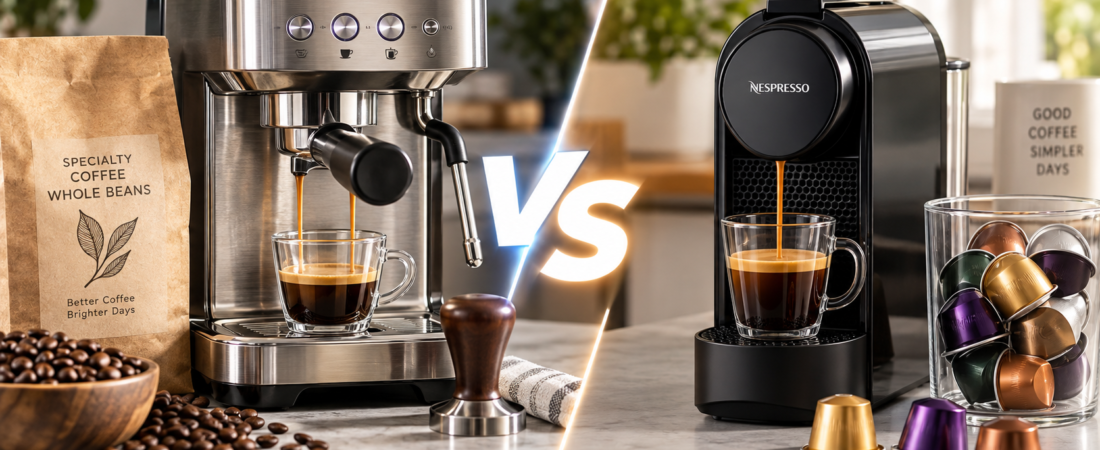
An espresso machine may seem expensive compared with a convenient coffee pod machine. But after making 1,000 cups of coffee, which one actually costs more?
The answer is surprisingly dependent on how much coffee you drink, which machine you buy, and how much you spend on each serving.
A $150 coffee pod machine can initially look like a bargain compared with a $500 espresso machine. However, coffee pods typically cost more per serving than freshly ground coffee beans.
Over time, that difference can add up.
In this espresso machine vs coffee pods comparison, we’ll calculate the true cost of making 1,000 cups, determine when a traditional espresso machine becomes cheaper, and explain which option makes the most sense for different households.
Comparison Outline
- Espresso machines vs coffee pod machines: Key differences
- Initial purchase costs
- Cost per cup
- The real cost of 1,000 cups
- Break-even point: When does an espresso machine become cheaper?
- One, two, or three cups per day
- Coffee quality and convenience
- Maintenance and environmental considerations
- Who should buy each type?
- Frequently asked questions
- The Compareason Verdict
1. Espresso Machine vs Coffee Pods: Quick Comparison
Traditional espresso machines and coffee pod machines both make concentrated coffee, but they offer very different experiences.
For this comparison, we’re focusing on a home espresso setup using whole coffee beans and a capsule machine using single-serving espresso-style pods.
| Feature | Espresso Machine | Coffee Pod Machine |
|---|---|---|
| Typical machine budget | $300–$700 | $100–$200 |
| Coffee cost per serving | $0.35–$0.70 | $0.70–$1.30 |
| Preparation | Grinding, dosing, brewing | Insert pod and press button |
| Cleaning | More frequent | Generally simpler |
| Flavor control | High | Limited |
| Coffee selection | Wide range of beans | Compatible capsule selection |
| Learning curve | Moderate to high | Low |
| Waste | Coffee grounds and packaging | Used capsules |
| Best for | Coffee enthusiasts and frequent drinkers | Convenience-focused drinkers |
These are illustrative U.S. shopping ranges rather than guaranteed prices. Actual costs vary by brand, retailer, machine type, and coffee selection.
Quick verdict: Coffee pods usually win on convenience and initial affordability. A traditional espresso machine can become more economical over time, especially when used frequently.
But the cheapest option depends on the numbers.
2. Initial Purchase Cost: Coffee Pods Have the Advantage
The first difference is obvious.
Coffee pod machines are generally less expensive to purchase.
Coffee Pod Machines
Entry-level capsule machines often cost approximately $100 to $200.
Popular examples include Nespresso Original-compatible machines and other single-serving systems.
Many are compact, require minimal preparation, and produce coffee quickly.
For someone who wants a simple morning routine, that convenience can be valuable.
Traditional Espresso Machines
A home espresso setup can cost considerably more.
A basic manual or semi-automatic espresso machine may cost a few hundred dollars, while machines with integrated grinders can cost substantially more.
For our comparison, we’ll assume a complete espresso setup costs $500, including the equipment needed to grind and brew coffee.
We’ll compare it with a $150 capsule machine.
That creates a $350 initial price difference.
Initial advantage: Coffee pod machine — $350 cheaper.
However, purchase price tells only part of the story.
3. Cost Per Cup: Where Espresso Starts Winning
The biggest long-term difference is the cost of the coffee itself.
Espresso Made From Whole Beans
Suppose you purchase quality roasted coffee beans for $18 per pound.
One pound contains approximately 454 grams.
If you use 18 grams of coffee for a double espresso, the bean cost is:
$18 ÷ 454 × 18 = approximately $0.71 per double espresso.
However, not every household uses an 18-gram double shot.
For a smaller 10-gram serving, the coffee cost would be approximately $0.40.
For our main calculation, we’ll use $0.45 per serving, representing a modest dose of approximately 11.4 grams at $18 per pound.
This is a smaller espresso serving, not a conventional 18-gram double.
Coffee Made From Capsules
Capsule prices vary significantly.
Original-style espresso capsules can cost around $0.70 to $1.00 or more, depending on the brand.
Larger-format capsules may cost more.
For our comparison, we’ll assume an average cost of $0.95 per capsule.
That creates the following difference:
| Cost per serving | Espresso Machine | Coffee Pods |
|---|---|---|
| Coffee | $0.45 | $0.95 |
| Difference | $0.50 more for pods |
Every cup made with whole beans saves approximately $0.50 in coffee costs under these assumptions.
At 100 cups, that’s $50.
At 500 cups, that’s $250.
At 1,000 cups, that’s $500.
But remember: the espresso machine cost $350 more upfront.
We also need to account for maintenance.
4. The Real Cost of 1,000 Cups
Let’s calculate the total cost of making 1,000 servings at home.
Our Assumptions
For a fair comparison, we’ll use the following hypothetical costs:
| Expense | Espresso Machine | Coffee Pod Machine |
|---|---|---|
| Machine and required equipment | $500 | $150 |
| Coffee per serving | $0.45 | $0.95 |
| Coffee for 1,000 servings | $450 | $950 |
| Cleaning and maintenance allowance | $60 | $30 |
| Total cost | $1,010 | $1,130 |
The maintenance amounts are planning allowances, not manufacturer guarantees.
They cover routine cleaning supplies and minor upkeep, but not major repairs or machine replacement.
Milk, sweeteners, electricity, water, taxes, and resale value are excluded.
The Result
After 1,000 servings:
Traditional espresso machine: $1,010
Coffee pod machine: $1,130
The espresso setup saves approximately $120.
That is not an enormous difference.
But it is enough to reverse the initial purchase-price advantage of the pod machine.
Cost Per Cup After 1,000 Servings
Including the initial equipment purchase:
- Espresso machine: $1.01 per serving
- Coffee pod machine: $1.13 per serving
Winner after 1,000 servings: Espresso machine, saving approximately $120.
However, this result assumes relatively small espresso servings. Using 18 grams of coffee for every double espresso would change the calculation substantially.
5. Break-Even Point: When Does Espresso Become Cheaper?
This is the most important part of the comparison.
The espresso machine starts with a $350 disadvantage.
But it saves $0.50 in coffee costs per serving.
To simplify the calculation, first ignore maintenance.
$350 ÷ $0.50 = 700 servings.
That means the espresso machine catches up after approximately 700 servings.
Now include our maintenance allowances.
The espresso setup has $30 more in estimated maintenance over 1,000 servings, equivalent to an additional $0.03 per serving.
Its net savings per serving become:
$0.50 − $0.03 = $0.47.
The adjusted break-even point is:
$350 ÷ $0.47 = approximately 745 servings.
Our estimated break-even point: 745 servings.
After that, the espresso machine becomes the less expensive option under our assumptions.
This is not a universal break-even point. More expensive beans, a higher-priced grinder, or cheaper capsules can delay it substantially.
6. How Long Until You Break Even?
The number of servings you drink each day changes how quickly the investment pays off.
| Coffee consumption | Annual servings | Approximate break-even time |
|---|---|---|
| 1 serving per day | 365 | 2.0 years |
| 2 servings per day | 730 | 1.0 year |
| 3 servings per day | 1,095 | 8.2 months |
One Serving Per Day
If you drink only one coffee per day, it takes approximately two years to recover the additional equipment cost.
For some people, the convenience of capsules may be worth more than the eventual savings.
Two Servings Per Day
At two servings daily, the espresso machine reaches the break-even point in just over one year.
That makes the economics more attractive.
Three Servings Per Day
At three servings daily, the break-even point arrives in approximately eight months.
For frequent coffee drinkers, the recurring cost of capsules becomes much more significant.
The Compareason insight: The number of cups you make matters more than the initial price difference alone.
7. What If You Prefer Double Espresso?
Our main calculation uses a relatively small coffee dose.
But many espresso enthusiasts prefer an 18-gram double shot.
At $18 per pound, that costs approximately $0.71 in beans.
If the comparable capsule drink costs $0.95, the coffee savings fall to approximately $0.24 per serving.
After allowing $0.03 per serving for additional espresso maintenance, the net savings are only about $0.21.
At that rate, recovering the $350 equipment difference takes approximately:
1,667 servings.
That’s more than twice as many as in our smaller-dose example.
And if your preferred drink requires two capsules to deliver the amount of coffee you want, the economics change in the opposite direction.
Two $0.95 capsules cost $1.90.
Compared with a $0.71 double espresso, whole beans become dramatically cheaper.
The key lesson: Compare equivalent drinks, not simply one capsule against one espresso shot.
Coffee dose, beverage size, and strength matter.
8. Coffee Quality: Is Fresh Espresso Actually Better?
Cost is important, but taste may matter even more.
Traditional Espresso Machines
Traditional espresso machines provide greater control over:
- Coffee bean selection
- Grind size
- Dose
- Extraction time
- Beverage strength
- Milk preparation
Freshly ground coffee can deliver excellent aroma and flavor when prepared correctly.
However, achieving consistent results requires practice.
Poor grinding, incorrect dosing, or inconsistent extraction can produce disappointing espresso even with expensive equipment.
Coffee Pod Machines
Coffee pod machines emphasize consistency.
The coffee is pre-portioned, and the brewing process requires little user input.
For someone who values predictable results without adjusting a grinder, capsules are convenient.
The limitation is flexibility.
Users generally have less control over coffee freshness, extraction variables, and available blends.
Which Makes Better Coffee?
A properly configured traditional espresso setup offers greater control and the potential for excellent results.
A capsule machine offers simplicity and repeatability.
Our take: Espresso wins for customization and experimentation. Capsules win for convenience and consistency.
9. Convenience: The Hidden Cost of Your Time
One major factor rarely appears in coffee cost comparisons.
Time.
A pod machine may require only a brief preparation and cleanup routine.
A traditional espresso setup often requires grinding, dosing, tamping, brewing, and cleaning.
Suppose a traditional espresso routine takes an additional three minutes per serving compared with a capsule machine.
Over 1,000 servings:
3 × 1,000 = 3,000 minutes.
That’s 50 hours.
If you assign your time a hypothetical value of $15 per hour, those 50 hours represent $750 in personal time.
This is not a cash expense, and many people genuinely enjoy making espresso.
But it demonstrates why the cheapest option on paper may not be the best option for everyone.
Our take: If making coffee is an enjoyable ritual, espresso preparation can be a benefit. If every morning is rushed, capsule convenience has real practical value.
10. Maintenance and Cleaning
Traditional espresso machines generally require more attention.
Depending on the machine, maintenance may include:
- Cleaning the portafilter and basket
- Backflushing compatible machines
- Descaling according to manufacturer guidance
- Cleaning the grinder
- Replacing water filters or worn components
Capsule machines typically require less daily cleaning, although descaling and regular maintenance remain necessary.
The maintenance difference can become significant if a traditional espresso machine needs professional repair.
For that reason, buyers should consider warranty coverage, replacement parts, and service availability before purchasing expensive equipment.
11. Environmental Impact: Pods vs Coffee Grounds
Coffee pods create single-serving packaging waste.
Some capsule systems offer recycling programs, but the practical environmental benefit depends on collection, transportation, material recovery, and local recycling infrastructure.
Traditional espresso machines generate used coffee grounds and packaging from bulk coffee purchases.
They generally avoid individual capsule packaging.
However, environmental impact also depends on machine manufacturing, electricity use, coffee production, water consumption, and disposal habits.
It would be misleading to declare one system universally more environmentally friendly without a full life-cycle comparison.
Our take: Whole-bean espresso typically avoids single-use capsule packaging, while the overall environmental comparison is more complex.
12. Who Should Buy an Espresso Machine?
A traditional espresso machine makes more sense if you:
- Drink two or more espresso servings per day
- Enjoy experimenting with different coffee beans
- Want control over grind size and extraction
- Prefer freshly ground coffee
- Plan to keep your equipment for several years
- Are willing to spend time learning and cleaning
- Want to reduce dependence on proprietary capsules
For frequent coffee drinkers, a well-chosen espresso setup can provide both financial and experiential value.
13. Who Should Buy a Coffee Pod Machine?
A coffee pod machine makes more sense if you:
- Drink coffee occasionally
- Want minimal preparation
- Prefer a compact machine
- Do not want to purchase a grinder
- Value consistent results
- Have limited kitchen space
- Prefer convenience over customization
A capsule machine can be the better purchase even when its long-term coffee cost is higher.
14. Frequently Asked Questions
Is an espresso machine cheaper than coffee pods?
It can be. Whole coffee beans often cost less per serving, but traditional espresso equipment requires a larger initial investment. The break-even point depends on equipment price, coffee dose, capsule cost, and maintenance.
How much does 1,000 cups of espresso cost?
In our illustrative scenario, 1,000 small espresso servings cost approximately $1,010 including $500 of equipment, $450 of coffee, and $60 of maintenance.
How much do 1,000 coffee pods cost?
At $0.95 per capsule, 1,000 capsules cost $950. Adding a $150 machine and $30 in maintenance brings the illustrative total to $1,130.
How many cups does it take for an espresso machine to pay for itself?
Under our main assumptions, approximately 745 servings. Using more expensive beans or a larger coffee dose increases the break-even point.
Is Nespresso cheaper than a traditional espresso machine?
Nespresso-style machines generally have lower upfront costs, but capsules can be more expensive per serving than whole beans. Frequent use can make traditional espresso more economical.
Does homemade espresso taste better than coffee pods?
Traditional espresso provides more control over beans and brewing variables, which can produce excellent results. Capsule machines prioritize consistency and convenience.
Is a $500 espresso machine worth buying?
It can be worthwhile for someone who drinks coffee frequently, enjoys the preparation process, and plans to keep the machine for several years. Occasional drinkers may get better value from a simpler setup.
Are coffee pods bad for the environment?
Coffee pods generate packaging waste, although some systems offer recycling programs. Their total environmental impact depends on materials, recycling participation, energy use, and other factors.
The Compareason Verdict: Which Should You Actually Buy?
Overall Winner for Frequent Coffee Drinkers: Traditional Espresso Machine
If you drink two or more espresso servings per day, enjoy freshly ground coffee, and plan to keep your equipment for several years, a traditional espresso machine is often the better long-term investment.
In our main 1,000-serving calculation, the espresso setup costs $1,010 compared with $1,130 for the capsule system.
That’s a savings of approximately $120.
The espresso machine also offers more control over coffee quality, bean selection, and preparation.
However, those savings are not guaranteed. Larger espresso doses or more expensive equipment can push the break-even point much farther into the future.
Best Choice for Convenience: Coffee Pod Machine
If you drink only one coffee per day, have limited time, or prefer minimal cleanup, a capsule machine can be the more practical choice.
Its lower upfront price and easy operation make it appealing even when capsules cost more over time.
Our Final Recommendation
Choose a traditional espresso machine if you drink coffee frequently, value customization, and are comfortable with the preparation process.
Choose a coffee pod machine if convenience, simplicity, and low upfront cost matter more than long-term savings.
The most important number is not the machine’s price.
It’s the total cost of the coffee you’ll actually drink.
A $150 machine is not necessarily cheaper than a $500 machine after years of use.
But a more expensive machine is not automatically a better investment either.
The smarter choice depends on your daily habits, preferred coffee strength, and how much you value your time.
Compare with Reason.