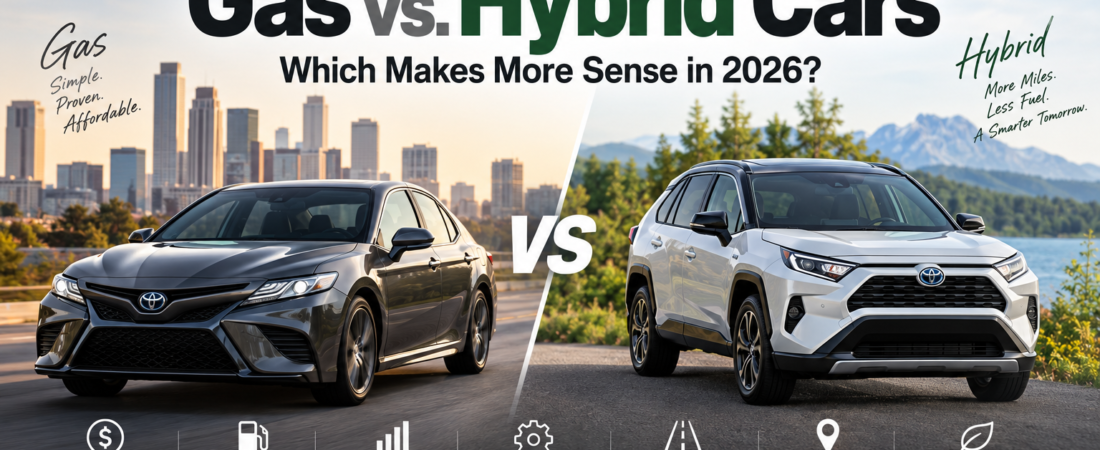
Hybrid vehicles are having a moment in 2026.
As buyers look for better fuel economy without fully committing to an electric vehicle, hybrids have become an increasingly attractive middle ground. Recent U.S. sales trends show that hybrids are taking a larger share of the new-car market, giving shoppers more choices than ever before.
But does that mean a hybrid is automatically the better choice?
Not necessarily.
Gas-powered vehicles still have some important advantages, including lower purchase prices in many cases, simpler buying decisions, and a huge selection of models.
So if you’re buying a car in 2026, which makes more sense: gas or hybrid?
Let’s compare.
Quick Comparison
| Category | Gas | Hybrid |
|---|---|---|
| Purchase Price | ✅ Usually Lower | Usually Higher |
| Fuel Economy | Average | ✅ Excellent |
| Long-Term Fuel Cost | Higher | ✅ Lower |
| Highway Driving | ✅ Very Good | Very Good |
| City Driving | Good | ✅ Excellent |
| Refueling Convenience | ✅ Excellent | ✅ Excellent |
| Mechanical Simplicity | ✅ Simpler | More Complex |
| Driving Range | Good | ✅ Excellent |
| No Charging Required | ✅ Yes | ✅ Yes |
| Resale Appeal | Good | ✅ Increasing |
Purchase Price: Gas Usually Costs Less Up Front
The first advantage of a traditional gasoline vehicle is straightforward: the initial price is often lower.
A hybrid adds an electric motor, battery and additional power-management technology to the traditional gasoline powertrain.
That can increase the sticker price.
The difference varies considerably by manufacturer and model, and some hybrids now carry only a modest premium over comparable gasoline versions.
Still, if your main goal is getting the lowest purchase price possible, a conventional gas vehicle often has the advantage.
Winner: Gas
Fuel Economy: Hybrid Wins
This is where hybrids earn their reputation.
A hybrid can recover energy while slowing down and use its electric motor to assist the gasoline engine.
That can significantly reduce fuel consumption, particularly in stop-and-go driving.
The difference is especially noticeable in cities, where conventional gas vehicles repeatedly accelerate, brake and idle.
A hybrid can use those situations much more efficiently.
For someone who drives frequently, those fuel savings can accumulate over years of ownership.
Winner: Hybrid
City Driving: Hybrid Has a Big Advantage
If most of your driving involves commuting, traffic, school runs or short local trips, a hybrid becomes particularly attractive.
Hybrids are designed to take advantage of conditions that are inefficient for conventional gasoline engines.
At lower speeds, the electric motor can assist or sometimes propel the vehicle without requiring as much gasoline.
Regenerative braking also captures some energy that would otherwise be lost as heat.
That makes city driving one of the strongest arguments for choosing a hybrid.
Winner: Hybrid
Highway Driving: The Difference Gets Smaller
Drive mostly on highways?
The decision becomes less obvious.
Once a vehicle is cruising steadily at highway speed, a hybrid has fewer opportunities to recover energy through braking.
The gasoline engine may therefore operate for much more of the trip.
Hybrids can still deliver excellent highway fuel economy, but the improvement over an efficient conventional gasoline vehicle may be smaller than it is around town.
For someone doing mostly long interstate trips, paying extra for a hybrid may take longer to recover through fuel savings.
Winner: Tie
Convenience: Both Are Easy
One reason hybrids are attracting buyers who aren’t ready for EVs is simple:
You don’t have to change how you refuel.
A regular hybrid doesn’t need to be plugged into a charger.
You simply stop at a gas station, fill the tank and continue driving.
That gives hybrids one of the major conveniences of gasoline vehicles while offering better fuel economy.
This is also an important distinction between a traditional hybrid and a plug-in hybrid.
Winner: Tie
Range: Hybrid Can Be Surprisingly Good
EV range receives a lot of attention, but hybrids can offer some of the longest practical driving ranges available.
They combine an efficient gasoline engine with electric assistance while still carrying a normal fuel tank.
Some hybrid vehicles can travel impressive distances between gas-station visits.
For road trips, that combination is difficult to beat.
You get excellent efficiency without planning charging stops.
Winner: Hybrid
Maintenance and Complexity: Gas Has an Advantage
A traditional gasoline vehicle generally has a simpler powertrain.
Hybrids add components such as a traction battery, electric motor and power electronics.
Modern hybrid systems have been used for decades and can be highly reliable, so additional complexity does not automatically mean poor reliability.
Hybrids may also reduce wear on certain components. Regenerative braking, for example, can reduce reliance on conventional friction brakes.
Still, when comparing basic mechanical simplicity, the conventional gasoline vehicle wins.
Winner: Gas
What About Hybrid Battery Replacement?
This is one of the biggest concerns shoppers have.
Hybrid batteries do eventually degrade, just like other batteries.
But buying a hybrid does not mean you’ll automatically face a major battery replacement bill after only a few years.
Battery longevity varies by vehicle, climate, usage and manufacturer.
Buyers should check the specific battery warranty and reliability history of the model they’re considering rather than assuming every hybrid will have the same long-term battery cost.
For someone planning to keep a vehicle for a very long time, however, potential battery replacement is still worth considering.
Resale Value: Hybrids Are Becoming More Attractive
The used-car market changes constantly, so no powertrain automatically guarantees better resale value.
But increasing consumer interest in fuel-efficient vehicles can help make hybrids attractive used-car options.
A buyer gets improved fuel economy without needing a home charger or changing refueling habits.
That makes hybrids accessible to a broad range of drivers.
Actual depreciation, however, depends heavily on the individual vehicle, brand, mileage and market conditions.
Winner: Slight Edge to Hybrid
Who Should Buy a Gas Car?
A gasoline vehicle still makes plenty of sense if you:
- Want the lowest possible purchase price
- Drive relatively few miles each year
- Mostly drive long highway trips
- Plan to keep the vehicle for a shorter period
- Prefer a simpler powertrain
- Find a significantly better deal on the gas version
If you drive only 5,000 or 6,000 miles per year, for example, fuel savings may be relatively small.
Paying thousands more solely to reduce fuel consumption might not make financial sense.
Who Should Buy a Hybrid?
A hybrid becomes particularly compelling if you:
- Drive frequently
- Spend a lot of time in traffic
- Do substantial city or suburban driving
- Want better fuel economy
- Want long driving range
- Don’t want to charge an EV
- Plan to keep the vehicle for several years
The more miles you drive, the more opportunities you have to recover the hybrid’s higher purchase price through lower fuel consumption.
The Most Important Calculation
Don’t choose a hybrid simply because its MPG number looks better.
Calculate the payback period.
Suppose the hybrid version costs $3,000 more.
If it saves you $600 per year in gasoline:
$3,000 ÷ $600 = 5 years
If you’re keeping the vehicle for eight years, that may make sense.
If you’re selling it after three years, the calculation looks very different.
And if the hybrid premium is only $1,500?
The economics become considerably more attractive.
That’s why the answer isn’t simply “hybrids save money.”
It depends on how much more the hybrid costs and how much you actually drive.
Our Pick: Hybrid — for Most Everyday Drivers
For many buyers in 2026, the hybrid is the more balanced choice.
It provides better fuel economy, excellent driving range and particularly strong efficiency in everyday city and suburban driving — without requiring a charging routine.
Gas vehicles still make sense when the purchase-price difference is substantial, annual mileage is low, or simplicity is the priority.
But as manufacturers offer more hybrid models and the price gap continues to narrow on some vehicles, hybrids are becoming increasingly difficult to ignore.
The simplest rule?
Drive more → Hybrid becomes more attractive.
Drive less → Gas may still make more financial sense.
Before buying, compare the actual gas and hybrid versions of the vehicle you want rather than choosing based on powertrain alone.
Compare with Reason.