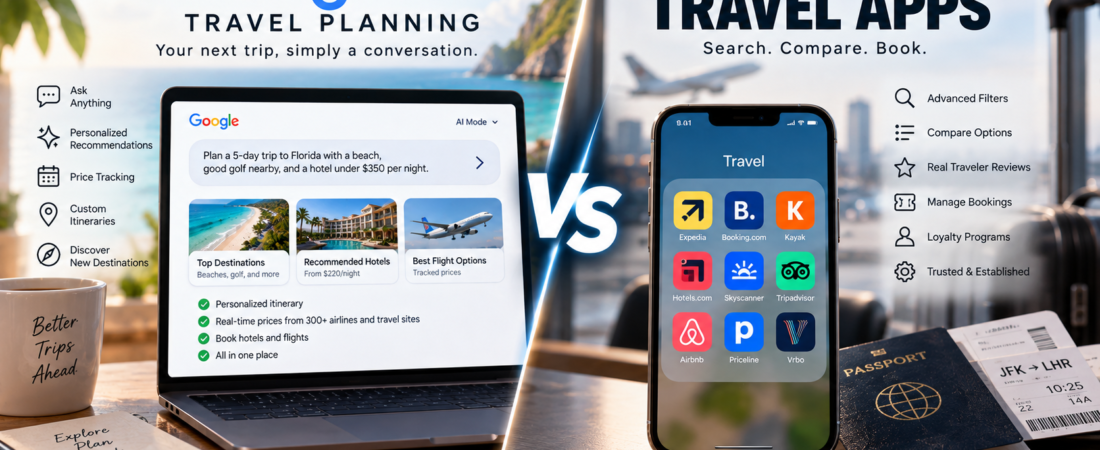
Planning a trip used to mean opening a lot of tabs.
One for flights.
Another for hotels.
Google Maps for locations.
A travel website for reviews.
Maybe a spreadsheet or Notes app to keep everything organized.
In 2026, artificial intelligence is beginning to change that process.
Google has been expanding AI-powered travel features that allow travelers to describe what they want in normal language and receive personalized suggestions instead of manually adjusting dozens of filters.
That sounds much easier.
But traditional travel apps have spent years perfecting flight searches, hotel comparisons, maps, reviews, and booking management.
So is AI finally the better way to plan a vacation?
Or are traditional travel apps still more reliable when it’s time to actually spend your money?
Let’s compare.
Quick Comparison
| Google AI Travel Planning | Traditional Travel Apps | |
|---|---|---|
| Getting Trip Ideas | Excellent | Good |
| Complex Questions | Excellent | Limited |
| Flight Comparison | Very Good | Excellent |
| Hotel Search | Very Good | Excellent |
| Price Tracking | Excellent | Excellent |
| Filters | Improving | Excellent |
| Reviews | Good | Excellent |
| Itinerary Creation | Excellent | Varies |
| Booking Control | Improving | Excellent |
| Speed | Excellent | Good |
| Reliability | Good | Excellent |
| Best For | Planning & discovery | Comparing & booking |
What Is Google AI Travel Planning?
Traditional travel search starts with filters.
Where are you going?
What dates?
How many travelers?
What hotel rating?
What’s your budget?
AI travel planning works differently.
You can start with the trip itself.
For example:
“Plan a five-day family trip to Florida with a beach, good golf nearby, and a hotel under $350 per night.”
Instead of manually searching each requirement separately, AI can interpret them together.
That’s the biggest change.
Google’s AI-powered search experience can help travelers explore destinations, compare options, track flight prices, and increasingly move from research toward booking.
In August 2026, Google announced additional travel capabilities for AI Mode, including expanded flight price tracking and hotel booking assistance.
The goal is clear:
Google doesn’t want AI to simply answer travel questions.
It wants AI to help organize the entire trip.
Trip Inspiration: Google AI Wins
Imagine you know you want a vacation.
But you don’t know where.
Traditional travel apps aren’t particularly good at this problem.
Most expect you to already have a destination.
AI doesn’t.
You can ask:
“Where can I go from New York for four days in October where it’s warm, has good food, and flights aren’t too expensive?”
That’s a much more natural way to begin planning.
AI can combine multiple preferences into a single search.
Traditional filters struggle with this because each preference may exist in a completely different category.
This makes AI particularly useful during the earliest stage of travel planning.
Winner: Google AI
Complex Travel Questions: Google AI Wins
This may be AI’s biggest advantage.
Travel decisions aren’t always simple.
You might want:
A nonstop flight.
A hotel near restaurants.
A golf course within 20 minutes.
Activities for children.
A walkable neighborhood.
And a total budget under $4,000.
With traditional apps, you may need several searches across several websites.
With AI, you can describe everything at once.
You can also continue the conversation.
“Make it one day shorter.”
“Find somewhere warmer.”
“What if I increase the hotel budget by $100?”
“Remove destinations that require renting a car.”
That’s fundamentally different from traditional travel search.
Instead of restarting your filters, you’re refining an idea.
Winner: Google AI
Flight Search: Traditional Apps Still Win
AI is becoming very good at discovering flights.
But when you’re actually choosing one, traditional flight-search interfaces still have an advantage.
Why?
Because flights involve precise details.
Departure time.
Arrival time.
Layovers.
Baggage.
Airline.
Fare class.
Refundability.
Seat options.
Airport.
Price.
Sometimes you want to see twenty options at once and immediately understand the differences.
A traditional comparison screen is extremely efficient for that.
AI can tell you which flight might suit you best.
But sometimes you don’t want AI to choose.
You want to see the entire board.
Winner: Traditional Travel Apps
Flight Price Tracking: It’s Almost a Tie
This category has become much more interesting.
Price alerts aren’t new.
Traditional travel services have offered them for years.
But AI can make price tracking more conversational.
Instead of simply tracking:
JFK → Miami, October 10–14
you can potentially describe a broader goal.
For example:
“Track affordable nonstop flights for a four-day Florida trip sometime next month.”
That flexibility is where AI becomes powerful.
Traditional price trackers remain excellent when you already know your exact destination and dates.
AI becomes more interesting when you’re flexible.
Winner: Tie
Hotels: Traditional Apps Win — For Now
AI is excellent at helping you decide where to stay.
Traditional hotel apps are still excellent at helping you decide which room to book.
That’s an important distinction.
AI can answer:
“Which neighborhood is better for a family visiting Chicago for the first time?”
Then it can suggest hotels based on your preferences.
But when you’re ready to book, details matter.
Room type.
Cancellation policy.
Breakfast.
Parking.
Resort fees.
Taxes.
Bed configuration.
Loyalty benefits.
Upgrade options.
Traditional booking interfaces display these details in structured formats that are easy to compare.
AI hotel booking is improving quickly, but traditional booking tools still provide more confidence at checkout.
Winner: Traditional Travel Apps
Personalization: Google AI Wins
Travel apps personalize results mostly through data.
AI can personalize them through conversation.
That’s a significant difference.
Suppose you’re traveling with two adults, a teenager, and a young child.
A generic list of “Top 10 Things to Do” may not be very useful.
You can instead ask AI:
“Give us activities that a teenager will enjoy but that aren’t too difficult for a four-year-old.”
Then:
“Remove museums.”
Then:
“Keep everything within 30 minutes of our hotel.”
This conversational refinement is where AI feels less like a search engine and more like a travel assistant.
Winner: Google AI
Reviews: Traditional Apps Win
AI can summarize reviews.
That’s convenient.
But sometimes you want to see the reviews yourself.
A hotel may have a 4.4 rating.
That doesn’t tell the whole story.
Maybe families love it.
Maybe business travelers hate it.
Maybe recent reviews complain about construction.
Maybe older reviews mention problems that were fixed months ago.
Reading recent traveler experiences gives you context that an AI summary can sometimes compress too aggressively.
For expensive hotels or important trips, original reviews remain valuable.
Winner: Traditional Travel Apps
Itinerary Building: Google AI Wins
This is where AI can save a lot of time.
A traditional travel app might help you book:
Flight.
Hotel.
Rental car.
Restaurant.
Tour.
But those bookings don’t automatically create a smart daily schedule.
AI can.
You can ask:
“Build a three-day itinerary from this hotel. Don’t schedule anything before 9 a.m., keep driving under 30 minutes, and leave two hours free every afternoon.”
That’s a task that might take a human traveler an hour to organize manually.
AI can produce a reasonable starting point in seconds.
Then you can change it.
“Move the beach day to Friday.”
“Add golf Saturday morning.”
“Find dinner near the hotel instead.”
This is exactly the kind of problem conversational AI handles well.
Winner: Google AI
Maps and Location: Traditional Tools Still Matter
A beautiful itinerary can still be a terrible itinerary if geography doesn’t make sense.
That’s why maps remain essential.
You need to know whether two attractions are actually close.
You need traffic estimates.
Walking routes.
Transit options.
Opening hours.
Parking.
Neighborhood boundaries.
AI can help interpret that information, but a visual map remains one of the best tools ever created for travel planning.
Sometimes seeing everything geographically is faster than reading an explanation.
Winner: Traditional Travel Apps
Speed: Google AI Wins
Traditional planning can become research.
AI turns much of that research into a conversation.
Instead of opening ten tabs and comparing information yourself, you can ask one detailed question.
For casual trips, that can dramatically reduce planning time.
AI is particularly useful when you don’t enjoy planning.
It can take a vague idea and turn it into something actionable quickly.
Winner: Google AI
Accuracy: Traditional Search Still Has an Advantage
Here’s AI’s biggest weakness.
Travel information changes constantly.
Hotel availability changes.
Flight prices change.
Restaurants close.
Schedules change.
Fees change.
Policies change.
AI-generated answers can also occasionally misunderstand information or present something that is no longer current.
That’s not a minor problem when money is involved.
A recommendation can be approximate.
A $2,000 airline ticket cannot.
Before paying, travelers should still verify critical information directly with the booking provider or travel company.
Think of AI as an extremely fast planner.
Not an infallible travel agent.
Winner: Traditional Travel Apps
Booking: Traditional Apps Win
Eventually, planning becomes purchasing.
And that’s where established travel apps still feel strongest.
Travelers are familiar with:
Booking confirmations.
Cancellation screens.
Saved trips.
Payment systems.
Customer support.
Reservation histories.
Loyalty programs.
AI is increasingly moving into these areas, but traditional platforms have years of infrastructure behind them.
When something goes wrong, that infrastructure matters.
Winner: Traditional Travel Apps
But AI Has One Huge Advantage
AI doesn’t have to replace traditional travel apps.
It can sit above them.
That’s probably where travel planning is heading.
AI can help answer:
Where should I go?
Then:
Which area should I stay in?
Then:
Which flight makes the most sense?
Then:
Which hotel fits my family?
Then:
What should we do each day?
Traditional services can handle the final transaction.
In other words, AI becomes the planner while established travel systems become the booking engine.
That combination may be more powerful than either one alone.
The Best Way to Plan a Trip in 2026
You don’t actually have to choose only one.
A smarter workflow looks like this:
Step 1 — Use AI for ideas
Ask broad questions about destinations, budgets, weather, activities, and neighborhoods.
Step 2 — Let AI build the first itinerary
Give it your actual preferences.
Not generic ones.
Step 3 — Use traditional travel tools to compare real options
Check flights, hotels, room types, reviews, and exact prices.
Step 4 — Verify important details
Check cancellation policies, baggage fees, hotel fees, schedules, and availability.
Step 5 — Use AI again to organize everything
Once you know your flights and hotel, have AI reorganize your itinerary around the actual reservations.
That’s where the two approaches complement each other extremely well.
Who Should Use Google AI Travel Planning?
Google AI makes the most sense for travelers who:
Don’t know exactly where they want to go.
Have complicated preferences.
Want to save planning time.
Are flexible with dates.
Want personalized itineraries.
Don’t enjoy opening dozens of browser tabs.
Or simply want help turning an idea into a real trip.
For these travelers, AI can feel revolutionary.
Who Should Stick With Traditional Travel Apps?
Traditional travel tools remain better for people who:
Already know exactly what they want.
Want complete control over filters.
Need to compare many prices simultaneously.
Care heavily about loyalty programs.
Want to read individual reviews.
Or are ready to make a reservation immediately.
For these tasks, a traditional interface can actually be faster than a conversation.
Compareason Verdict
Our Pick: Google AI + Traditional Travel Apps
This comparison has an unusual winner.
We wouldn’t choose only one.
Google AI is becoming the better travel planner.
Traditional travel apps remain the better booking tools.
AI wins when the question is:
“What should I do?”
Traditional travel apps win when the question becomes:
“Exactly which one should I buy?”
That’s why the smartest travel strategy in 2026 is to combine them.
Use AI to research faster, narrow your choices, understand destinations, and build the itinerary.
Then use established travel tools to verify prices, inspect details, read recent reviews, and complete important reservations.
AI may eventually handle the entire process seamlessly.
We’re not completely there yet.
But the days of planning a vacation with 27 browser tabs open may finally be coming to an end.
Compare Better. Choose Smarter.