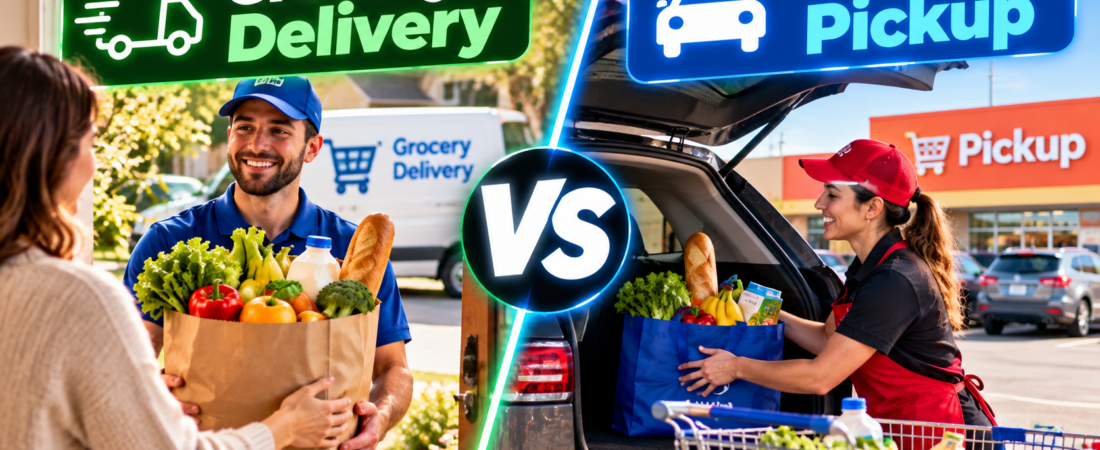
Online grocery shopping solved one problem and created another.
You no longer have to walk through every aisle, wait at checkout, load groceries into your car, and push a cart through a crowded parking lot.
Instead, you can order everything from your phone.
But then comes the decision:
Delivery or curbside pickup?
At first, delivery seems like the obvious winner.
Someone else shops for you and brings the groceries directly to your door.
Curbside pickup still requires you to drive to the store.
But convenience isn’t free.
Delivery fees, service charges, tips, memberships, minimum orders, and sometimes different pricing can quietly increase the cost of a grocery order.
Pickup has costs too.
You use gas.
You spend time driving.
And depending on the retailer, there may still be fees or minimum purchase requirements.
So when you compare the entire transaction, which option actually comes out ahead?
Grocery delivery vs curbside pickup — which really saves more money?
Grocery Delivery vs Curbside Pickup at a Glance
| Grocery Delivery | Curbside Pickup | |
|---|---|---|
| Drive to store | No | Yes |
| Delivery fee | Often | Usually lower or none |
| Tip | Common | Usually not expected |
| Service fees | Possible | Less common |
| Gas cost | None for shopper | Yes |
| Shopping time | Very low | Very low |
| Pickup wait | None | Possible |
| Delivery window | Required | Pickup window |
| Impulse buying | Low | Low |
| Convenience | Highest | High |
| Best for | Maximum time savings | Lower-cost convenience |
The biggest difference isn’t the groceries.
It’s who handles the last few miles.
With delivery, you’re paying someone else to bring the order to you.
With pickup, you’re doing that part yourself.
Pickup Is Becoming a Serious Alternative to Delivery
Online grocery shopping is no longer synonymous with home delivery.
Pickup has become a major part of the market.
In 2026 consumer research from the National Retail Federation and HappyOrNot, 31% of respondents said they use buy online, pick up in store or curbside pickup for grocery purchases, compared with 29% who use home delivery. (nrf.com)
That difference is small.
But it reveals something important:
A lot of shoppers want the convenience of ordering online without necessarily paying for the final delivery.
And retailers are competing hard for those customers.
An October 2026 Ipsos study evaluating grocery fulfillment experiences found significant differences between retailers in both home delivery and curbside pickup performance. (ipsos.com)
Online grocery shopping has effectively split into two different convenience models.
The Obvious Cost: Delivery Fees
Let’s start with the easiest difference.
Delivery may include some combination of:
- delivery fee
- service fee
- small-order fee
- membership fee
- priority delivery fee
- driver tip
Not every retailer charges all of these.
Some memberships eliminate certain delivery fees once you reach a minimum order.
But eliminating the visible delivery fee doesn’t necessarily mean the delivery is free.
A service fee may remain.
You may still tip.
And you’re potentially paying for an annual or monthly membership.
Pickup is often structurally simpler.
Order.
Drive to the store.
Park in the designated space.
Receive groceries.
Go home.
That’s one reason pickup can occupy an attractive middle ground between traditional shopping and delivery.
The Tip Changes the Math Quickly
Suppose your grocery order is:
$150
You choose delivery.
Imagine the combined delivery and service charges are $8.
Then you tip $12.
Your $150 grocery order becomes:
$170
That’s about a 13% increase before considering any membership costs or potential price differences.
Now imagine curbside pickup is free.
You drive five miles round trip.
Even if the trip costs a few dollars in fuel and vehicle expenses, pickup may still come out substantially cheaper.
But that’s only the financial side.
Delivery gave you something pickup didn’t:
your time.
What Is an Hour of Your Time Worth?
This is where the comparison gets much more interesting.
Suppose curbside pickup requires:
15 minutes driving to the store.
10 minutes waiting.
15 minutes driving home.
That’s 40 minutes.
Delivery requires:
zero driving.
If delivery costs $15 more, you’re essentially paying:
$15 to recover 40 minutes.
Is that expensive?
It depends on you.
For someone working from home, caring for young children, running a business, or dealing with a packed schedule, paying $15 to eliminate a grocery trip might be an excellent trade.
For someone who passes the grocery store on the way home every day, paying the same $15 may make very little sense.
The value of delivery therefore depends heavily on something that doesn’t appear on the receipt:
the opportunity cost of your time.
Pickup Has a Hidden Advantage: You Can Combine Trips
Imagine the grocery store is five miles away.
Driving there exclusively to pick up groceries creates a separate trip.
But what if the store is:
next to your gym,
on your commute,
near your child’s school,
or beside another store you already planned to visit?
Now the marginal transportation cost becomes very small.
You’re not really making a grocery trip.
You’re adding a five-minute stop to a trip you were already making.
That makes curbside pickup much harder for delivery to beat financially.
Delivery Has Its Own Hidden Advantage: No Car Required
Now flip the situation.
What if you live in a city and don’t own a car?
Suddenly curbside pickup isn’t convenient at all.
You may need:
public transportation,
a taxi,
a rideshare,
or a long walk carrying groceries.
Delivery can become the cheaper option once transportation is included.
The same is true for shoppers with limited mobility.
A comparison based only on delivery fees misses this completely.
The real cost is:
groceries + fees + transportation + time.
Both Options Can Reduce Impulse Purchases
Here’s where both delivery and pickup can beat traditional grocery shopping.
You aren’t walking through the store.
That matters.
Supermarkets are designed around product discovery.
You pass bakery displays.
Endcaps.
Snacks.
Drinks.
Seasonal items.
Sale displays.
Products placed near checkout.
When you shop online, you can search for exactly what you need and add it to your cart.
That doesn’t eliminate impulse purchases — grocery apps can promote products too — but it changes the environment significantly.
If avoiding the physical store prevents even $10 of unplanned purchases, that savings can offset part of a pickup or delivery cost.
This is why comparing only the final service fee can be misleading.
The $150 Grocery Test
Let’s compare two hypothetical $150 grocery orders.
Option A: Delivery
Groceries: $150
Fees: $7
Tip: $10
Transportation: $0
Total: $167
Option B: Curbside Pickup
Groceries: $150
Pickup fee: $0
Transportation cost: $4
Tip: $0
Total: $154
Pickup saves:
$13
If you place four similar orders per month:
$13 × 4 = $52 per month
Over a year:
$624
That’s enough money to matter.
But now add time.
If every pickup takes 40 minutes, four pickups require:
160 minutes per month
or about:
32 hours per year.
Suddenly the decision becomes less obvious.
Would you pay $624 per year to recover roughly 32 hours?
That’s about:
$19.50 per hour.
For some households, absolutely.
For others, no.
Memberships Can Change Everything
Frequent delivery users shouldn’t evaluate each delivery independently.
Many grocery services offer memberships that reduce or eliminate delivery fees on qualifying orders.
If you order once every two months, paying for a membership may not make sense.
If you order twice every week, the economics change dramatically.
Imagine a membership costs $100 per year.
You place:
100 grocery orders per year.
The membership effectively costs:
$1 per order.
Now imagine you place:
10 orders per year.
It costs:
$10 per order.
Same membership.
Completely different value.
This is why delivery can become much more competitive for heavy users.
But “Free Delivery” Isn’t Always Free
This phrase deserves attention.
A service can advertise:
FREE DELIVERY
while your transaction still includes other costs.
Depending on the retailer or platform, you may encounter:
- service fees
- minimum-order requirements
- membership costs
- tips
- priority charges
And grocery pricing itself can vary by retailer or platform.
The Federal Trade Commission has previously taken action against delivery platforms over how prices and fees are represented to consumers, illustrating why shoppers should examine the final checkout total rather than focusing on the word “free.” (ftc.gov)
Before placing an order, look at:
the final total.
That’s the number that matters.
Pickup Can Have Waiting Problems Too
Pickup isn’t always:
drive in → groceries appear → drive away.
Sometimes you arrive and wait.
Five minutes.
Ten minutes.
Maybe longer during busy periods.
The October 2026 Ipsos grocery fulfillment study evaluated factors including employee interaction, order accuracy, wait time, substitutions, and overall fulfillment experience — all areas where retailers can perform differently. (ipsos.com)
That means pickup quality isn’t universal.
A great pickup operation can feel almost effortless.
A bad one can make you wonder why you didn’t simply go inside.
Substitutions Matter More Than You Think
You ordered:
Brand A Greek yogurt.
It’s unavailable.
What happens next?
Maybe you get Brand B.
Maybe you get a different size.
Maybe the item disappears from the order entirely.
This can happen with both delivery and pickup.
But substitutions introduce a different type of cost:
you may not receive exactly what you wanted.
If an important ingredient is missing, you might end up making another trip to the store anyway.
That can destroy the convenience advantage.
Most grocery platforms now allow customers to approve substitutions or specify preferences, but it’s worth checking those settings carefully.
Fresh Produce Is Still Complicated
There’s one part of grocery shopping where many people still prefer being inside the store:
choosing fresh food.
You might want:
slightly green bananas,
a ripe avocado,
firm tomatoes,
a specific cut of meat,
or strawberries that look particularly fresh.
With delivery or pickup, someone else makes those decisions.
Professional shoppers can do a good job.
But they don’t know exactly how you like your avocados.
This doesn’t directly show up as a fee.
It’s a control cost.
For packaged products, online ordering is straightforward.
For produce, meat, seafood, and bakery items, preferences become more personal.
Families May Value Delivery Differently
Consider a household with two young children.
Getting everyone into the car for grocery pickup can involve:
shoes,
jackets,
car seats,
snacks,
traffic,
and a child who suddenly needs the bathroom.
A $10 delivery premium may look very different in that household.
Now consider someone who lives alone and drives past the supermarket every evening.
Pickup may require almost no additional effort.
Same grocery order.
Same fees.
Completely different value.
That’s why there isn’t one universal winner.
Which Is Better for Large Orders?
Large orders can make delivery more valuable.
The shopper handles:
multiple bags,
heavy beverages,
bulk items,
and transportation.
You avoid moving everything from store to car.
But larger orders also create larger tips if you calculate tips as a percentage of the order.
Pickup avoids much of that additional cost while still eliminating the time spent walking the aisles.
For budget-focused families buying a large weekly order, curbside pickup can therefore be a particularly strong compromise.
Which Is Better for Small Orders?
This is where delivery can become expensive.
Imagine you need:
milk,
eggs,
bread,
and coffee.
Total:
$25
If fees and tip add $10, you’ve increased your effective grocery cost by:
40%.
That’s difficult to justify unless avoiding the trip is extremely valuable.
Pickup also may not make sense if you need to drive 20 minutes specifically for four products.
For tiny emergency orders, sometimes the old-fashioned option wins:
go inside and buy them.
The Best Strategy May Be Using Both
You don’t actually have to choose one system forever.
A smart household might use:
Curbside pickup for the normal weekly grocery order.
Then use:
Delivery during unusually busy weeks, bad weather, illness, or when getting to the store is difficult.
This turns delivery into a premium convenience tool rather than the default.
You’re paying for convenience when convenience is particularly valuable.
That’s very different from paying for it automatically every week.
Grocery Delivery vs Curbside Pickup: Which Saves More Money?
If your primary goal is spending less, curbside pickup will often have the advantage.
You avoid most delivery-related fees and tips while still skipping the time-consuming part of walking through the store.
And if you combine pickup with another trip you’re already making, the transportation cost can become minimal.
But delivery wins a different comparison.
It can save more of your time.
For busy families, people without cars, shoppers with mobility limitations, or anyone placing large grocery orders, paying extra for delivery can be completely rational.
So don’t ask only:
“Which one is cheaper?”
Ask:
“How much am I paying to avoid the trip?”
If delivery costs $15 extra and saves you an hour, you now know the real transaction you’re making.
You’re not just buying groceries.
You’re buying back an hour of your day.
Whether that’s worth $15 is a decision only you can make.
Compare with Reason.