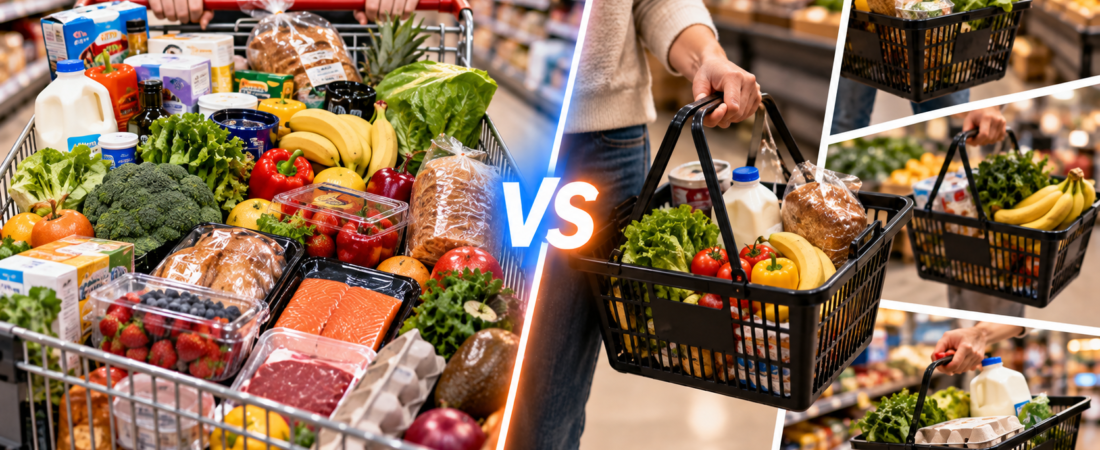
You walk into the grocery store for milk.
That’s it.
Just milk.
Twenty minutes later, you’re walking out with milk, strawberries, sparkling water, chips, a frozen pizza and something that was apparently too good of a deal to leave behind.
Total:
$47.83.
This is the hidden problem with grocery shopping more often.
But shopping only once a week creates a different problem.
You buy enough lettuce, berries, avocados, chicken and yogurt to last seven days.
Then Friday arrives.
The lettuce is wilted.
The berries look questionable.
You forgot about the chicken.
And the avocados somehow went from rock-hard to unusable while you were sleeping.
Into the trash they go.
So the grocery shopping once a week vs several times a week debate isn’t as simple as fewer trips equals less spending.
One strategy can expose you to more impulse purchases.
The other can encourage you to buy more food than you’ll actually use.
And with grocery costs remaining a major concern for American households in 2026, figuring out which habit actually saves money matters more than it used to. Recent reporting on U.S. consumer confidence continues to identify high everyday costs, including groceries, as an important source of financial pressure. Reuters
So let’s compare the two strategies.
Grocery Shopping Once a Week vs Several Times a Week at a Glance
| Once a Week | Several Times a Week | |
|---|---|---|
| Number of store visits | Lower | Higher |
| Impulse-buy opportunities | Lower | Higher |
| Planning required | Higher | Lower |
| Fresh produce flexibility | Lower | Higher |
| Risk of overbuying perishables | Higher | Lower |
| Food waste potential | Higher if poorly planned | Potentially lower |
| Transportation/time cost | Lower | Higher |
| Ability to react to changing plans | Lower | Higher |
| Best for | Organized meal planners | Flexible households |
The important word here is:
potential.
Neither shopping schedule automatically saves money.
Your behavior determines much of the result.
Why Shopping Once a Week Seems Cheaper
The logic is pretty convincing.
If you enter a supermarket only four times per month instead of twelve, you have eight fewer opportunities to buy things you weren’t planning to buy.
You also reduce:
Driving.
Gas.
Travel time.
Parking.
Checkout time.
And the endless process of wandering through aisles looking at food.
For someone who sticks to a meal plan, a weekly grocery trip can be extremely efficient.
You decide what you’re eating.
Make a list.
Buy everything.
Go home.
Done.
The grocery store becomes a planned transaction instead of a recurring activity.
But There’s a Hidden Cost: The Optimistic Grocery Cart
Sunday-you is extremely ambitious.
Sunday-you thinks that this week you’re going to eat:
Salad.
Fresh berries.
Broccoli.
Chicken.
Greek yogurt.
Bananas.
Avocados.
And homemade dinners every night.
Wednesday-you gets invited to dinner.
Thursday-you orders takeout because work ran late.
Friday-you doesn’t feel like cooking.
Saturday-you opens the refrigerator.
And discovers the remains of Sunday-you’s optimism.
That’s where weekly grocery shopping can become expensive.
You didn’t save money by avoiding the supermarket if $25 worth of food went into the trash.
Food Waste Changes the Entire Calculation
This is one of the biggest weaknesses of large grocery trips.
Buying seven days of shelf-stable food isn’t particularly difficult.
Buying seven days of highly perishable food is different.
Fresh items such as:
Berries.
Leafy greens.
Fresh herbs.
Mushrooms.
Certain fruits.
Fresh seafood.
Prepared foods.
can have relatively short useful lives.
The FDA specifically recommends monitoring what’s already in your refrigerator and eating or freezing foods before they need to be discarded. It also recommends using the freezer to extend the useful life of many foods. U.S. Food and Drug Administration
That means the real issue isn’t simply how much food you buy.
It’s whether you can use it before it deteriorates.
Let’s Look at a Simple Example
Imagine two people each intend to spend:
$150 per week on groceries.
Shopper A: Once a Week
One Sunday trip:
$150
But by the end of the week:
Wilted vegetables: $6
Unused berries: $5
Forgotten meat: $9
Food discarded:
$20
Effective groceries actually used:
$130
Shopper B: Three Times a Week
Three trips:
$65
$45
$40
Total planned spending:
$150
But each extra trip includes an unplanned purchase.
Trip 1: $4 snack
Trip 2: $7 drink/dessert
Trip 3: $6 sale item
Impulse spending:
$17
Total:
$167
In this example, neither strategy is particularly impressive.
Shopper A loses money through waste.
Shopper B loses money through impulse purchases.
That’s the real grocery-shopping battle.
Waste vs temptation.
Frequent Shopping Solves One Major Problem
Imagine you don’t know what you’ll want for dinner Friday.
Instead of trying to predict your entire week on Sunday, you buy food for:
Monday.
Tuesday.
Wednesday.
Then you return Thursday and buy what you need for the next few days.
Now you’re purchasing produce much closer to when you’ll actually eat it.
That’s useful.
You can look inside the refrigerator and say:
“We still have carrots, half a bag of spinach and chicken.”
Then buy only what’s missing.
This is much harder when you’re predicting your refrigerator seven days into the future.
Fresh Food Is Where Frequent Shopping Makes the Most Sense
There’s very little reason to buy toilet paper three times a week.
Same with:
Rice.
Pasta.
Canned beans.
Coffee.
Frozen vegetables.
Cereal.
Paper towels.
Those products can easily be purchased in larger quantities.
But perishables behave differently.
The FDA recommends refrigerating perishable produce such as strawberries, lettuce, herbs and mushrooms at 40°F or below, and storing pre-cut or packaged produce refrigerated as well. U.S. Food and Drug Administration
Even with correct refrigeration, freshness doesn’t last forever.
So buying smaller quantities more frequently can make sense for households that eat a lot of fresh food.
But Every Store Visit Is Another Chance to Spend Money
Here’s the downside.
You walk through the door.
You see:
A new flavor.
A sale.
A display near checkout.
A bakery item.
A drink.
Something your child asks for.
Something you’re suddenly convinced you need.
You may have entered for:
eggs + bananas + milk
and leave with:
eggs + bananas + milk + $18 of other things.
Do that twice a week and those little additions start to matter.
Even an average of just:
$10 extra × 2 additional trips per week
becomes:
$20 per week
or roughly:
$1,040 per year.
That’s illustrative, not an estimate of what the average household actually spends.
But it shows how surprisingly expensive small impulse purchases can become.
The $5 Problem Is Bigger Than It Looks
Five dollars doesn’t feel like much inside a supermarket.
That’s exactly why it’s dangerous.
Suppose every additional grocery trip leads to just one unnecessary $5 purchase.
Two extra trips per week:
$10
52 weeks:
$520 per year.
Now make it $10 per visit:
$1,040 per year.
Make it $15:
$1,560 per year.
Suddenly your shopping frequency matters.
Not because supermarkets charge you admission.
Because every visit creates another purchasing opportunity.
Frequent Shopping Also Costs Time
Money isn’t the only cost.
Suppose a grocery trip takes:
10 minutes driving there.
20 minutes shopping.
5 minutes checkout.
10 minutes driving home.
5 minutes putting everything away.
That’s:
50 minutes.
Do that once a week:
50 minutes.
Do it three times:
150 minutes.
That’s an additional:
100 minutes every week.
Across a year, that’s about:
87 hours.
Again, that’s just an illustrative scenario.
Your supermarket might be two minutes away.
Or twenty.
But frequent shopping has a real convenience cost that grocery receipts don’t show.
And Transportation Isn’t Free
If you drive specifically to the grocery store, additional trips also mean additional:
Fuel.
Mileage.
Vehicle wear.
Potential tolls.
And possibly parking.
For someone who passes the supermarket during their normal commute, this may barely matter.
For someone who drives 15 minutes specifically to shop, it matters more.
So geography changes the calculation.
A person living above a supermarket can shop differently from someone living eight miles from one.
Shopping Once a Week Works Extremely Well — If You Plan
Weekly shopping becomes much more powerful when you know approximately what you’re going to eat.
You don’t necessarily need a spreadsheet.
You just need a rough plan.
For example:
Monday — chicken
Tuesday — pasta
Wednesday — tacos
Thursday — leftovers
Friday — fish
Saturday — flexible
Sunday — eat out
Now your shopping list has a purpose.
You’re no longer buying:
“vegetables.”
You’re buying:
Broccoli for Monday.
Peppers for Wednesday.
Salad for Friday.
That distinction can reduce random purchases.
The Shopping List Is More Important Than Shopping Frequency
Two people can both shop once a week and get completely different results.
One enters the supermarket with no plan.
The other enters with a list organized around meals.
Their grocery bills can behave very differently.
The same applies to frequent shoppers.
A person who goes to the store three times a week with a strict list may spend less than someone who goes once a week and fills an enormous cart without knowing what they’ll cook.
So the more useful comparison isn’t simply:
1 trip vs 3 trips.
It’s:
planned shopping vs reactive shopping.
Your Refrigerator Should Be Part of Your Shopping List
Before going grocery shopping, open the refrigerator.
It sounds ridiculously obvious.
But it’s easy to forget what you already own.
Look at:
Produce drawer.
Meat.
Dairy.
Leftovers.
Freezer.
Then build meals around what needs to be used.
The FDA specifically recommends checking your refrigerator regularly to keep track of what you have and eating or freezing food before it has to be discarded. U.S. Food and Drug Administration
That one habit can matter regardless of how frequently you shop.
Your Freezer Can Make Weekly Shopping Much Better
The freezer is probably the weekly shopper’s best friend.
Imagine buying chicken for:
Monday.
Wednesday.
Saturday.
Instead of leaving all three portions refrigerated for nearly a week, freeze what you won’t use soon.
The FDA notes that properly handled food stored at 0°F (-18°C) remains safe while frozen, although quality can gradually decline over time. U.S. Food and Drug Administration
That means weekly shopping doesn’t have to mean keeping seven days of perishables in the refrigerator.
You can divide the week between:
fresh + refrigerated + frozen.
That changes the equation considerably.
Bulk Buying Isn’t Automatically Saving Money
Here’s another weekly-shopping trap.
You see:
Family Pack — Better Value.
And mathematically, it may indeed cost less per pound.
But cost per pound only matters if you eat the food.
Suppose:
Small package: $8
Large package: $12
The large package appears to be the better deal.
But if you throw away $5 worth of the larger package:
You didn’t save $4.
You spent $4 more.
The best price per unit isn’t always the lowest cost to your household.
Several Small Trips Can Reduce Overbuying
Frequent shoppers have an advantage here.
Instead of asking:
“What will we eat this week?”
they can ask:
“What will we eat for the next two days?”
That’s much easier to predict.
Your schedule is clearer.
You know whether you’re eating out.
You know whether you’re working late.
You know what’s still in the refrigerator.
So the quantities can be more accurate.
That can reduce waste.
But only if those trips don’t turn into recreational shopping.
Sales Can Complicate Everything
Suppose chicken is normally:
$5.49/lb
but this week it’s:
$3.49/lb.
A weekly shopper might buy several packages and freeze them.
That can create genuine savings.
A frequent shopper who buys only what they need today may miss the opportunity.
This is one reason grocery shopping isn’t simply about minimizing inventory.
Strategic stocking of:
Shelf-stable products.
Frozen food.
Frequently used staples.
And genuinely useful sale items
can lower long-term costs.
But there’s an important phrase there:
genuinely useful.
A 40% discount on something you never intended to buy isn’t necessarily saving money.
2026 Is Making Grocery Value More Important
This comparison is especially relevant right now.
Recent reporting in September 2026 shows U.S. consumers continuing to express concern about high everyday costs and inflation. Reuters
Grocery retailers are responding aggressively.
Recent reporting describes major chains emphasizing discounts and lower-priced products as they compete for increasingly cost-conscious shoppers. Business Insider
That’s useful for consumers.
But it can also create another trap:
buying because something is discounted rather than because you need it.
Saving 30% on something you use is a discount.
Saving 30% on something you throw away is still waste.
The Best Strategy May Actually Be a Hybrid
Here’s where this comparison gets interesting.
You don’t necessarily have to choose between:
one giant weekly trip
and:
three complete shopping trips.
There is a third option.
The Main Trip + Fresh-Food Refill
For example:
Sunday
Buy:
Meat.
Frozen foods.
Dairy.
Eggs.
Pantry staples.
Drinks.
Household items.
Produce for the first half of the week.
Then:
Thursday
A very small trip for:
Fresh fruit.
Vegetables.
Milk.
Bread.
Anything genuinely needed for the weekend.
This solves several problems simultaneously.
You aren’t wandering around the supermarket every day.
But you’re also not trying to keep delicate produce perfect for seven days.
For many households, that may be a more practical system than either extreme.
The Trick Is Making the Second Trip Boring
The refill trip only works if it stays a refill trip.
If Thursday’s list says:
Milk
Bananas
Spinach
then buy:
Milk.
Bananas.
Spinach.
Not:
Milk.
Bananas.
Spinach.
Cookies.
Soda.
Frozen pizza.
Ice cream.
And a $14 item you noticed near checkout.
The moment the refill trip becomes another full shopping experience, much of the financial advantage disappears.
Grocery Pickup Can Change the Equation Too
There’s another interesting strategy.
If entering the store encourages you to buy things you don’t need, ordering groceries for pickup can reduce exposure to:
Endcaps.
Bakery smells.
Checkout displays.
Random promotions.
You can build your cart around your actual list.
Of course, online pricing, fees, substitutions and availability vary by retailer, so pickup isn’t automatically cheaper.
But behaviorally, it can make it easier to see:
“My cart is $163. Do I really need all of this?”
That’s harder when you’re already standing at checkout with a physical cart.
Which Strategy Works Better for Families?
Families often benefit from the main-trip-plus-refill approach.
Why?
Because certain foods disappear unpredictably.
Milk.
Fruit.
Bread.
Snacks.
A household with children can think it has enough bananas for six days and discover Tuesday afternoon that it does not.
Trying to perfectly forecast an entire family’s fresh-food consumption for seven days can be difficult.
A small midweek refill provides flexibility without requiring constant shopping.
Which Strategy Works Better for One Person?
Single-person households have almost the opposite problem.
Package sizes.
A bag of spinach doesn’t become smaller because only one person is eating it.
Neither does:
Bread.
Herbs.
Berries.
Milk.
Salad mixes.
Buying an entire week’s worth of fresh food for one person can therefore create waste surprisingly quickly.
Smaller, more frequent fresh-food purchases may make more sense — particularly if the store is nearby.
Alternatively, freezing portions immediately can make weekly shopping work just as well.
What About Food Safety?
Shopping frequency doesn’t determine food safety by itself.
Storage does.
The FDA recommends keeping refrigerators at 40°F (4°C) or below and freezers at 0°F (-18°C). Perishable groceries should be refrigerated promptly, and foods requiring refrigeration generally shouldn’t remain at room temperature for more than two hours — or one hour when temperatures are above 90°F. U.S. Food and Drug Administration
This becomes particularly relevant if you do one enormous weekly trip.
A packed car full of groceries followed by multiple errands isn’t ideal for perishable food.
Get refrigerated and frozen items home promptly.
Try This for Four Weeks
There’s a simple way to find out which system actually works for you.
Don’t guess.
Test it.
Weeks 1–2
Shop once per week.
Track:
Grocery spending
Food thrown away
Unplanned purchases
Weeks 3–4
Do:
One main trip + one small refill trip.
Track the same things.
Then calculate:
Actual Grocery Cost = Money Spent + Value of Food Thrown Away
You could even add transportation cost if you want to be precise.
The result might surprise you.
Someone who spends $170 and wastes $5 is financially ahead of someone who spends $155 and throws away $30 of food.
The receipt doesn’t tell the whole story.
Grocery Shopping Once a Week vs Several Times a Week: Which Saves More Money?
Shopping once a week has a powerful financial advantage:
You enter the store less often.
That means fewer opportunities for impulse purchases, less driving and less time spent shopping.
For disciplined meal planners — especially people who use their freezer well — one weekly trip can be extremely efficient.
But it has a weakness:
Overbuying.
If a large weekly cart routinely produces wilted vegetables, spoiled fruit and forgotten leftovers, the apparent savings disappear.
Shopping several times a week solves that problem by allowing you to buy fresher food in smaller quantities.
But every additional visit creates another chance to spend money you never planned to spend.
That’s why the most practical system for many households may sit somewhere in the middle:
One planned weekly grocery trip + one tightly controlled fresh-food refill.
Buy staples and longer-lasting foods once.
Buy fragile produce closer to when you’ll eat it.
Freeze what you won’t use soon.
Check your refrigerator before shopping.
And most importantly:
Measure what you throw away, not just what you spend at checkout.
Because the cheapest grocery strategy isn’t the one that produces the smallest receipt.
It’s the one that produces the least wasted money.
Compare with Reason.