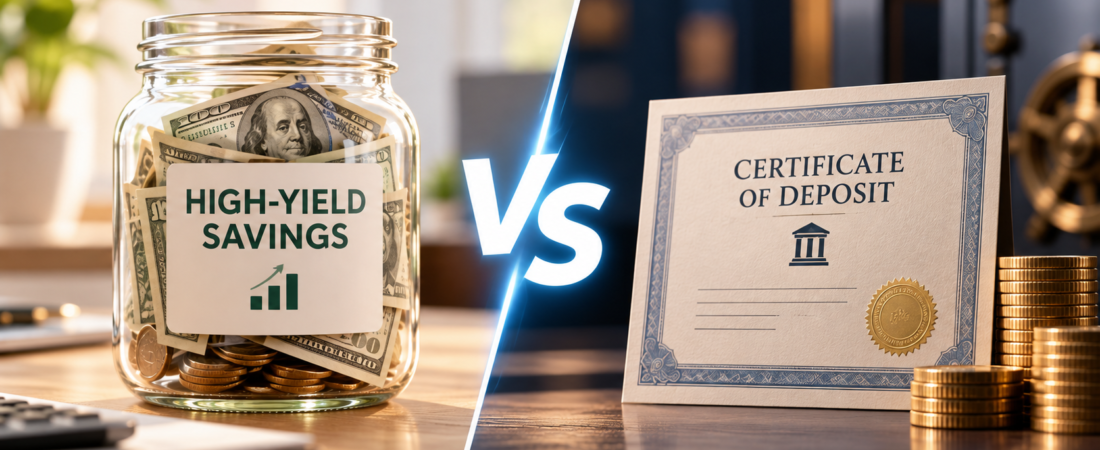
High-yield savings account vs CD is one of the most practical comparisons for anyone trying to earn more interest on cash without taking on stock-market risk.
Both can pay significantly more interest than a typical savings account, and deposits at federally insured banks can qualify for FDIC protection within applicable limits. But there is one major difference: a high-yield savings account keeps your money accessible, while a traditional CD generally asks you to lock your money away for a set period in exchange for a fixed rate. Fidelity
So if you have $10,000 sitting in cash, which one makes more sense?
The answer may depend less on which account advertises the highest APY and more on when you might need the money.
High-Yield Savings Account vs CD at a Glance
| Feature | High-Yield Savings Account | CD |
|---|---|---|
| Interest rate | Usually variable | Usually fixed |
| Access to money | Generally flexible | Usually locked until maturity |
| Early withdrawal penalty | Generally no CD-style penalty | Often applies |
| Add more money later | Usually yes | Usually no for standard CDs |
| Rate can fall | Yes | No during a fixed-rate term |
| Good for emergency fund | Strong fit | Usually less suitable |
| Good for known future expense | Good | Strong fit if timing matches |
| FDIC insurance | Eligible accounts | Eligible accounts |
The biggest difference is simple: HYSA gives you flexibility; a CD gives you predictability.
What Is a High-Yield Savings Account?
A high-yield savings account, or HYSA, works much like a traditional savings account but generally offers a much higher APY.
The money remains accessible, and you can typically add more money whenever you want. That makes an HYSA particularly useful for emergency savings or money you may need on short notice.
The trade-off is that the interest rate is generally variable.
If market interest rates fall, banks can reduce the APY they pay on savings accounts. If rates rise, the APY can also increase.
That means today’s attractive rate isn’t necessarily guaranteed for the next year. Fidelity
Banks may also impose their own transaction, minimum-balance, or withdrawal rules, so the account terms still matter. Consumer Financial Protection Bureau
Internal Link
This is a perfect place to link our existing article:
High-Yield Savings Account vs Regular Savings Account
Use this sentence in WordPress:
Not sure whether a high-yield account is worth switching to in the first place? See our High-Yield Savings Account vs Regular Savings Account comparison.
Highlight the bold text and link it to the existing Compareason article.
What Is a CD?
A certificate of deposit is also a deposit account, but it works differently.
You deposit money for a predetermined period—perhaps several months, one year, or longer—and the bank generally gives you a fixed interest rate for that term.
If interest rates fall after you open the CD, your fixed rate doesn’t fall with them.
That’s one of the biggest advantages of a CD.
But there’s a catch.
You generally agree to leave the money in the account until the CD reaches maturity. Taking money out early can result in an early-withdrawal penalty, and the exact penalty varies by institution and CD. Consumer Financial Protection Bureau
That makes a CD potentially attractive for money you know you won’t need immediately.
What Happens to $10,000?
Let’s use a simple example.
Suppose you have $10,000 and you’re comparing:
- HYSA paying 3.75% APY
- 12-month CD paying 4.00% APY
These are examples for illustration—not claims about the best rates currently available.
If those rates remained applicable for a full year:
| $10,000 Deposit | Approx. Value After One Year |
|---|---|
| HYSA at 3.75% | $10,375 |
| CD at 4.00% | $10,400 |
| Difference | $25 |
That’s an important point.
A quarter-percentage-point difference on $10,000 amounts to only about $25 over one year in this simplified example.
So choosing the CD solely because the advertised APY is slightly higher may not make sense if there’s a meaningful chance you’ll need the money early.
When comparing high-yield savings account vs CD, liquidity can sometimes matter more than a small difference in APY.
When a High-Yield Savings Account Makes More Sense
An HYSA can be particularly useful when the money serves as your financial safety net.
Imagine that the $10,000 is your emergency fund.
Your car could need a major repair. Your home could need an unexpected repair. You could face an unplanned expense next month.
In those situations, access to the money matters.
An HYSA allows your cash to continue earning interest without requiring you to predict exactly when you’ll need it.
That makes it particularly suitable for:
- Emergency funds
- Short-term savings
- Upcoming purchases without a fixed date
- Cash you may need unexpectedly
- Savings you’re continuing to build each month
The downside is that the APY can change.
When a CD Makes More Sense
Now imagine that the $10,000 isn’t your emergency fund.
You already have sufficient liquid savings, and this money is intended for something one year from now.
Maybe it’s a car down payment. Maybe it’s tuition. Maybe it’s money you simply don’t plan to touch.
In that situation, locking in a CD rate can become more attractive.
You know the rate from the beginning, and you don’t have to worry about the bank lowering your APY halfway through the term.
CDs can therefore make sense for:
- Money with a specific future date
- Savers who want predictable returns
- Cash that won’t be needed for emergencies
- People concerned that savings rates may fall
Fidelity also notes that CDs can be useful when the maturity date aligns with a specific financial goal. Fidelity
What If Interest Rates Fall?
This is where the difference becomes more interesting.
Suppose you open a high-yield savings account and rates decline several months later.
Your bank may lower your savings APY.
But if you locked in a fixed-rate CD before rates fell, your CD would generally continue paying its contracted rate until maturity.
That makes CDs potentially more attractive when you want to lock in today’s yield.
The opposite can also happen.
If rates rise after you open a fixed-rate CD, your money remains locked at the old rate while new savings accounts or CDs may offer more.
An HYSA adjusts more easily to changing rate environments.
What About a CD Ladder?
There is also a middle ground.
Instead of putting the entire $10,000 into one CD, you could divide the money among CDs with different maturity dates.
For example:
$2,500 → 3-month CD
$2,500 → 6-month CD
$2,500 → 9-month CD
$2,500 → 12-month CD
As each CD matures, you can either use the money or reinvest it.
This is commonly called a CD ladder.
It doesn’t provide the same immediate liquidity as a savings account, but it can reduce the problem of having all your money locked until one distant maturity date. Fidelity similarly describes CD ladders as a way to combine yield opportunities with periodic access to funds. Fidelity
Could You Use Both?
Absolutely.
For many savers, this doesn’t have to be an all-or-nothing decision.
Suppose you have $10,000 but want to keep part of it available.
You might keep:
$5,000 in a high-yield savings account for emergencies and short-term needs.
Then put:
$5,000 into a CD to lock in a fixed rate on money you don’t expect to use.
This approach gives you some liquidity while still allowing part of your savings to earn a predictable return.
High-Yield Savings Account vs CD: Which Fits Your Money?
The better choice depends primarily on what the $10,000 is supposed to do.
If it’s your emergency fund or you may need the money unexpectedly, the flexibility of a high-yield savings account can be valuable.
If you already have emergency savings and know you won’t need the money until a specific date, a CD can offer something an HYSA cannot: a guaranteed fixed rate for the CD term.
And if the APY difference is small, calculate the actual dollar difference before giving up liquidity.
On $10,000, even a seemingly meaningful difference in advertised rates may translate into only a few dollars per month.
Sometimes maximizing every fraction of a percentage point matters less than having the right money available at the right time.
Comparing other places to keep your cash? Read High-Yield Savings Account vs Regular Savings Account to compare liquidity and interest.
Compare with Reason.