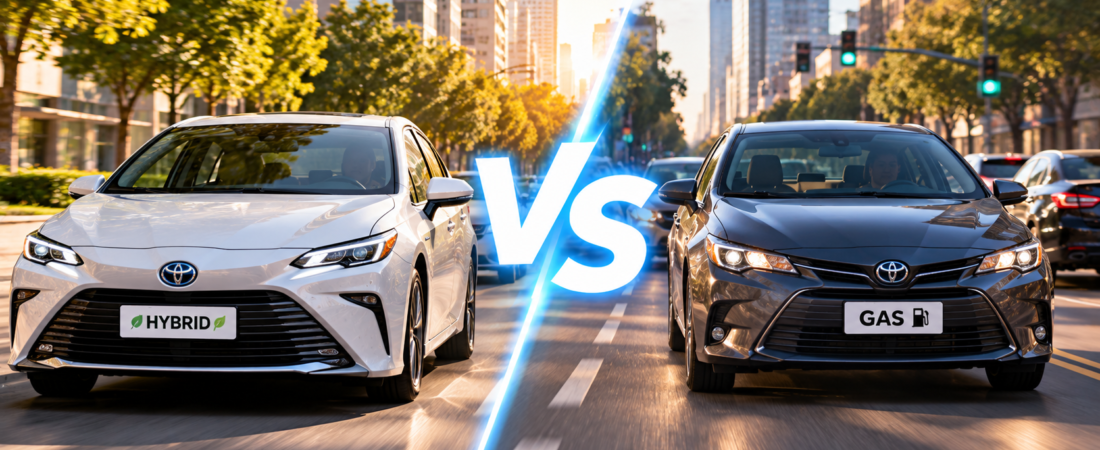
In this comparison, “hybrid” means a conventional full hybrid (HEV), not a plug-in hybrid (PHEV) or mild hybrid.
Full hybrid (HEV): Can drive using the engine, electric motor, or both. No plugging in required.
Plug-in hybrid (PHEV): Has a larger battery that can be charged from an outlet and can travel farther on electricity alone.
Mild hybrid (MHEV): Uses a small electric system to assist the engine but generally cannot drive on electric power alone.
If most of your driving happens around town, choosing between a hybrid and a regular gas car can have a surprisingly large effect on what you spend over the next several years.
The traditional argument is simple.
A gas car costs less to buy.
A hybrid uses less fuel.
But that doesn’t automatically mean the hybrid is the cheaper car to own.
You have to consider the higher purchase price, fuel savings, maintenance, brake wear, mileage and how long you plan to keep the vehicle.
And where you drive matters enormously.
A hybrid’s biggest efficiency advantage often appears exactly where traditional gasoline vehicles struggle most: stop-and-go city traffic.
So in the hybrid vs gas car for city driving comparison, does paying more upfront actually save money in the long run?
Let’s do the math.
Hybrid vs Gas Car at a Glance
| Hybrid | Gas Car | |
|---|---|---|
| Purchase price | Usually higher | Usually lower |
| City fuel economy | Usually much better | Usually lower |
| Highway advantage | Smaller | More competitive |
| Stop-and-go efficiency | Excellent | Less efficient |
| Regenerative braking | Yes | No |
| Brake wear | Often lower | Typically higher |
| Powertrain complexity | Higher | Lower |
| Charging required | No | No |
| Best environment | City/mixed driving | Highway/low annual mileage |
| Main advantage | Fuel efficiency | Lower initial cost |
Unlike a plug-in hybrid or EV, a conventional hybrid doesn’t need to be plugged in.
You fill it with gasoline exactly like a normal car.
The difference happens underneath.
Why Hybrids Are So Good in City Traffic
Traditional gasoline engines don’t particularly like stop-and-go driving.
Every time you accelerate, the engine has to move the vehicle again.
Every time you brake, much of the car’s kinetic energy is converted into heat through the brakes and effectively wasted.
A hybrid can recover some of that energy.
During braking and deceleration, regenerative braking uses the electric motor as a generator, capturing energy and storing it in the battery.
That stored energy can then help accelerate the vehicle again.
This creates an unusual situation.
For many cars, highway MPG is better than city MPG.
With some hybrids, the opposite can happen.
City traffic gives the hybrid system repeated opportunities to:
brake → recover energy → accelerate electrically → repeat.
That’s exactly the environment where hybrid technology can be most useful.
Let’s Compare Two Similar Cars
Suppose you’re choosing between two versions of the same compact SUV.
We’ll use simplified example numbers rather than a specific model.
Gas Version
Purchase price: $32,000
City fuel economy: 28 MPG
Hybrid Version
Purchase price: $34,000
City fuel economy: 42 MPG
The hybrid costs:
$2,000 more upfront.
Now suppose you drive:
12,000 miles per year
and about:
80% of those miles are city driving.
Let’s use $3.50 per gallon as an example gasoline price.
These numbers are illustrative; actual fuel prices, vehicle MPG and purchase-price differences vary.
Annual Fuel Cost: Gas Car
12,000 miles ÷ 28 MPG =
429 gallons
429 × $3.50 =
about $1,502 per year
Annual Fuel Cost: Hybrid
12,000 miles ÷ 42 MPG =
286 gallons
286 × $3.50 =
about $1,001 per year
Estimated annual difference:
about $501
Now the $2,000 hybrid premium doesn’t look quite as large.
At roughly $500 in annual fuel savings:
$2,000 ÷ $500 = about 4 years
After approximately four years, the fuel savings alone could theoretically recover the additional purchase price.
Keep the vehicle eight years and the calculation becomes much more interesting.
What If Gas Costs $4.50?
Fuel prices change the equation dramatically.
Using the same example:
Gas Car
429 gallons × $4.50 =
about $1,931 per year
Hybrid
286 gallons × $4.50 =
about $1,287 per year
Difference:
about $644 per year
Now the theoretical payback period on the $2,000 hybrid premium becomes roughly:
3.1 years.
That’s one reason hybrid demand can rise when gasoline prices increase.
In fact, recent U.S. market data illustrates that relationship.
Reuters reported that hybrid vehicles represented approximately 19% of U.S. retail vehicle sales in August 2026, up from roughly 16% before the recent rise in gasoline prices. Hybrids reached about 20% in May. Reuters
So hybrids are no longer a tiny niche within the American car market.
They’re increasingly becoming a mainstream alternative to traditional gasoline vehicles.
But What If You Don’t Drive Much?
This is where the gas car can become much more attractive.
Suppose you drive only:
5,000 miles per year.
Using the same 28 MPG vs 42 MPG comparison at $3.50 per gallon:
Gas
5,000 ÷ 28 × $3.50 ≈ $625/year
Hybrid
5,000 ÷ 42 × $3.50 ≈ $417/year
Difference:
about $208 per year
If the hybrid costs $2,000 more:
$2,000 ÷ $208 ≈ 9.6 years
That’s a very different calculation.
If you’re only keeping the car for four years, you might sell it long before fuel savings recover the higher purchase price.
This is why asking whether hybrids “save money” isn’t enough.
The better question is:
How much do you drive?
City Driving Makes the Hybrid More Attractive
Now imagine two drivers who each drive 12,000 miles per year.
Driver A
Mostly highway.
Long commute.
Few traffic lights.
Steady 65-mph cruising.
Driver B
Mostly city.
School drop-offs.
Grocery stores.
Restaurants.
Short trips.
Heavy traffic.
Constant stopping.
Driver B is generally giving the hybrid powertrain more opportunities to use regenerative braking and electric assistance.
That can make the hybrid’s relative advantage much larger.
This is also why comparing only the combined MPG number on a window sticker can hide an important part of the story.
Look separately at:
City MPG
and
Highway MPG.
If most of your driving is urban, city MPG matters more.
What About Brake Replacement?
Here’s another potentially overlooked advantage.
Hybrids use regenerative braking for part of the vehicle’s deceleration.
That means the traditional friction brakes may not have to do as much work during normal driving.
Less friction-brake use can mean slower brake-pad wear.
For a driver constantly stopping in city traffic, that can become meaningful over years of ownership.
A gasoline vehicle relies much more heavily on conventional brakes.
However, brake life varies enormously depending on driving style, terrain, vehicle weight and brake design, so it shouldn’t be treated as a guaranteed dollar amount.
Think of potentially reduced brake wear as a secondary benefit rather than the main reason to buy a hybrid.
Does a Hybrid Cost More to Maintain?
This is one of the most common concerns.
A hybrid has:
- Gasoline engine
- Electric motor
- High-voltage battery
- Power electronics
- Regenerative braking system
That sounds considerably more complicated than a traditional gas vehicle.
And technically, it is.
But hybrids also eliminate or reduce some mechanical workloads.
The electric motor assists the gasoline engine.
The engine can shut off when it isn’t needed.
Regenerative braking reduces reliance on friction brakes.
Many modern hybrids also use powertrains designed specifically around efficiency and long-term operation.
That doesn’t mean hybrid repairs can never be expensive.
It means that “more components” does not automatically translate into “higher routine maintenance costs.”
What About the Hybrid Battery?
This is usually the scary part.
People imagine buying a hybrid and receiving a massive battery replacement bill a few years later.
Hybrid batteries can certainly fail.
And replacement isn’t cheap.
But the financial question should be evaluated in context.
If you’re buying a new or relatively new hybrid and keeping it for a normal ownership period, battery failure may not be the immediate expense some buyers imagine.
If you’re buying an older used hybrid with very high mileage, however, battery condition becomes much more important.
So the battery question matters differently for:
a new 2026 hybrid
versus
a 12-year-old used hybrid.
For older vehicles, a pre-purchase inspection and information about battery health can be especially valuable.
Hybrids Are Becoming More Mainstream
One concern buyers used to have was that hybrid vehicles were unusual.
That’s increasingly difficult to argue.
Recent U.S. demand has been strong enough that automakers without broad hybrid lineups have been under pressure to add them.
Reuters reported that hybrids sold from dealer inventory more than twice as quickly as non-hybrid gasoline cars during the second quarter of 2026, citing J.D. Power data. Reuters
Toyota and Honda have benefited from their broad hybrid offerings, while other automakers have been expanding or accelerating hybrid plans. Reuters
For buyers, that also means the choice is no longer limited to a few unusual hybrid models.
Popular sedans and SUVs increasingly offer both gasoline and hybrid alternatives.
Resale Value Matters Too
Our earlier calculation assumed the hybrid’s extra $2,000 purchase price simply disappears.
Real ownership doesn’t necessarily work that way.
When you eventually sell the vehicle, the hybrid may also be worth more than the equivalent gasoline model.
If you pay $2,000 more today but recover $1,000 of that difference at resale, your effective hybrid premium was closer to $1,000.
On the other hand, future used-car preferences can change.
Fuel prices can fall.
New technologies can arrive.
Specific models can depreciate differently.
So resale shouldn’t be treated as guaranteed savings.
But it absolutely belongs in a true ownership-cost comparison.
The Hybrid Premium Is Critical
Suppose Hybrid A costs only:
$1,200 more than the gas version.
That’s potentially easy to recover.
But suppose Hybrid B costs:
$5,000 more.
Now the math changes dramatically.
Even saving $500 per year on fuel would require approximately:
10 years
to recover a $5,000 premium from fuel savings alone.
This is why you shouldn’t simply compare:
Hybrid vs Gas.
Compare the actual trims you’re considering.
Sometimes the hybrid model includes additional equipment, a different drivetrain or a higher trim level.
That can make the apparent “hybrid premium” misleading.
The Gas Car Still Has One Major Advantage
It’s usually simpler to understand financially.
Pay less.
Buy gas.
Drive.
If the gasoline model already gets excellent fuel economy and you don’t drive many miles, the hybrid premium may take a long time to recover.
There is nothing financially irrational about choosing the cheaper gas version in that situation.
A hybrid’s value grows when you actually use its efficiency advantage.
Who Should Consider the Hybrid?
A hybrid becomes especially interesting if you:
- Drive 10,000+ miles annually
- Spend a lot of time in city traffic
- Keep vehicles for many years
- Live somewhere with expensive gasoline
- Frequently make short urban trips
- Want better fuel economy without charging
- Can buy the hybrid for a modest premium
The combination of high mileage + city driving + long ownership is particularly favorable.
Who Should Consider the Gas Version?
The regular gas car may make more sense if you:
- Drive very few miles
- Mostly drive highway
- Replace vehicles frequently
- Can buy the gas version significantly cheaper
- Have inexpensive gasoline
- Prefer the simplest possible powertrain
- Are buying used and concerned about an aging hybrid battery
Again, there isn’t one answer for everyone.
The math depends on how the vehicle will actually be used.
Hybrid vs Gas Car for City Driving: Which Costs Less?
For drivers who spend most of their time in city traffic, the hybrid has a strong structural advantage.
Regenerative braking and electric assistance are particularly useful in the constant acceleration and deceleration of urban driving.
And today’s market suggests buyers increasingly recognize that advantage: hybrids accounted for roughly 19% of U.S. retail vehicle sales in August 2026. Reuters
But buying a hybrid isn’t automatically a money-saving decision.
The key calculation is:
Hybrid purchase premium ÷ annual fuel savings = approximate payback period
If the hybrid costs $2,000 more and saves $500 annually, the calculation can make sense quickly.
If it costs $5,000 more and saves only $200 annually, the gas version may remain cheaper for a very long time.
So before choosing the badge on the back of the car, calculate the numbers using your mileage, your fuel price and your actual driving pattern.
That’s where the real answer usually appears.
Compare with Reason.