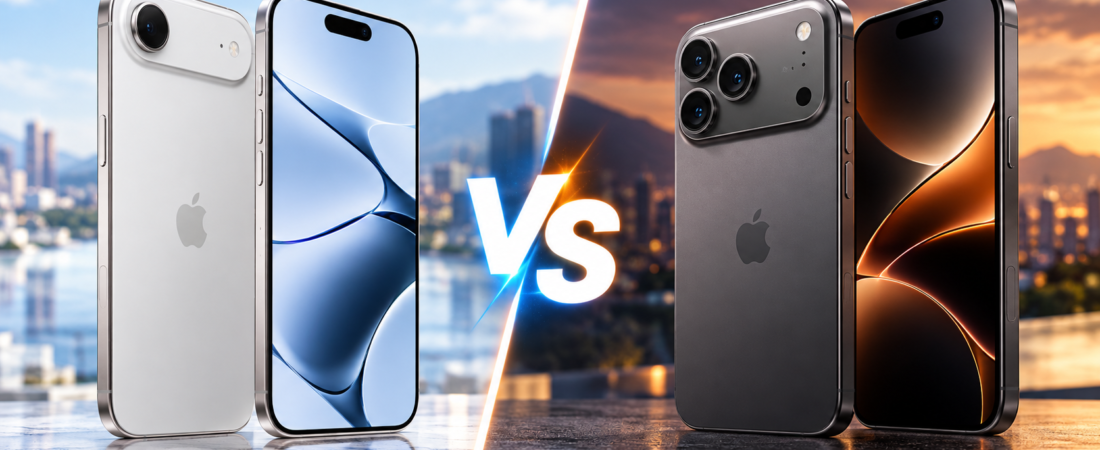
Apple’s 2026 iPhone lineup creates an unusually interesting buying decision.
The iPhone Air starts at $1,099, while the new iPhone 18 Pro starts at $1,199 in the United States.
That means just $100 separates them.
At first glance, the choice might seem obvious: spend another $100 and get the Pro.
But it is not quite that simple.
The iPhone Air offers something the Pro cannot fully replicate — an exceptionally thin and light titanium design with a larger 6.5-inch display. The iPhone 18 Pro, meanwhile, focuses on performance, cameras, battery life and professional features.
So which one actually makes more sense?
Let’s compare.
iPhone Air vs iPhone 18 Pro at a Glance
| Feature | iPhone Air | iPhone 18 Pro |
|---|---|---|
| Starting price | $1,099 | $1,199 |
| Price difference | — | +$100 |
| Display | 6.5-inch OLED | 6.3-inch OLED |
| Refresh rate | ProMotion up to 120Hz | ProMotion up to 120Hz |
| Processor | A19 Pro | A20 Pro |
| Rear camera philosophy | Single 48MP Fusion system | Advanced Pro camera system |
| Main camera | 48MP | 48MP variable aperture |
| Weight | 165g | Heavier Pro design |
| Thickness | 5.64mm | Thicker |
| Best for | Thin/light design | Performance, cameras, battery |
Apple lists the Air at just 5.64 mm thick and 165 grams, while still giving it a 6.5-inch Super Retina XDR display with ProMotion up to 120Hz.
That makes this comparison less about “cheap versus expensive” and more about design versus capability.
Design: The iPhone Air Has a Real Advantage
The biggest reason to choose the iPhone Air is obvious the moment you hold it.
It is extremely thin.
At only 5.64 mm, the Air is designed around portability. It also weighs just 165 grams despite having a 6.5-inch display.
That combination matters more than specification sheets suggest.
People carry their phones for hours every day. A lighter phone can be noticeably more comfortable when reading, traveling, taking photos or simply carrying it in a pocket.
The Air also uses a titanium design, so it does not necessarily feel like the cheaper phone.
The iPhone 18 Pro takes a different approach.
It is built around additional camera hardware, higher sustained performance and battery capability rather than minimum thickness.
If you value the feeling of an exceptionally thin phone, the Air has a legitimate advantage that spending another $100 does not replace.
Display: Bigger Screen or More Compact Phone?
Interestingly, the Air actually gives you the larger display.
The iPhone Air has a 6.5-inch Super Retina XDR OLED display with ProMotion up to 120Hz, Always-On display support and up to 3,000 nits of outdoor peak brightness.
The iPhone 18 Pro uses a smaller 6.3-inch form factor.
That creates two very different experiences.
The Air gives you more screen area while remaining remarkably light.
The Pro is more compact but packs considerably more hardware into its body.
For browsing, social media, email and video, the Air’s large display combined with its low weight may actually be the more appealing design.
Performance: A19 Pro vs A20 Pro
This is where the iPhone 18 Pro begins pulling away.
The iPhone Air uses Apple’s A19 Pro, including a six-core CPU and five-core GPU.
The iPhone 18 Pro moves to the newer A20 Pro and includes Apple’s next-generation vapor-chamber thermal system designed to improve sustained performance.
For normal tasks such as:
email,
web browsing,
social media,
streaming,
navigation,
and everyday photography,
the Air already has more than enough performance.
But users who play demanding games, edit video, use intensive AI applications or keep their phones for many years may appreciate the extra headroom of the A20 Pro.
Cameras: This Is the Biggest Difference
For many buyers, the camera system is the strongest argument for spending another $100.
The iPhone Air uses a 48MP Fusion Main camera that also provides an optical-quality 2x option through its sensor.
For everyday photography, that is plenty.
But the iPhone 18 Pro is built as a much more serious camera phone.
Apple introduced a 48MP Fusion Main camera with variable aperture on the 18 Pro, giving users more control over light and depth of field. Apple also positions the 18 Pro as its most advanced Pro camera system to date.
If your phone is your primary camera, the $100 difference becomes much easier to justify.
For someone who mostly takes casual family photos, food photos and vacation shots, the Air may still be completely sufficient.
Battery Life
Thin phones inevitably face physical limits.
Apple rates the iPhone Air for up to 27 hours of video playback.
Apple emphasizes significantly improved battery life on the iPhone 18 Pro generation, helped by improvements in Apple silicon and the internal design.
This is important because battery life affects almost every user, regardless of whether they care about camera technology or processor benchmarks.
If you regularly finish the day with a nearly empty battery, the Pro’s extra capacity may matter more than the Air’s thinner body.
The $100 Question
This is what makes the comparison unusual.
If the difference were $300 or $400, choosing the Air would be much easier to understand.
But the current difference is only:
$100.
Over three years of ownership, that works out to roughly $2.78 per month.
For that relatively small difference, the iPhone 18 Pro provides the newer processor, more advanced camera system and a design optimized more heavily around sustained performance and battery capability.
That makes the Pro particularly compelling for buyers who keep their phones for several years.
But there is an important exception.
You should not buy the Pro simply because it is technically better.
If the main reason you want the Air is its exceptionally thin, light design, the Pro cannot give you that experience.
Who Should Choose the iPhone Air?
The iPhone Air makes the most sense if you prioritize:
a thin and light phone,
a larger 6.5-inch display,
everyday performance,
simple photography,
and comfortable one-handed or travel use.
The Air is not simply a lesser Pro.
It is a different design philosophy.
Who Should Choose the iPhone 18 Pro?
The iPhone 18 Pro makes more sense if you prioritize:
camera capability,
battery life,
maximum performance,
gaming,
video creation,
or keeping your phone for several years.
With only $100 separating the starting prices, buyers who do not specifically value the Air’s thin design may find the Pro’s additional hardware especially relevant.
Bottom Line
The iPhone Air and iPhone 18 Pro target different priorities despite their surprisingly similar prices.
The iPhone Air emphasizes thinness, low weight and a larger display.
The iPhone 18 Pro emphasizes cameras, performance and battery capability.
The key question is therefore not simply whether the Pro is worth another $100.
It is whether you value the Air’s thin-and-light design enough to trade some Pro capabilities for it.
For many buyers, that is the real decision.
Compare with Reason.