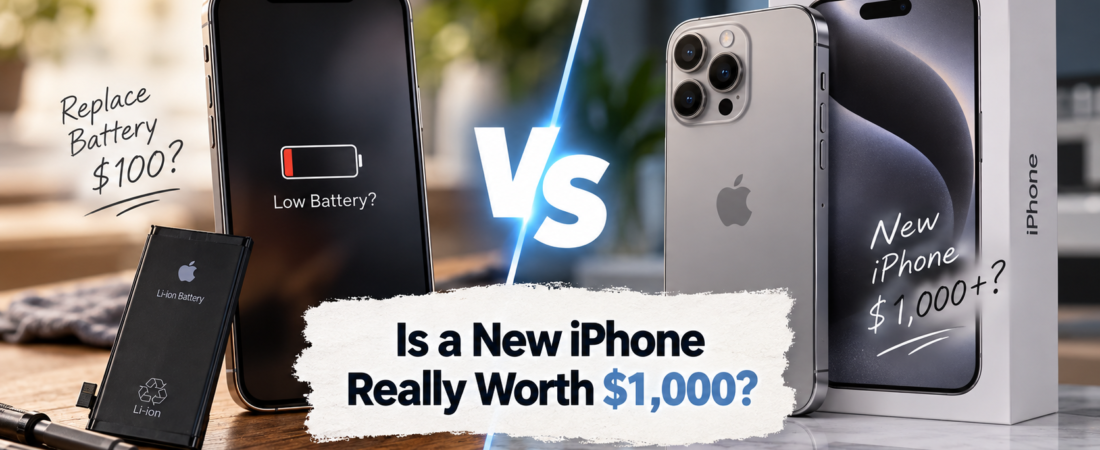
Your iPhone still works. The screen looks fine, the camera takes good pictures, and your favorite apps run normally.
But there’s one problem.
The battery doesn’t last nearly as long as it used to.
You start charging your phone in the afternoon. Battery percentage drops faster than expected. And suddenly, a brand-new iPhone begins to look tempting.
Apple’s newest models promise faster processors, better cameras, improved battery life, and additional features.
But do you really need to spend $1,000 or more to solve a problem that might cost around $100 to fix?
In this iPhone upgrade vs battery replacement comparison, we’ll examine the real financial difference between purchasing a new iPhone and replacing the battery in an existing device.
We’ll also calculate the two-year ownership cost, consider trade-in value and depreciation, and identify when upgrading actually makes sense.
The answer may surprise anyone who automatically replaces their phone every two or three years.
Quick Verdict: If your current iPhone still performs well and receives security updates, replacing the battery is usually the smarter financial decision. Upgrading becomes more attractive when you need new features, your phone has multiple problems, or the cost of repairs approaches the value of the device.
Comparison Outline
- iPhone upgrade vs battery replacement: Quick comparison
- How much does an iPhone battery replacement cost?
- How much does upgrading really cost?
- The Compareason Calculation: Two-year cost
- What about trade-in value?
- Battery health: When should you replace it?
- Performance and everyday usability
- Camera improvements and new features
- Software support and security
- Environmental impact
- When upgrading is worth the money
- When battery replacement is the smarter choice
- Frequently asked questions
- The Compareason Verdict
1. iPhone Upgrade vs Battery Replacement: Quick Comparison
Both options can improve your daily smartphone experience, but they solve different problems.
| Feature | Battery Replacement | New iPhone Upgrade |
|---|---|---|
| Typical upfront cost | Around $89–$119 | $799–$1,199+ |
| Battery life improvement | Restores battery capacity | New battery and potentially greater efficiency |
| Processor performance | Unchanged | Usually improved |
| Camera quality | Unchanged | May improve significantly |
| Display | Unchanged | Depends on model |
| Software support | Limited by existing model | Generally longer remaining support |
| Data transfer | Usually unnecessary | Required |
| Environmental impact | Extends device life | Requires another device |
| Best for | Otherwise functional iPhones | Older or limited devices |
Prices are illustrative U.S. estimates. Actual battery service fees vary by iPhone model, warranty status, service provider, and location. New-device pricing varies by model, storage, and promotions.
The biggest distinction is simple.
A battery replacement restores one aging component.
A new iPhone replaces the entire device.
If the battery is your only complaint, replacing the entire phone may be an unnecessarily expensive solution.
2. How Much Does an iPhone Battery Replacement Cost?
Apple offers battery replacement services for supported iPhone models.
Out-of-warranty pricing varies by model.
For budgeting purposes, many recent iPhone battery replacements fall around $89–$119 in the United States, although some models and service circumstances may differ.
The exact price should be confirmed through Apple’s repair estimate before scheduling service.
What Does Battery Replacement Actually Fix?
Lithium-ion batteries gradually lose capacity as they age.
As battery health declines, the phone may require more frequent charging.
A replacement battery can improve:
- Daily battery endurance
- Unexpected shutdowns caused by degraded battery condition
- Performance limitations related to battery health
- Overall reliability between charges
However, a battery replacement does not make the processor faster than it was when the phone was new.
It also does not improve the camera, display, or other hardware.
What If You Have AppleCare+?
AppleCare+ may cover battery service at no additional charge when the battery retains less than 80% of its original capacity, subject to the plan’s terms and eligibility.
That can make keeping an existing iPhone even more attractive.
Our Example
For the main calculation, we’ll assume a battery replacement costs $100.
This is a rounded budgeting assumption rather than a quote for a specific model.
Our Take: Spending approximately $100 to restore battery performance can be excellent value when the rest of the phone remains in good condition.
3. How Much Does Upgrading to a New iPhone Really Cost?
The advertised price of a new iPhone is only one part of the financial calculation.
You should also consider:
- Trade-in value
- Sales tax
- Accessories
- Financing costs
- Carrier requirements
- Future resale value
For our example, we’ll assume a new iPhone costs $1,000 before tax.
Example: Buying a $1,000 iPhone
Suppose your existing iPhone has a trade-in value of $250.
The immediate net device cost becomes:
$1,000 − $250 = $750.
That’s considerably less than the full retail price.
But it is still much more expensive than a $100 battery replacement.
What About Carrier Promotions?
Wireless carriers sometimes advertise free or heavily discounted iPhones.
However, many promotions require:
- Eligible unlimited plans
- Monthly bill credits
- A qualifying trade-in
- Maintaining service for a specified period
- Paying taxes or activation charges
A phone advertised as free may not have a zero total economic cost.
For example, upgrading to a plan that costs $20 more per month creates an additional expense of:
$20 × 36 months = $720.
That extra plan cost can substantially reduce the value of the phone promotion.
Our Take: Always compare the total cost of upgrading, including plan requirements and trade-in value, rather than focusing only on the advertised phone price.
4. The Compareason Calculation: Two-Year Ownership Cost
Let’s compare two choices over the next 24 months.
Option A: Keep Your Existing iPhone
Assumptions:
- Current iPhone market value: $250
- Battery replacement: $100
- Ownership period: 24 additional months
- Estimated resale value after two years: $100
- No other repairs
Option B: Upgrade to a New iPhone
Assumptions:
- New iPhone price: $1,000
- Trade-in credit for existing phone: $250
- Estimated new iPhone resale value after two years: $550
- Ownership period: 24 months
- No financing interest
For a fair economic comparison, we must recognize that keeping the old phone means giving up the opportunity to sell it today for $250.
That is an opportunity cost, even though no money leaves your bank account.
Option A: Battery Replacement
Current phone value: $250.
Battery replacement: $100.
Estimated resale value after two years: $100.
Economic ownership cost:
$250 + $100 − $100 = $250.
Two-year economic cost: $250.
Actual cash spending during the period is only $100, assuming no additional repairs.
Option B: Upgrade
New iPhone purchase price: $1,000.
Estimated resale value after two years: $550.
Economic ownership cost:
$1,000 − $550 = $450.
Two-year economic cost: $450.
The existing phone’s $250 trade-in is an important source of funding, but it is also an asset you give up. In a consistent economic comparison, it must not be treated as a free discount available only to the upgrade option.
Two-Year Comparison
| Financial Factor | Replace Battery | Upgrade iPhone |
|---|---|---|
| Device value at start | $250 | $1,000 |
| Battery service | $100 | $0 |
| Device value after 2 years | $100 | $550 |
| Two-year economic cost | $250 | $450 |
| Average monthly cost | $10.42 | $18.75 |
Result: Battery replacement saves approximately $200 over two years under these assumptions.
The difference is smaller than the initial $900 gap between a $100 repair and a $1,000 purchase because the new phone retains more resale value.
Taxes, accessories, financing, and carrier-plan changes could widen the difference.
The Important Lesson
Comparing only the purchase price of a new iPhone with the cost of a replacement battery can exaggerate the long-term difference.
A fair comparison accounts for the value of both devices at the beginning and end of the period.
The Compareason Insight: Battery replacement usually wins on immediate cash savings, but depreciation and resale value determine the true economic difference over time.
5. What About Trade-In Value?
Trade-in value can significantly change the decision.
A relatively recent iPhone may still qualify for a substantial trade-in credit.
An older device may have little remaining resale value.
Example: Different Trade-In Values
Assume a new iPhone costs $1,000.
| Existing iPhone Trade-In | Cash Needed for Upgrade |
|---|---|
| $100 | $900 |
| $250 | $750 |
| $400 | $600 |
| $600 | $400 |
These figures exclude taxes and financing.
A higher trade-in value reduces the cash required at purchase.
But remember: your current phone has value whether you trade it in or continue using it.
Why Trade-In Timing Matters
Smartphones generally depreciate as they age.
A phone worth $400 today may be worth considerably less in two years.
However, upgrading every year or two can also expose you repeatedly to depreciation on newer, more expensive devices.
The best strategy depends on how much you value the newer hardware.
Our Take: A generous trade-in offer can make upgrading more attractive, but it should be evaluated against the value of keeping the existing phone.
6. Battery Health: When Should You Replace It?
Battery health is one of the most useful indicators when deciding whether to replace an iPhone battery.
Apple provides battery health information in iOS.
Depending on the model and software version, you can check battery capacity and service recommendations in Settings.
What Does 80% Battery Health Mean?
A battery showing 80% maximum capacity can store approximately 80% of the energy it could store when new, under Apple’s battery health measurement.
That does not mean the phone will necessarily last exactly 20% less time in every situation.
Actual battery endurance also depends on software activity, temperature, network conditions, and usage.
General Battery Health Guide
| Battery Health | General Consideration |
|---|---|
| 90–100% | Usually healthy |
| 85–89% | Some aging, replacement often unnecessary |
| 80–84% | Evaluate daily endurance |
| Below 80% | Battery service may be worthwhile |
These ranges are practical guidelines, not official Apple replacement requirements for every device.
Signs You May Need a New Battery
- Battery percentage drops unusually quickly
- The phone shuts down unexpectedly
- Charging is required several times daily
- Battery health indicates service is recommended
- Performance management is affecting usability
However, battery drain can also result from software bugs, weak cellular signals, or power-intensive applications.
Before paying for service, check whether the problem is actually caused by battery degradation.
Our Take: If battery health is below 80% and the phone otherwise works well, replacement is often worth considering.
7. Performance: Does a New iPhone Feel Much Faster?
New iPhones generally include more powerful processors and improved hardware.
But how much difference will you actually notice?
Everyday Tasks
For activities such as:
- Messaging
- Web browsing
- Social media
- Video streaming
- Online banking
- Navigation
A reasonably recent iPhone may already perform very well.
The latest processor may offer limited practical benefit for these tasks.
Demanding Applications
Newer processors can be more valuable for:
- Advanced mobile gaming
- Video editing
- Computational photography
- On-device AI features
- Demanding augmented reality applications
The difference depends on how old your existing iPhone is.
Upgrading from a very old device can produce a major improvement.
Upgrading from a relatively recent model may feel much less dramatic.
Does Battery Replacement Improve Performance?
Sometimes.
If an aging battery causes performance management to limit peak processor output, replacing it may restore more consistent performance.
However, a new battery does not increase the phone’s original processing capability.
Our Take: For everyday users with relatively recent iPhones, battery replacement may solve the most noticeable problem without requiring a new device.
8. Camera Improvements: When Upgrading Becomes More Attractive
Camera technology is one of the strongest reasons to upgrade an iPhone.
Newer models may offer improvements in:
- Low-light photography
- Optical zoom
- Image processing
- Video stabilization
- Portrait photography
- Dynamic range
- Professional video features
But the importance of those improvements depends on how you use your phone.
Casual Photography
If you mainly take family photos, vacation pictures, and social media images, a relatively recent iPhone may already produce excellent results.
Content Creation
For someone who regularly records videos, creates social media content, or relies on smartphone photography for professional work, newer camera hardware may offer meaningful benefits.
The Real Question
Will the improved camera change what you can create?
Or will it simply make photos that already look good slightly better?
Our Take: Camera improvements can justify upgrading for serious creators, but they may offer limited value for casual users.
9. Software Support and Security: When an Older iPhone Becomes a Risk
Battery life and performance are important, but software support can be an even bigger reason to upgrade.
Apple regularly releases iOS updates that introduce new features, improve performance, and address security vulnerabilities.
However, older iPhone models eventually stop receiving the latest major iOS versions.
Some may continue receiving security updates for a period afterward, but support is not indefinite.
Why Software Support Matters
An outdated operating system may eventually create problems with:
- Banking and payment applications
- Security vulnerabilities
- New app compatibility
- Privacy protections
- Connected devices
- Certain Apple services
For someone who relies on an iPhone for financial transactions, business communication, and personal information, security support should be a major consideration.
Does Battery Replacement Extend Software Support?
No.
Replacing the battery improves the existing hardware’s endurance, but it does not change which software versions the device supports.
A phone that is approaching the end of its software support may not be a good candidate for an expensive repair.
When Should You Upgrade?
Consider upgrading when your iPhone no longer receives important security updates or can no longer run essential applications.
However, don’t assume that a phone is unsupported simply because it cannot install the newest major iOS version.
Check Apple’s current security release information for your specific model.
Our Take: Battery replacement makes the most sense when the existing iPhone still has a reasonable period of software support remaining.
10. Environmental Impact: Repairing vs Replacing
Financial cost isn’t the only consideration.
Smartphone manufacturing requires raw materials, energy, transportation, and complex production processes.
Replacing a functioning phone creates demand for another device, even if the original is traded in or recycled.
Battery Replacement
Replacing a battery can extend the useful life of an existing phone.
This may reduce the need for manufacturing a replacement device sooner.
It also allows consumers to continue using hardware that already meets their needs.
Buying a New iPhone
New devices can offer greater energy efficiency, longer software support, and improved capabilities.
However, manufacturing a new smartphone has an environmental impact.
Trading in or recycling an old device can help recover materials or extend its useful life through resale.
Which Is Better for the Environment?
Extending the useful life of an existing smartphone is generally a sensible way to reduce unnecessary replacement.
However, a precise environmental comparison requires considering manufacturing emissions, electricity consumption, repairs, and recycling.
Our Take: When an iPhone remains functional and secure, battery replacement can be a practical way to reduce electronic waste.
11. When Upgrading to a New iPhone Is Worth the Money
Replacing the battery isn’t always the smartest decision.
There are situations where upgrading provides meaningful value.
Scenario A: Your iPhone Is No Longer Supported
If your existing phone no longer receives important security updates, upgrading may be necessary.
A new battery cannot solve software compatibility or security limitations.
Better Choice: Upgrade.
Scenario B: Your Phone Has Multiple Problems
Suppose your iPhone needs:
- Battery replacement: $100
- Screen repair: $250
- Charging port repair: $100
The combined repair cost would be:
$100 + $250 + $100 = $450.
If the phone is only worth $200 in working condition, spending $450 on repairs may not make financial sense.
The actual decision depends on repair estimates and the cost of a suitable replacement.
Better Choice: Consider upgrading.
Scenario C: You Need Better Camera Capabilities
For professional content creators, improved camera hardware may provide real value.
If newer features help produce higher-quality work or eliminate the need for additional equipment, upgrading may be justified.
Better Choice: Upgrade if the improvements meet a specific need.
Scenario D: A Carrier Offers a Strong Promotion
A trade-in promotion can make upgrading more attractive.
However, compare the entire contract.
A $1,000 promotional credit spread over 36 months may require maintaining an eligible plan for the full period.
If the plan costs significantly more than your existing service, the promotion may be less valuable than it appears.
Better Choice: Calculate the total contract cost before deciding.
12. When Battery Replacement Is the Smarter Choice
For many iPhone owners, replacing the battery is the simplest and most economical option.
Scenario A: Your Phone Works Perfectly Except for Battery Life
The screen is undamaged.
The camera works well.
Applications run smoothly.
The only significant complaint is poor battery endurance.
Better Choice: Replace the battery.
Scenario B: Your iPhone Is Only Two or Three Years Old
A relatively recent iPhone may still provide strong performance and modern features.
Replacing its battery can make it comfortable to use for another year or two, depending on software support and overall condition.
Better Choice: Replace the battery if the device meets your needs.
Scenario C: You Want to Reduce Monthly Expenses
A battery replacement may cost around $100.
A new iPhone may require hundreds of dollars upfront or monthly financing payments.
For someone prioritizing financial flexibility, repairing the existing device may be more sensible.
Better Choice: Replace the battery.
Scenario D: You Don’t Need the New Features
If you rarely use advanced photography, demanding games, or newer AI features, upgrading may provide limited practical value.
Better Choice: Keep your existing iPhone.
13. Frequently Asked Questions
Is it better to replace an iPhone battery or buy a new phone?
If your iPhone still performs well, receives security updates, and has no major hardware problems, battery replacement is usually the cheaper option. Upgrading makes more sense when the device is outdated, damaged, or lacks features you genuinely need.
How much does an iPhone battery replacement cost?
Apple’s out-of-warranty battery service pricing varies by model and location. For budgeting purposes, many recent models fall around $89–$119, although actual prices may differ. Check Apple’s current repair estimate for your specific iPhone.
Is replacing an iPhone battery worth it at 80% health?
It can be, particularly if battery endurance has become inconvenient. Battery health near or below 80% may indicate meaningful degradation, but the decision should also consider actual daily performance and the phone’s overall condition.
Will replacing my iPhone battery make it faster?
It may restore performance that was limited by an aging battery. However, replacing the battery does not increase the processor’s original capabilities.
How many more years can an iPhone last after battery replacement?
It depends on the device’s age, condition, usage, and remaining software support. Some users may comfortably extend ownership by another one or two years or longer, but there is no guaranteed lifespan.
Is it worth replacing the battery in a three-year-old iPhone?
Often, yes. If the phone remains functional and secure, a battery replacement may provide better financial value than purchasing a new device.
Does AppleCare+ cover battery replacement?
Eligible AppleCare+ plans generally include battery service at no additional charge when the battery retains less than 80% of its original capacity, subject to Apple’s terms.
Should I upgrade my iPhone every two years?
Not necessarily. Many iPhones remain useful beyond two years. Upgrading should depend on performance, battery condition, software support, and whether newer features justify the expense.
Does replacing an iPhone battery reduce trade-in value?
A properly performed battery replacement generally should not be treated as equivalent to device damage, but trade-in eligibility and valuation depend on the buyer or program’s inspection criteria. Keep service records and check the specific trade-in terms.
Is a $1,000 iPhone worth buying?
It can be if you need its features and plan to use it extensively. However, if your existing phone already meets your needs, a battery replacement may offer substantially better value.
Is a carrier’s free iPhone promotion really free?
Not always. Many promotions use monthly bill credits and require an eligible service plan, trade-in, or long-term commitment. Compare the total service and device costs over the promotional period.
Should I replace the battery before selling my iPhone?
Only if the expected increase in resale value exceeds the replacement cost. For some devices, selling without repair may be more economical.
14. The Compareason Verdict: iPhone Upgrade vs Battery Replacement
Overall Winner for Saving Money: Battery Replacement
For most people whose existing iPhone remains functional, secure, and capable of running essential applications, replacing the battery is the more economical choice.
A battery replacement can restore much of the convenience of a healthy battery without requiring the purchase of an entirely new smartphone.
Our hypothetical two-year ownership calculation illustrates the difference.
| Financial Result | Battery Replacement | New iPhone |
|---|---|---|
| Initial device value | $250 | $1,000 |
| Battery service | $100 | $0 |
| Estimated value after 2 years | $100 | $550 |
| Two-year economic cost | $250 | $450 |
| Monthly economic cost | $10.42 | $18.75 |
Under these assumptions, replacing the battery saves approximately $200 in economic ownership cost over two years.
The immediate cash difference can be much larger, especially when the existing phone is already paid off.
However, the exact savings depend on resale values, repair pricing, taxes, financing, and promotions.
Best Choice for New Features and Long-Term Software Support: Upgrade
Buying a new iPhone makes more sense when the existing device has reached meaningful limitations.
These may include outdated software support, multiple hardware problems, insufficient performance, or missing camera and connectivity features.
For buyers who depend on their phones for professional work, these improvements may justify the additional expense.
The Compareason Calculation: What Would Change the Winner?
Our original example assumes the existing iPhone can remain usable for another two years after a $100 battery replacement.
But suppose it requires an additional $250 repair during that period.
The economic cost of keeping it would increase from $250 to $500.
That would exceed the $450 estimated economic cost of upgrading.
This illustrates the key financial risk of repairing older electronics.
Battery replacement is attractive when it solves the main problem. It becomes less attractive when multiple expensive repairs are likely.
Our Final Recommendation
Replace the battery if your iPhone still performs well, receives security updates, and the battery is your only major complaint.
You can potentially extend the useful life of your phone while avoiding unnecessary spending.
Upgrade if your iPhone is no longer secure, requires multiple costly repairs, or lacks features that materially improve your daily life or work.
And before accepting a carrier promotion, compare the complete cost of the phone and service plan.
A new iPhone can be an excellent purchase.
But a functioning older iPhone with a fresh battery can be an even smarter financial decision.
The Compareason Verdict: Don’t replace a $1,000 phone just because a $100 battery has worn out. Upgrade when the entire device—not just its battery—no longer meets your needs.
Compare with Reason.