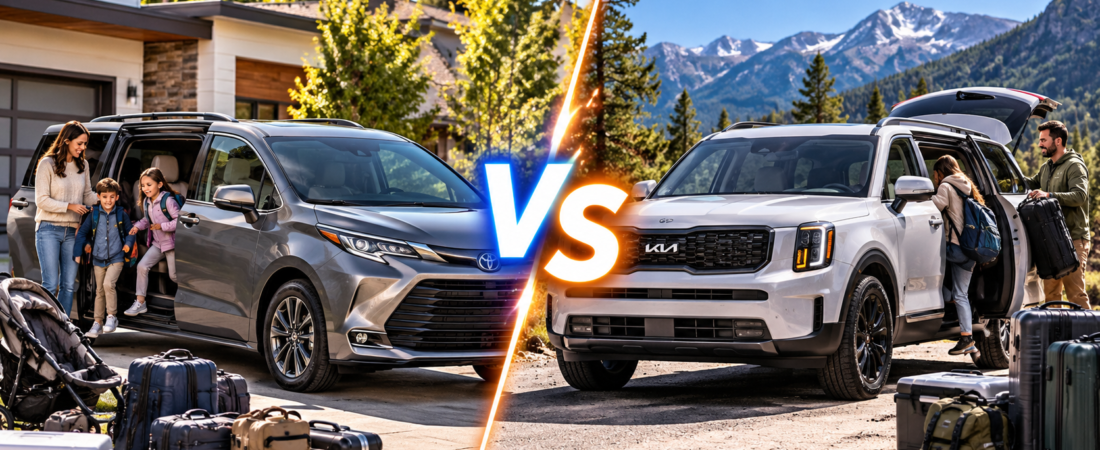
Minivan vs 3-row SUV sounds like a comparison that should have been settled years ago.
For many American families, it was.
They picked the SUV.
Three-row SUVs look tougher, sit higher, often offer all-wheel drive, and don’t carry the suburban-parent stereotype that has followed minivans for decades.
Walk through a school parking lot and the result is obvious.
Tahoes.
Palisades.
Tellurides.
Pilots.
Grand Highlanders.
Traverses.
Families clearly love SUVs.
But here’s the strange part:
If you ignore styling and image for a moment and judge these vehicles purely by what families actually do with them, the minivan starts looking remarkably difficult to beat.
Kids climbing into the third row.
Car seats.
Strollers.
Sports equipment.
Costco runs.
Airport luggage.
Grandparents.
Road trips.
Tight parking spaces.
For many of those tasks, the supposedly boring minivan may actually be the more intelligently designed vehicle.
So did families pick the wrong car?
Minivan vs 3-Row SUV at a Glance
| Minivan | 3-Row SUV | |
|---|---|---|
| Third-row access | Excellent | Usually harder |
| Sliding doors | Yes | No |
| Cargo flexibility | Excellent | Good to excellent |
| Child-seat friendliness | Excellent | Good |
| Ground clearance | Lower | Higher |
| AWD availability | Some models | Common |
| Towing | Moderate | Often better |
| Fuel economy | Often strong | Varies widely |
| Driving position | Lower | Higher |
| Parking-lot convenience | Excellent | Depends on size |
| Image/style | Practical | More desirable |
| Best for | Family transportation | Family + broader capability |
The SUV wins on capability and image.
The minivan often wins on the boring stuff.
And the boring stuff is what families do every day.
The SUV Won the Image War
There’s a reason minivans lost market share.
It wasn’t necessarily because they stopped being useful.
SUVs simply became desirable.
A three-row SUV can be:
a family car,
a luxury vehicle,
an adventure vehicle,
a tow vehicle,
and sometimes even a status symbol.
A minivan sends a much clearer message:
I have kids.
For some buyers, that’s enough to eliminate it immediately.
The auto industry responded accordingly.
Automakers flooded the market with SUVs in nearly every size and price category while the number of minivan choices shrank dramatically.
Today, the U.S. minivan market is concentrated around only a handful of major models such as the Toyota Sienna, Honda Odyssey, Chrysler Pacifica and Kia Carnival.
But fewer choices don’t necessarily mean the concept is obsolete.
It may mean fashion won.
Sliding Doors Might Be the Most Underrated Family-Car Feature
Imagine this familiar parking-lot scenario.
Your child is sitting in the second row.
The SUV next to you is parked slightly too close.
Your child opens the door.
You immediately say:
“Careful!”
Now imagine the same situation in a minivan.
Press a button.
The door slides backward.
Problem solved.
Sliding doors don’t look adventurous.
But they’re almost perfectly designed for:
tight garages,
school drop-off,
parking lots,
car seats,
young children,
and grandparents.
A traditional SUV door requires clearance beside the vehicle.
A sliding door doesn’t.
That difference seems trivial in a showroom.
After 1,000 school drop-offs, it doesn’t.
Car Seats Change the Entire Comparison
Three-row SUVs look enormous from the outside.
Then you install two child seats.
Suddenly getting someone into the third row can become an engineering problem.
Depending on the seating layout, you may need to:
fold a seat,
slide a seat,
climb between captain’s chairs,
or squeeze past a child seat.
Minivans are generally designed around this problem from the beginning.
Wide openings.
Low step-in height.
Sliding doors.
Walk-through access.
Flexible second-row seating.
The difference becomes even more obvious when adults need to reach inside to buckle a child.
A high SUV can force shorter adults to reach upward and inward.
A minivan’s lower floor can make the same task easier.
Again, not exciting.
Extremely useful.
The Third Row Is Where Many SUVs Get Exposed
A vehicle can technically have seven seats without comfortably carrying seven people.
That’s important.
Some three-row SUVs offer genuinely spacious third rows.
Others offer something closer to:
emergency seating.
Kids may fit.
Adults may tolerate it for 20 minutes.
But put six adults in the vehicle for a three-hour drive and the brochure’s seating capacity suddenly feels optimistic.
Minivans are usually packaged differently.
Their boxier bodies and lower floors allow manufacturers to dedicate more usable volume to passengers.
That can mean:
more legroom,
more headroom,
easier entry,
and better visibility.
If you regularly use all three rows, this matters far more than whether the vehicle can climb a dirt trail you’ll never visit.
Then There’s Cargo Space
Here’s one of the classic three-row SUV problems.
Fill all the seats.
Now load everyone’s luggage.
Where does it go?
Large SUVs can provide substantial cargo room, especially full-size models.
But many midsize three-row SUVs sacrifice a surprising amount of luggage space when the third row is upright.
Minivans are shaped like boxes for a reason.
Boxes are efficient.
That means the same vehicle that carries six or seven people can often handle:
strollers,
sports bags,
groceries,
suitcases,
coolers,
and all the miscellaneous objects families somehow accumulate.
You may not appreciate that space on a test drive.
You appreciate it at the airport.
The Minivan’s Low Floor Is a Secret Weapon
SUV marketing celebrates ground clearance.
For off-road driving, snow and rough terrain, that’s useful.
But every inch the vehicle rises also means passengers and cargo have farther to climb.
Minivans take the opposite approach.
The floor is low.
Kids can climb in more easily.
Older relatives can step in more easily.
Heavy objects don’t need to be lifted as high.
Dogs don’t need to jump as far.
If your normal terrain is:
driveway → school → supermarket → soccer field → highway,
a lower floor may provide more daily value than extra ground clearance.
But SUVs Absolutely Have Real Advantages
This isn’t a case where minivans secretly beat SUVs at everything.
They don’t.
A good three-row SUV can offer capabilities a minivan simply can’t match.
Depending on the model, that can include:
higher towing capacity,
greater ground clearance,
more robust AWD systems,
better rough-road ability,
larger wheel-and-tire options,
and stronger performance.
If you tow a large boat or camper, the difference can be decisive.
If you live where roads become genuinely difficult in winter, capability matters.
If you regularly travel on unpaved roads, clearance matters.
A minivan shouldn’t win simply because it has sliding doors.
The question is whether you actually use the SUV capabilities you’re paying for.
AWD Is No Longer an Automatic SUV Victory
This comparison used to be easier.
Need all-wheel drive?
Buy an SUV.
That’s no longer necessarily true.
Some modern minivans offer AWD, including the Toyota Sienna and Chrysler Pacifica.
That doesn’t turn them into off-road vehicles.
But for many families, AWD isn’t about off-roading.
It’s about:
rain,
snow,
slippery driveways,
and winter confidence.
For those buyers, the gap between minivan and SUV has narrowed.
The important distinction is:
AWD is not the same thing as off-road capability.
Many families need the first.
Very few need the second.
Fuel Economy Can Become a Big Deal
Family vehicles accumulate miles quickly.
School.
Work.
Sports.
Lessons.
Shopping.
Vacations.
Weekend activities.
Suppose one vehicle averages:
24 mpg
and another averages:
35 mpg.
At 15,000 miles per year:
24 mpg = about 625 gallons.
35 mpg = about 429 gallons.
Difference:
roughly 196 gallons per year.
At $3.50 per gallon, that’s approximately:
$686 per year.
Over five years:
more than $3,400.
Of course, actual fuel economy varies enormously by model.
A hybrid three-row SUV may perform very well.
A large V6 or V8 SUV may use considerably more fuel.
The point is that family vehicles often drive enough miles for efficiency differences to matter.
The SUV Can Become Much More Expensive Very Quickly
This is where buyers need to compare actual vehicles rather than categories.
A midsize three-row SUV may be reasonably priced.
A large body-on-frame SUV can easily move into a completely different financial category.
Higher purchase price.
Larger tires.
More fuel.
Potentially higher insurance.
More expensive suspension and brake components.
The jump from a practical family crossover to a huge luxury SUV can add tens of thousands of dollars.
And sometimes the family’s actual transportation needs haven’t changed at all.
They still need to carry:
two adults,
three children,
and a soccer bag.
They’re simply doing it in a much more expensive package.
The Costco Test
Forget horsepower.
Here’s a better family-car test.
Take the entire family to Costco.
Leave the third row up.
Now buy:
paper towels,
toilet paper,
water,
groceries,
snacks,
and whatever giant item you didn’t intend to buy.
Can everything fit?
This is where vehicle packaging becomes more important than exterior dimensions.
A vehicle can look massive while using its space inefficiently.
Another can look boring and swallow nearly everything.
For families, usable space beats visual size.
The Airport Test Is Even Better
Five people.
Five suitcases.
Three carry-ons.
A stroller.
Maybe golf clubs.
Everyone needs a seat.
Everything needs to fit.
This is the moment when a vehicle’s brochure specifications become reality.
Folding the third row creates lots of cargo space.
But if your passenger is sitting there, you can’t fold it.
When comparing family vehicles, always ask:
How much cargo space is available with every seat I’m actually going to use?
That’s a much more useful number.
Kids Eventually Become Teenagers
Another mistake is buying only for today’s family.
A 7-year-old fits almost anywhere.
A 15-year-old doesn’t.
If you’re planning to keep the vehicle for seven or eight years, today’s third-row child may eventually be:
5’8″,
5’10”,
or taller.
Suddenly:
legroom,
foot space,
headroom,
USB ports,
cupholders,
and climate vents
matter a lot more.
A third row that’s fine for elementary-school children may become miserable when those children become teenagers.
Why Do People Still Choose the SUV?
Because vehicles aren’t appliances.
People don’t choose cars based only on utility.
They choose them because of:
design,
identity,
driving position,
performance,
brand,
image,
and emotion.
And that’s completely legitimate.
Someone may fully understand that a minivan is more practical and still prefer a three-row SUV.
The mistake isn’t choosing the SUV.
The mistake is pretending practicality was the reason if it wasn’t.
Sometimes the honest answer is:
“The minivan works better, but I like the SUV more.”
That’s a perfectly valid reason to buy a car.
It’s just a different reason.
What About the Kia Carnival?
The Kia Carnival illustrates how blurry this category has become.
Kia calls it an MPV, and its styling intentionally borrows SUV-like cues.
Why?
Because automakers understand the problem.
Consumers want minivan practicality.
They don’t necessarily want a vehicle that looks like a minivan.
That tells you something fascinating about the market.
The problem may never have been the minivan’s functionality.
It may have been its image.
Who Should Buy the Minivan?
A minivan deserves serious consideration if you:
regularly use the third row,
have multiple young children,
use car seats,
carry grandparents,
make frequent road trips,
haul lots of luggage,
live in suburban parking lots,
or simply want maximum passenger space for the money.
The more often all seats are occupied, the stronger the minivan becomes.
If your vehicle’s main job is transporting people comfortably, it’s incredibly difficult to beat.
Who Should Buy the 3-Row SUV?
The SUV makes more sense if you:
tow regularly,
need meaningful ground clearance,
travel on rough roads,
want stronger off-road capability,
prefer the higher driving position,
need specific performance capabilities,
or simply strongly prefer SUV styling.
And that last reason matters.
You’re going to look at the vehicle every day.
Practicality isn’t the only thing you’re allowed to value.
Minivan vs 3-Row SUV: Did Families Pick the Wrong Car?
So did millions of families make a mistake by abandoning minivans?
Not exactly.
SUVs became popular because they’re extremely versatile vehicles.
But minivan vs 3-row SUV looks very different when you remove image from the equation.
If the primary job is:
moving children,
accessing three rows,
carrying luggage,
handling school drop-off,
loading groceries,
and surviving family road trips,
the minivan remains remarkably difficult to beat.
The three-row SUV is often the vehicle families want.
The minivan may still be the vehicle many families actually need.
And maybe that’s why the minivan never disappeared.
It was never really bad at its job.
It just lost the popularity contest.
Compare with Reason.