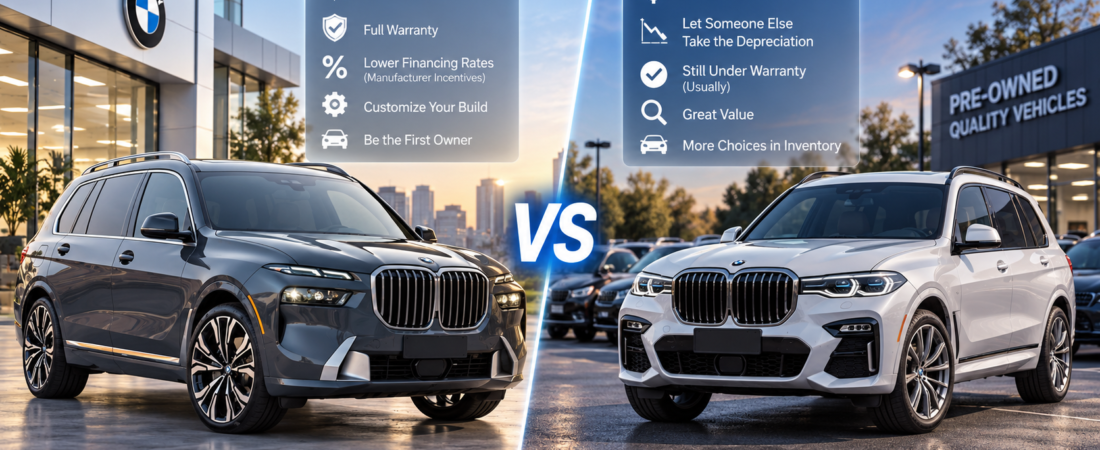
Buying a slightly used car used to feel like one of the easiest financial decisions in car shopping.
Let someone else take the first depreciation hit.
Buy the same vehicle two or three years later.
Save thousands of dollars.
Drive essentially the same car.
For decades, that strategy made sense.
But the car market of 2026 is making the decision much more complicated.
New vehicles have become extremely expensive. The average new-vehicle transaction price in the U.S. reached $50,089 in August 2026, according to Kelley Blue Book data.
At the same time, used cars aren’t exactly cheap.
The average used-vehicle listing price reached $27,239 in August, 7% higher than a year earlier, according to Cox Automotive.
And there’s another twist.
Financing a used car can cost considerably more than financing a new one.
So if you’re shopping for a vehicle today, should you spend more for something brand new?
Or is the traditional strategy — buying a two-year-old version of the same vehicle — still the smarter move?
Let’s compare.
Quick Comparison
| New Car | 2-Year-Old Used Car | |
|---|---|---|
| Purchase Price | Higher | Lower |
| Financing | Usually Better | Usually Higher Rates |
| Warranty | Full | Partially Remaining |
| Maintenance | Minimal | Usually Still Low |
| Depreciation | Higher Early On | Previous Owner Absorbed Some |
| Technology | Latest | Usually Very Similar |
| Vehicle History | Known | Must Verify |
| Selection | Better Customization | Depends on Inventory |
| Long-Term Ownership | Excellent | Excellent |
| Best For | Keeping 7–10+ Years | Maximizing Value |
At first glance, the used car seems like the obvious financial winner.
But the purchase price doesn’t tell the whole story.
Round 1: Purchase Price
Winner: 2-Year-Old Used Car
This is still the biggest reason to buy used.
Cars depreciate.
The moment a new vehicle begins accumulating miles, it starts becoming a used vehicle.
After two years, someone else has already absorbed part of that depreciation.
Imagine the new version of a vehicle costs $50,000.
If a comparable two-year-old example sells for $40,000, that’s a $10,000 difference before you even begin negotiating.
You may be getting:
The same engine.
Nearly identical styling.
Most of the same technology.
The same basic interior.
And very similar driving characteristics.
That is why slightly used vehicles can offer tremendous value.
You’re often buying most of the car for considerably less money.
Winner: 2-Year-Old Used Car
Round 2: Financing
Winner: New Car
This is where many buyers make a mistake.
They compare sticker prices but ignore financing.
According to Cox Automotive’s August 2026 market data, the average prime auto-loan rate tracked by Dealertrack was approximately:
New vehicle: 9.93%
Used vehicle: 14.03%
Those are market averages for the particular credit tier Cox tracks, not the rate every buyer will receive. Your actual APR can vary dramatically based on credit, lender, loan term, vehicle and manufacturer promotions.
But the difference illustrates an important point.
Manufacturers frequently subsidize new-car financing.
You may occasionally see promotional offers such as:
0.9%
1.9%
2.9%
or other below-market rates on certain models.
Used cars rarely receive comparable manufacturer financing support.
That means a $40,000 used vehicle financed at a high rate can sometimes come surprisingly close in monthly payment to a more expensive new vehicle receiving subsidized financing.
Always compare:
Purchase price + interest cost
not simply:
Purchase price.
Winner: New Car
Round 3: Depreciation
Winner: 2-Year-Old Used Car
Depreciation is usually fastest early in a vehicle’s life.
That makes the first owner vulnerable to the biggest dollar loss.
Suppose you buy a new car for $50,000.
Several years later it may be worth dramatically less.
That doesn’t necessarily matter if you plan to keep the vehicle for ten years.
But if you frequently trade cars, depreciation becomes one of your largest ownership expenses.
Buying two years old lets the previous owner absorb some of that initial decline.
This is especially important with:
Luxury cars.
Some EVs.
Vehicles with aggressive new-car incentives.
Models that historically depreciate quickly.
Buying slightly used doesn’t eliminate depreciation.
It simply means you enter the depreciation curve later.
Winner: 2-Year-Old Used Car
Round 4: Warranty
Winner: New Car
Nothing beats starting at mile zero.
With a new vehicle, you generally receive the manufacturer’s complete new-car warranty period.
You know exactly how the vehicle has been driven.
You know its maintenance history.
There are no mystery accidents.
No questionable repairs.
No previous owner who ignored oil changes.
A two-year-old car may still have substantial factory warranty remaining, depending on the manufacturer, mileage and original in-service date.
But you’ve already consumed part of it.
Certified Pre-Owned programs can reduce this disadvantage by adding inspections and warranty coverage, although CPO vehicles may cost more than ordinary used examples.
For maximum peace of mind:
New wins.
Round 5: Technology
Winner: Tie — Usually
Twenty years ago, buying a three-year-old vehicle could mean noticeably outdated technology.
Today, that depends heavily on the model.
A 2024 vehicle and a 2026 version of the same generation may share:
The same infotainment system.
The same display.
The same engine.
The same driver-assistance technology.
The same basic interior.
Sometimes the differences are surprisingly small.
That creates an interesting opportunity.
If the model hasn’t undergone a major redesign, the two-year-old vehicle may provide almost the same experience for much less money.
But there’s one important exception:
Generation changes.
If the 2026 model has been completely redesigned while the 2024 vehicle belongs to the previous generation, the new model may offer substantial improvements.
Never compare model years alone.
Compare vehicle generations and equipment.
Winner: Tie
Round 6: Maintenance
Winner: New Car — Slightly
A two-year-old vehicle isn’t old.
A properly maintained two-year-old car with reasonable mileage may still have many years of reliable service ahead.
But wear has already started.
Depending on mileage, you may eventually need:
Tires.
Brakes.
Battery.
Alignment.
Fluids.
Other routine maintenance.
A new vehicle resets everything to zero.
You also know exactly how it has been treated since day one.
The difference isn’t enormous at two years old, but it exists.
Winner: New Car — Slightly
Round 7: Reliability Risk
Winner: New Car
Used vehicles always introduce uncertainty.
Why did the previous owner sell it?
Was it driven aggressively?
Was it properly maintained?
Was it repaired after an accident?
Was it frequently driven short distances?
Did it spend its life parked outside?
A vehicle-history report and pre-purchase inspection can reduce the risk.
They can’t completely eliminate it.
Buying new removes almost all of those questions.
You’re starting the story yourself.
Winner: New Car
Round 8: Value for Money
Winner: 2-Year-Old Used Car
Now we arrive at the strongest argument for buying slightly used.
Consider two cars parked beside each other.
One is brand new.
The other is two years old with 20,000 miles.
Same generation.
Same engine.
Same trim.
Same color.
Nearly identical features.
If the used vehicle costs thousands less, ask yourself:
How much is zero miles actually worth to me?
Sometimes the answer is a lot.
Sometimes it isn’t.
The second buyer gets to enjoy almost the same product without paying for the most expensive part of the vehicle’s life.
That’s why two- to three-year-old cars have traditionally occupied a sweet spot.
They’re still modern.
They’re still relatively new.
But they’re no longer priced as brand new.
Winner: 2-Year-Old Used Car
But 2026 Has Changed the Math
Here’s where today’s market becomes important.
Used vehicles have remained unusually expensive.
Cox Automotive reported that the average retail used-vehicle listing price reached $27,239 in August 2026, up 7% from a year earlier, even as inventory remained relatively tight.
At the wholesale level, however, the market has recently begun softening. During the first half of September, Manheim’s seasonally adjusted used-vehicle index fell 1% from August and slipped 0.4% below the same period last year.
That means the market isn’t moving uniformly.
Retail used prices remain elevated, while wholesale values have recently shown some cooling.
For shoppers, this makes individual vehicle comparisons especially important.
The old rule —
“Always buy two years used.”
— isn’t enough anymore.
The $5,000 Rule
Here’s a more useful way to approach the decision.
Don’t ask:
“Is used cheaper?”
It almost always is.
Ask:
“Is it cheaper enough?”
Suppose:
New car: $48,000
Two-year-old version: $43,000
Difference: $5,000
Now consider what the extra $5,000 might buy you:
Two additional years of vehicle life.
Full warranty.
New tires.
New brakes.
No mileage.
Known history.
Possibly better financing.
Potentially newer technology.
In that situation, buying new might make more sense.
But now imagine:
New car: $48,000
Two-year-old version: $35,000
Difference: $13,000
That’s a completely different decision.
If they’re otherwise similar, the used car becomes extremely attractive.
The important number isn’t the used-car price.
It’s the price gap between equivalent vehicles.
Financing Can Completely Change the Winner
Let’s take another hypothetical example.
New:
$48,000 at 2.9%
Used:
$40,000 at 8.9%
The used vehicle starts $8,000 cheaper.
But once interest is included over a multi-year loan, part of that advantage disappears.
Now add:
Less remaining warranty.
20,000 miles.
Potential tire replacement.
Possible maintenance.
Suddenly the comparison is much closer.
This is why buyers should compare the total amount paid, not merely the monthly payment.
Dealerships can make almost any vehicle appear affordable by extending the loan.
A $700 payment for 72 months is very different from a $700 payment for 48 months.
When Buying New Makes More Sense
A new vehicle becomes particularly attractive when:
The new model has strong manufacturer incentives.
Financing rates are dramatically lower.
The used version retains unusually high resale value.
You’re planning to keep the vehicle for many years.
The model has recently been redesigned.
You highly value warranty protection.
The used/new price difference is relatively small.
In these situations, paying more upfront can actually be reasonable.
When Buying Two Years Used Makes More Sense
Used becomes especially attractive when:
The vehicle depreciates quickly.
The current generation hasn’t changed.
The used example has low mileage.
The vehicle has a clean history.
You can pay cash or obtain competitive financing.
The remaining factory warranty is substantial.
The new-to-used price difference is large.
Luxury vehicles can sometimes make particularly interesting used purchases because the first owner may absorb a large depreciation hit.
But repair costs after warranty expiration should always be considered.
Don’t Forget Certified Pre-Owned
There is also a middle option:
Certified Pre-Owned.
CPO vehicles typically undergo manufacturer-defined inspections and may include additional warranty coverage or benefits.
That gives buyers some of the value of used ownership with additional reassurance.
The downside?
CPO vehicles generally command a premium over equivalent non-certified used cars.
In August, Cox Automotive recorded 227,432 U.S. CPO sales, showing that this remains a significant part of the used-car market.
For someone nervous about buying used but unwilling to pay full new-car pricing, CPO can be worth considering.
Our Pick: 2-Year-Old Used Car — If the Discount Is Big Enough
For pure value, our pick remains the 2-Year-Old Used Car.
But there’s an important condition:
The price difference has to justify it.
Buying a two-year-old car for only a few thousand dollars less than new may not be a bargain — especially if the new vehicle offers subsidized financing, a complete warranty and updated technology.
But when the depreciation discount is substantial, the logic behind slightly used cars remains powerful.
Someone else paid for the first years of depreciation.
You get most of the same vehicle.
And you keep more money in your pocket.
The smartest strategy in 2026 isn’t:
Always buy new.
And it isn’t:
Always buy used.
It’s this:
Compare the same trim, calculate the total financing cost, check the remaining warranty, and measure the real price gap.
If that gap is small, buy new.
If that gap is large, two years used can still be one of the smartest ways to buy a car.
Compare with Reason.