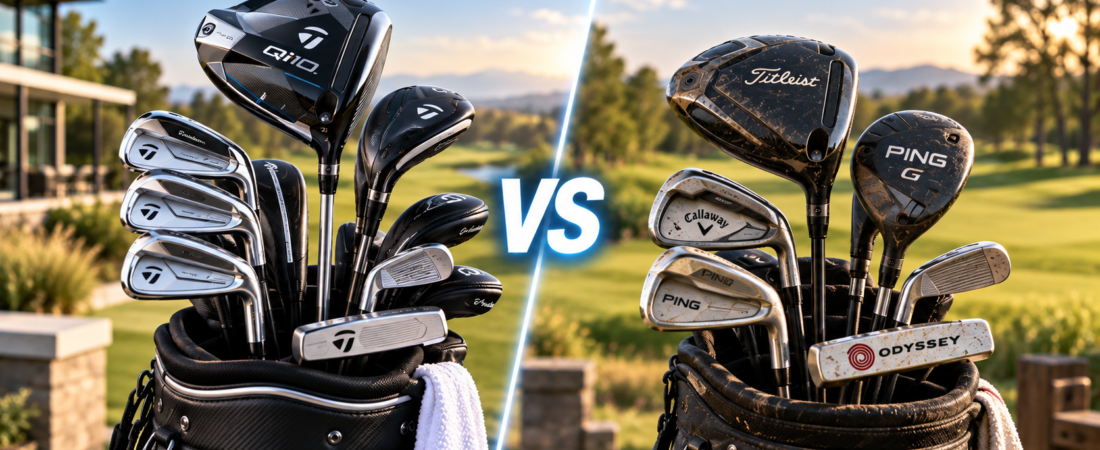
Walk into a golf store today and it’s easy to believe that better golf is sitting right there on the wall.
The newest driver promises more speed.
The latest irons offer more forgiveness.
New wedges advertise improved spin.
Putters arrive with new materials, inserts, alignment systems, and weighting technology.
And every year, another generation replaces the one that was supposed to change your game last year.
But there’s another side to the golf equipment market.
Pre-owned clubs.
A driver that cost $600 or more when it launched may become dramatically cheaper after a few product cycles.
A quality iron set can remain completely playable for many years.
And for beginners, juniors, or golfers still developing their swing, buying the newest equipment may not always be the smartest use of money.
Interest in used golf equipment appears strong as golf attracts younger players. Recent UK marketplace data reported by eBay showed searches for “pre-owned golf club sets” rising 96% year over year, alongside growing golf interest among younger adults.
So which makes more sense?
Brand-new golf clubs or pre-owned equipment?
Let’s compare.
Quick Comparison
| New Golf Clubs | Pre-Owned Golf Clubs | |
|---|---|---|
| Price | Expensive | Much cheaper |
| Latest Technology | Yes | Usually slightly older |
| Condition | Perfect | Varies |
| Custom Fitting | Excellent | More difficult |
| Warranty | Usually included | Depends on seller |
| Selection | Current models | Huge across generations |
| Resale Value | Depreciates quickly | Less depreciation remaining |
| Beginners | Often unnecessary | Excellent value |
| Juniors | Can get expensive | Often smarter |
| Serious Fitted Players | Excellent | Depends on specs |
| Overall Value | Good | Excellent |
The key question isn’t whether new clubs are better.
They usually are — at least technically.
The better question is:
Are they better enough to justify the price?
Round 1: Price
Winner: Pre-Owned
This is the easiest category.
Golf equipment has become expensive.
A premium new driver can cost hundreds of dollars. Add fairway woods, hybrids, irons, wedges, and a putter, and a complete premium setup can quickly cost several thousand dollars.
Pre-owned equipment changes the equation.
Golf clubs don’t suddenly stop working when a new model is released.
A premium driver from a few generations ago may still offer excellent ball speed and forgiveness.
Quality irons can remain useful for many years.
Putters can remain relevant for decades.
The first owner has already absorbed a large portion of the depreciation.
That’s especially attractive for golfers who don’t need to own the newest equipment every season.
Winner: Pre-Owned
Round 2: Technology
Winner: New — But By Less Than You Might Think
Manufacturers continue improving golf equipment.
Modern drivers offer sophisticated weighting systems, advanced face designs, improved aerodynamics, and greater stability on off-center strikes.
Modern irons can combine stronger ball speed with impressive forgiveness.
New wedges continue experimenting with grooves, sole designs, and center-of-gravity placement.
So yes:
New clubs generally contain the latest technology.
But equipment improvement doesn’t necessarily happen in giant jumps every year.
A five- or ten-year comparison can reveal meaningful changes.
A one-year comparison?
Often much less dramatic.
For example, a golfer moving from a driver released many generations ago to a modern model may see noticeable improvements.
But replacing last year’s premium driver simply because this year’s version launched may produce a much smaller difference.
Golf marketing moves annually.
Golf technology tends to evolve more gradually.
Winner: New — but the gap can be small.
Round 3: Custom Fitting
Winner: New
This is one of the strongest arguments for buying new.
A proper fitting can help determine:
Club length.
Lie angle.
Loft.
Shaft weight.
Shaft flex.
Launch characteristics.
Spin.
Grip size.
Set composition.
Driver head and shaft combination.
When buying new, you can often order the club specifically for your swing.
With used equipment, you’re usually buying someone else’s specifications.
Maybe the shaft is too heavy.
Maybe the irons are one degree upright.
Maybe the driver is cut shorter.
Maybe the grips are oversized.
Maybe the previous owner selected a low-spin shaft that doesn’t suit your swing at all.
A bargain isn’t really a bargain if the club doesn’t fit you.
Winner: New
Round 4: Driver
Winner: Depends on How Old the Used Driver Is
Drivers are one area where technology matters more.
Modern drivers have become extremely good at protecting ball speed on imperfect contact.
For golfers who don’t consistently find the center of the face, forgiveness can matter more than another theoretical mile per hour of ball speed.
But that doesn’t mean you need the newest driver.
A premium driver that’s two or three generations old may still perform extremely well.
The smarter question is:
How much performance am I actually gaining for the extra money?
If a new $650 driver performs almost identically for you to a used $300 driver, the answer is obvious.
But if a fitting shows the new combination gives you better launch, tighter dispersion, and more consistent distance?
Then the upgrade may be justified.
Don’t buy the model year.
Buy the numbers.
Winner: Depends
Round 5: Irons
Winner: Pre-Owned — for Many Golfers
Irons can be one of the best categories to buy used.
A well-made iron doesn’t become obsolete quickly.
Forged player’s irons from years ago can still feel excellent.
Game-improvement irons from recent generations can still provide plenty of forgiveness.
Unless you’re specifically looking for a major technology change or custom fitting, a clean used iron set can provide tremendous value.
There is one important consideration:
Groove and face condition.
Heavily worn clubs, especially those used frequently on sandy ranges or played for many seasons, may show significant face wear.
But a two- or three-year-old iron set in excellent condition?
That’s often difficult to distinguish from new once you’ve played a few rounds.
Winner: Pre-Owned
Round 6: Wedges
Winner: New
Here’s where our recommendation changes.
Wedges are wear items.
Every shot from sand, rough, dirt, and range mats gradually wears the face and grooves.
That doesn’t mean a used wedge is automatically bad.
But condition matters much more than with many other clubs.
For players who depend on spin and short-game control, fresh grooves have real value.
A barely used wedge can still be a great purchase.
A heavily played wedge that’s been through hundreds of bunker shots?
Much less attractive.
If we’re choosing one category where paying for new equipment makes particularly good sense:
Wedges are near the top of the list.
Winner: New
Round 7: Putter
Winner: Pre-Owned
Putters are almost the opposite of wedges.
They don’t experience the same type of wear.
And putter technology doesn’t suddenly make older designs useless.
Some golfers still use putters that are decades old.
Why?
Because putting is enormously dependent on:
Feel.
Alignment.
Confidence.
Stroke.
Speed control.
A putter that fits your eye and stroke can remain effective for years.
There is very little reason to avoid a used putter simply because it’s used.
In fact, the used market gives you access to an enormous variety of designs from different generations.
Winner: Pre-Owned
Round 8: Beginners
Winner: Pre-Owned
A beginner usually doesn’t know what type of golfer he or she will become.
Swing speed changes.
Technique changes.
Ball flight changes.
Preferences change.
A golfer who starts with a slice may develop a draw.
Someone who initially needs extremely forgiving irons may eventually prefer a more compact head.
Spending several thousand dollars on a completely custom premium set before developing a consistent swing can be unnecessary.
A quality used set allows a beginner to learn the game without making a huge financial commitment.
Then, once the swing becomes more stable, a professional fitting becomes much more useful.
Winner: Pre-Owned
Round 9: Junior Golfers
Winner: Pre-Owned — With One Big Condition
Junior golfers create an interesting equipment problem.
They grow.
Sometimes quickly.
A club that fits perfectly today may become too short surprisingly soon.
That makes repeatedly buying expensive new equipment difficult to justify.
Used equipment can make tremendous sense.
But there’s one thing parents should not do:
Simply give a junior an adult club because it was cheap.
Club length and weight matter.
A shaft that’s too long or too heavy can make it harder for a junior to develop speed and proper movement.
The ideal strategy is often:
Correct fit + reasonable equipment cost.
That might mean junior-specific equipment, properly shortened equipment, or carefully selected pre-owned clubs that match the player’s size and strength.
A $1,500 iron set that doesn’t fit is worse than a $400 set that does.
Winner: Pre-Owned — if properly fitted.
Round 10: Resale Value
Winner: Pre-Owned
Buy a brand-new driver at full retail price and you’re purchasing it at the highest point of its depreciation curve.
Once newer models arrive, its resale value can decline quickly.
Buy that same driver later on the used market and much of the depreciation has already occurred.
If you decide to sell it again after a year or two, your dollar loss may be smaller.
This creates an interesting strategy for golfers who enjoy changing equipment.
Instead of:
Buy new → trade later → lose heavily
you can:
Buy used → play → resell → upgrade used again.
For equipment enthusiasts, that can make golf considerably cheaper.
Winner: Pre-Owned
But There’s a Hidden Danger With Used Clubs
Used golf equipment has one major problem:
Counterfeits and unknown modifications.
A club may look legitimate but have:
A fake head.
An aftermarket shaft.
A shaft that has been tipped.
A modified swing weight.
A shortened length.
A changed grip.
Or internal damage that isn’t immediately obvious.
That’s why the seller matters.
Buying from an established golf retailer, manufacturer-certified program, reputable specialty shop, or seller with strong buyer protection can reduce risk.
The cheapest listing isn’t always the best deal.
Especially with premium equipment, authenticity matters.
The Sweet Spot: One to Three Generations Old
For many golfers, this may be the smartest part of the market.
Not ancient equipment.
Not the newest release.
Instead:
Premium equipment from one to three generations ago.
You can often get modern technology without paying the launch price.
The clubs still look current.
Replacement parts and shafts are easier to find.
And performance may be surprisingly close to the latest model.
This is especially attractive for:
Drivers.
Fairway woods.
Hybrids.
Irons.
Putters.
Wedges are the exception where condition should carry much more weight.
Don’t Upgrade Because of the Calendar
Golf companies operate on product cycles.
Your golf swing doesn’t.
A new driver appearing in stores doesn’t suddenly make your current driver worse.
If your current club gives you:
Good launch.
Good spin.
Consistent dispersion.
Confidence.
Appropriate distance.
Then replacing it simply because a newer model exists may accomplish very little.
Upgrade when you can identify a problem.
Maybe you need more forgiveness.
Maybe your shaft no longer matches your speed.
Maybe your irons launch too low.
Maybe your wedge grooves are worn.
Maybe your driver spins too much.
That’s when new equipment becomes meaningful.
The Best Strategy May Be a Mixed Bag
There’s no rule saying every club in your bag needs to be new or used.
In fact, the smartest setup may combine both.
For example:
Driver: 1–2 generations old, professionally fitted.
Fairway wood: Pre-owned.
Hybrid: Pre-owned.
Irons: Pre-owned or new depending on fitting needs.
Wedges: New.
Putter: Whatever works — new or 20 years old.
That approach puts money where technology, fitting, and wear actually matter.
Instead of paying for the newest model throughout the bag, you pay for performance where it matters most.
Our Pick: Pre-Owned Golf Clubs — for Most Golfers
For most recreational golfers, our pick is Pre-Owned Golf Clubs.
Not because new clubs aren’t better.
They often are.
But because the difference between new technology and useful technology isn’t always the same thing.
A properly fitted premium club from a few generations ago can still be an excellent golf club.
And the money saved can be substantial.
There are exceptions.
Buy new when custom fitting produces a meaningful improvement.
Be cautious with heavily used wedges.
Make sure juniors have equipment that fits their size and strength.
And if the newest club genuinely produces better launch, dispersion, distance, or consistency, paying more may be worthwhile.
But don’t assume the newest club automatically produces the lowest score.
For most golfers, a better investment may be:
Buy the right club — not the newest club.
Then spend some of the money you saved on lessons, practice, and actually playing golf.
Because a three-year-old driver with a better swing will beat a brand-new driver with the same old problems.
Compare with Reason.