Holiday shopping season no longer begins on Black Friday.
Amazon’s October Prime Big Deal Days has increasingly turned early October into the unofficial start of holiday deal season, giving shoppers a major opportunity to buy gifts, electronics, home products, and everyday essentials weeks before Thanksgiving.
In 2026, Amazon Prime Big Deal Days runs October 6–7, offering Prime members 48 hours of deals across more than 35 categories. Amazon says new featured deals will drop three times per day during the event. Amazon News
That creates an increasingly common shopping dilemma:
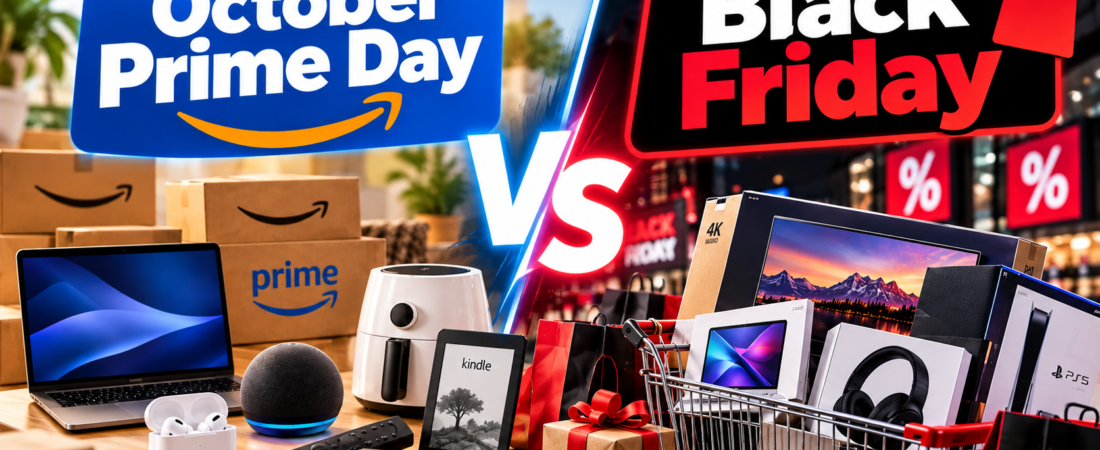
October Prime Day vs Black Friday — should you buy now or wait until November?
The answer depends heavily on what you are buying.
Some products can reach excellent prices during October, while others may benefit from the broader competition and larger selection surrounding Black Friday and Cyber Monday.
Here is how the two shopping events compare.
October Prime Day vs Black Friday at a Glance
| October Prime Day | Black Friday | |
|---|---|---|
| Timing | Early October | Late November |
| Major advantage | Early holiday deals | Huge retailer competition |
| Membership | Many headline Amazon deals require Prime | Generally no membership required |
| Amazon devices | Often particularly attractive | Also frequently discounted |
| TVs | Good deals possible | Often worth comparing with November deals |
| Laptops | Some strong offers | Broader retailer competition |
| Small appliances | Strong category | Strong category |
| Holiday gifts | Buy early and avoid rush | Larger holiday-shopping event |
| Inventory risk | Earlier access | Popular items may sell quickly |
| Best strategy | Buy when price history shows a strong deal | Wait selectively for categories likely to see broader competition |
The biggest mistake is assuming that one sale is automatically cheaper than the other.
Instead, think about the product category, current price, price history, and how much you value waiting.
Why October Prime Day Matters More Than It Used To
October used to be relatively quiet between back-to-school shopping and Black Friday.
That has changed.
Amazon now positions Prime Big Deal Days as a kickoff to the fall and holiday shopping season. Its 2026 event runs October 6–7 and includes deals spanning technology, kitchen products, fashion, beauty, toys, home goods and other categories. Amazon News
And shoppers don’t necessarily have to wait until October 6. Amazon has already begun offering early Prime Big Deal Days promotions ahead of the main event. Amazon News
That means consumers effectively get an early decision point:
Buy in October and finish some holiday shopping early — or wait another six or seven weeks for Black Friday?
Where October Prime Day Can Make Sense
There are several situations where buying during October can be perfectly reasonable.
Amazon Devices
Amazon naturally has strong incentives to discount products within its own ecosystem.
Devices such as Fire TV products, Echo devices, Kindle readers, Ring products and other Amazon hardware frequently become prominent parts of Amazon shopping events.
If an Amazon device you already planned to buy reaches a historically low or near-low price, waiting for Black Friday simply to chase another few dollars may not be worthwhile.
Small Appliances
Coffee makers, air fryers, vacuums, blenders and other small household appliances are heavily represented during major online sales.
Recent early Prime Big Deal Days coverage has already shown substantial discounts across home and appliance products ahead of the October event. Tom’s Guide
These products are especially suitable for price-history shopping.
If the model you want is already at or near its previous low, October may be enough.
Everyday Products
This is an overlooked advantage of October Prime Day.
Black Friday shopping often focuses on major purchases.
October Prime Day can also be useful for things you were going to buy anyway:
- household supplies
- personal-care products
- pet products
- clothing
- kitchen accessories
- seasonal items
Amazon says its 2026 event includes deals across more than 35 categories, with new featured drops arriving throughout the event. Amazon News
A 25% discount on something you genuinely need can be more valuable than a 50% discount on something you never planned to buy.
Where Waiting for Black Friday May Make More Sense
October deals can be excellent, but November has one major structural advantage:
competition.
Black Friday isn’t one retailer’s event.
Amazon, Best Buy, Walmart, Target, manufacturers and many other retailers are competing for the same holiday spending at roughly the same time.
That can matter for expensive electronics.
TVs
October can produce excellent television deals — including some very aggressive early 2026 promotions. Tom’s Guide
But Black Friday has traditionally been one of the most competitive periods for television sales.
The important distinction is model quality.
A huge percentage discount does not automatically mean you’re getting the TV you actually want.
Retailers may promote inexpensive models specifically designed to hit attractive Black Friday price points.
So instead of asking:
“Which sale has the cheapest TV?”
ask:
“What is the lowest price for this exact TV model?”
That’s a much better comparison.
Laptops
Laptops are another category where waiting can be useful.
During Black Friday and Cyber Monday, multiple retailers compete across Windows laptops, gaming machines, Chromebooks and Apple computers.
A recent deals analysis from Tom’s Guide specifically suggests that laptops and TVs are categories where November’s broader Black Friday competition can be advantageous, while Amazon devices and some small appliances can be attractive during Prime Big Deal Days. Tom’s Guide
That doesn’t mean every Black Friday laptop will beat every October deal.
It means you may have more competing options.
Expensive Electronics
The same principle applies to many premium electronics.
Suppose a $1,500 product is discounted to $1,299 in October.
That’s a legitimate $201 saving.
Waiting six weeks in hopes of paying $1,249 might save another $50 — but it could also result in the October deal disappearing.
This is where price history becomes more useful than sale-event names.
Don’t Trust the Percentage Discount Alone
This may be the most important rule of the entire article.
“40% off” does not necessarily mean an exceptional deal.
The meaningful number is the product’s actual selling-price history.
A product advertised as:
$199 → $119
looks dramatically discounted.
But if that product regularly sells for $129 throughout the year, the true opportunity is much smaller than the headline suggests.
Amazon itself now highlights a Price History feature that can show up to 365 days of pricing information on eligible product pages, specifically to help shoppers evaluate whether a deal represents good value. Amazon News
Independent price trackers can provide additional context as well.
The question should always be:
Is this price unusually low for this exact product?
Not:
How large is the discount badge?
October Prime Day Has One Hidden Advantage: Time
Price isn’t the only cost involved in holiday shopping.
There is also:
- time
- stress
- shipping uncertainty
- inventory availability
- last-minute purchasing
Buying several gifts in early October can remove those purchases from your November and December shopping entirely.
That has value.
Imagine an item costs:
$89 during October Prime Day
and later reaches:
$79 on Black Friday.
Technically, waiting saved $10.
But if buying early meant securing the exact color, size or model you wanted and avoiding six weeks of deal monitoring, the $10 difference may not matter much.
The cheapest purchase isn’t always the most convenient purchase.
Black Friday Has Its Own Hidden Advantage: Comparison Shopping
October Prime Day naturally keeps shoppers inside the Amazon ecosystem.
Black Friday is different.
You may see the same product discounted simultaneously at several retailers.
That gives you more opportunities to compare:
- price
- bundles
- store credit
- extended returns
- shipping
- loyalty rewards
- financing offers
Sometimes two stores sell a product for the exact same price, but one includes a gift card or accessory.
The sticker price alone doesn’t capture that difference.
What About Apple Products?
Apple products are interesting because the manufacturer itself usually isn’t the only place worth checking.
Retailers can discount AirPods, Apple Watches, iPads, MacBooks and other Apple hardware during major shopping events.
There are already Apple-related promotions appearing around the early October deal period in 2026. Tom’s Guide
But Black Friday brings more retailers into direct competition.
For expensive Apple products, it can therefore make sense to compare the October price against recent historical lows rather than assuming either October or November will automatically win.
If October already matches a historical low, buying early can be reasonable.
If the discount is modest, waiting may create more choices.
A Better Strategy: Split Your Shopping
You don’t actually need to choose one event.
This is probably the smartest approach.
Buy in October when:
The exact item you already wanted reaches a historically strong price.
This can be particularly attractive for Amazon hardware, household products, smaller appliances and holiday gifts where availability matters.
Consider waiting when:
You’re shopping for expensive TVs, laptops or other major electronics and the October discount isn’t especially compelling.
November’s wider retailer competition gives you another opportunity.
This approach avoids the biggest mistake shoppers make during sale season:
waiting for the sake of waiting.
Should You Buy Now or Wait?
The best way to approach October Prime Day vs Black Friday isn’t to predict which event will have the biggest discount overall.
Instead, decide based on the individual product.
If an item you already planned to buy hits a historically low price during Prime Big Deal Days, buying in October can make sense.
If you’re shopping for an expensive product with only a modest October discount — especially a TV, laptop or premium electronic device — Black Friday may provide more opportunities to compare competing retailers.
Most importantly, don’t let a countdown timer make the decision for you.
Check the exact model.
Check its price history.
Compare other retailers.
Then decide whether the possible savings from waiting are worth another six or seven weeks.
Sometimes the best Black Friday deal is the product you bought in October at an already excellent price.
And sometimes patience really does pay.
Compare with Reason.