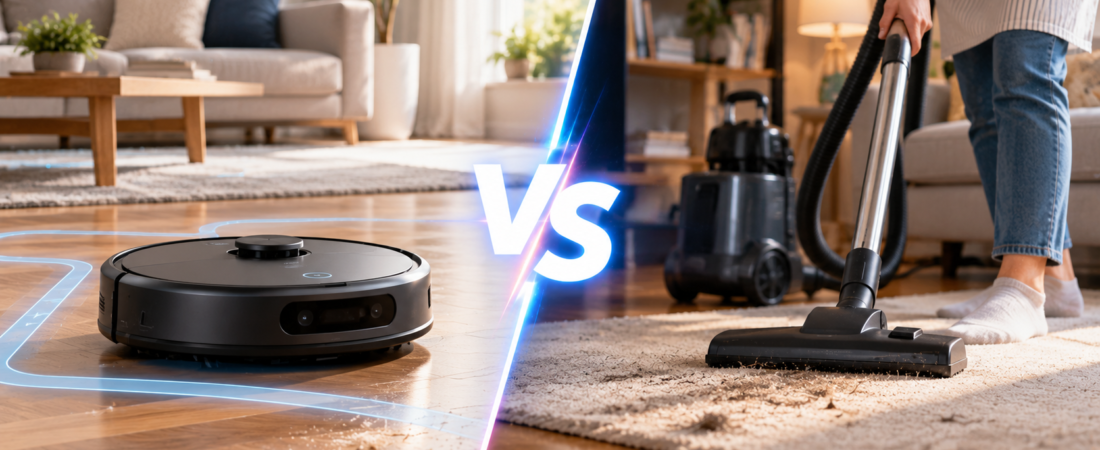
Vacuuming doesn’t seem like a major household task.
Until you count how often you do it.
Twenty minutes here. Forty minutes on the weekend. Another quick cleanup after dinner. A second pass because someone tracked dirt through the house.
Over an entire year, those small cleaning sessions can add up to dozens of hours.
That’s one reason robot vacuums have become so popular.
Instead of waiting until the floor looks dirty, a robot can quietly clean several times a week — or even every day — while you’re doing something else.
But robot vacuums aren’t completely automatic.
They need maintenance. They can miss areas. Stairs still need attention. Corners may require manual cleaning, and somebody occasionally has to rescue the robot from a cable, sock or awkward piece of furniture.
So when comparing a robot vacuum vs weekly house cleaning, the real question isn’t simply which one cleans better.
It’s this:
Which approach actually gives you more of your time back?
Robot Vacuum vs Weekly House Cleaning at a Glance
| Robot Vacuum | Weekly Manual Cleaning | |
|---|---|---|
| Daily effort | Very low | Low between cleanings |
| Weekly active cleaning time | Usually low | Often 30–90+ minutes |
| Floor cleanliness between cleanings | More consistent | Gradually gets dirtier |
| Deep cleaning ability | Moderate | Better |
| Corners and stairs | Limited | Better |
| Under furniture | Often excellent | Depends on access |
| Initial cost | Higher | Lower |
| Ongoing maintenance | Required | Minimal |
| Works while you’re away | Yes | No |
| Best advantage | Saves active time | Better control |
The important distinction is active time.
A robot might spend several hours cleaning your home each week.
But you don’t necessarily spend those hours cleaning.
That changes the calculation.
The Traditional Weekly Cleaning Routine
A common household cleaning pattern is simple.
During the week, dirt accumulates.
Then Saturday or Sunday becomes cleaning day.
You vacuum the floors.
Maybe you mop.
You move chairs.
You clean around furniture.
You reach corners.
And depending on the size of the home, the process can easily take an hour or more.
Suppose vacuuming and basic floor cleaning takes just:
60 minutes per week.
Over one year:
60 minutes × 52 weeks = 52 hours.
That’s more than two full days spent cleaning floors.
Even a relatively efficient 30-minute weekly routine adds up to:
26 hours per year.
This is where robot vacuums become interesting.
They don’t necessarily clean dramatically faster.
They reduce how much of your time the cleaning requires.
How Much Time Does a Robot Vacuum Actually Save?
Imagine a robot vacuum runs four times per week.
Each cleaning cycle takes 90 minutes.
That’s six hours of vacuuming every week.
At first glance, that sounds worse than spending one hour manually vacuuming.
But you’re not pushing the vacuum for those six hours.
The robot is.
Your active involvement might look more like:
- 2 minutes checking the floor before cleaning
- 5 minutes emptying or checking the robot
- 5–10 minutes of maintenance occasionally
- 15–20 minutes manually cleaning missed areas
Instead of spending an hour actively vacuuming, you might spend perhaps 20–30 minutes managing the overall process.
And newer self-emptying robots can reduce that involvement further.
That’s the real value proposition.
A robot vacuum doesn’t eliminate cleaning time.
It transfers much of the work from you to the machine.
The Biggest Advantage of a Robot Vacuum: Frequency
Most people don’t manually vacuum every day.
A robot can.
That changes what “clean” looks like.
Imagine two identical homes.
Home A
Vacuumed manually every Saturday.
Home B
Robot vacuum runs Monday, Wednesday, Friday and Sunday.
Home A may be extremely clean immediately after Saturday’s cleaning.
But by Friday, nearly a week of:
dust,
hair,
crumbs,
pet fur,
and tracked-in dirt
may have accumulated.
Home B may never receive quite the same aggressive manual cleaning.
But it gets cleaned repeatedly.
That can make the floor feel consistently cleaner throughout the week.
Robot Vacuums Are Particularly Good at One Boring Job
They are persistent.
A person sees a small amount of dust under a couch and thinks:
I’ll get it next time.
A robot doesn’t care.
If the robot can physically fit under the couch, it can travel underneath it every time it runs.
Beds, sofas and other low furniture are actually areas where a robot can sometimes have an advantage over manual cleaning.
Not because it has more suction.
Because it goes there repeatedly.
Frequency can compensate for some of the difference in cleaning power.
But a Robot Vacuum Doesn’t Replace House Cleaning
This is where expectations sometimes go wrong.
Buying a robot vacuum does not mean:
You never have to vacuum again.
There are several areas where humans still have an obvious advantage.
Stairs are the easiest example.
Most robot vacuums cannot clean a staircase.
Corners can also be difficult.
Robots usually use small spinning side brushes to move debris toward the main cleaning path, but extremely tight areas may still need attention.
Then there are:
baseboards,
behind doors,
around complicated furniture,
under objects the robot cannot clear,
and places where cables or clutter block access.
A traditional vacuum lets you deliberately target those areas.
A robot follows its navigation system.
Weekly Manual Cleaning Is Better at Deep Cleaning
Suppose someone spills cereal on the floor.
You probably aren’t going to open an app and wait for a robot to navigate across the house.
You’ll grab a vacuum.
The same applies to concentrated dirt.
Manual cleaning lets you see the problem and immediately attack it.
You can:
go over an area multiple times,
use attachments,
move furniture,
vacuum edges,
adjust suction,
and clean exactly where needed.
A robot is designed primarily for maintenance cleaning.
A person is better at problem cleaning.
That’s an important difference.
The Best Comparison May Be Maintenance vs Reset
Think of weekly manual cleaning as a reset.
The floor becomes dirty throughout the week.
Then you reset it to clean.
Robot cleaning works differently.
Instead of allowing the floor to become noticeably dirty, it tries to remove smaller amounts of debris continuously.
That’s closer to maintenance.
The two routines look like this:
Weekly cleaning
Clean → dirtier → dirtier → dirtier → clean again.
Robot cleaning
Clean → slightly dirty → clean → slightly dirty → clean.
Neither system is inherently perfect.
But the experience of living with them can feel very different.
What About Mopping?
This comparison has become more complicated because many modern robot vacuums also mop.
Some models can:
vacuum,
mop,
lift the mop over carpet,
return to a dock,
wash their mop pads,
dry the pads,
and empty their dustbins.
That makes automated floor maintenance much more realistic than it was with early robot vacuums.
But automated mopping has the same limitation as automated vacuuming.
It’s usually strongest as regular maintenance.
If your kitchen floor has dried food stuck to it or something has spilled, manual cleaning may still be faster and more effective.
Again, automation reduces routine work.
It doesn’t eliminate every cleaning job.
The Hidden Time Cost: Preparing for the Robot
There’s one part of robot vacuum ownership people sometimes forget.
The robot needs a reasonably robot-friendly floor.
Before starting a cleaning cycle, you may need to pick up:
charging cables,
small toys,
socks,
lightweight rugs,
pet toys,
or anything else that could become tangled.
Modern robots have improved significantly at recognizing obstacles.
But no obstacle-avoidance system is perfect.
And sometimes the preparation becomes its own cleaning routine.
Ironically, that can have a benefit.
Knowing the robot will run at 10 a.m. may encourage you to keep the floor clear.
Your home becomes easier to clean because you’ve adapted it to automation.
Maintenance Isn’t Zero
A traditional vacuum requires relatively little maintenance.
Empty the bin.
Occasionally clean the filter.
Remove hair from the brush.
A robot vacuum adds more components.
Depending on the model, you may eventually need to maintain or replace:
- Main brushes
- Side brushes
- Filters
- Mop pads
- Dust bags
- Dock components
Hair can wrap around rollers.
Sensors can become dirty.
Wheels can collect debris.
A self-emptying dock reduces daily effort, but it doesn’t make the machine maintenance-free.
So the robot saves cleaning labor while introducing some equipment-management labor.
Let’s Compare a Year of Cleaning Time
Consider a hypothetical household.
Manual cleaning takes:
60 minutes every week.
Annual active cleaning time:
52 hours.
Now suppose the household switches to a robot.
The robot handles routine floor cleaning four times per week.
The owner still spends:
15 minutes per week maintaining the robot
plus:
20 minutes per week manually cleaning missed areas.
That’s:
35 minutes per week.
Over a year:
about 30 hours.
Estimated active time saved:
about 22 hours per year.
That’s nearly three eight-hour workdays.
Now imagine someone previously spent 90 minutes cleaning floors every week.
The potential time savings become much larger.
But if you live in a small apartment that takes only 15 minutes to vacuum manually, the calculation changes dramatically.
Saving 10 minutes isn’t nearly as valuable.
The Size and Layout of Your Home Matter
Robot vacuums make more sense in some homes than others.
A large single-level home with open floors is almost ideal.
The robot can travel freely between rooms and clean a large area without intervention.
A small apartment is different.
If the entire floor can be manually vacuumed in 10 or 15 minutes, setting up and maintaining an expensive robot may not save much time.
A multi-story home creates another challenge.
One robot cannot normally move itself between floors.
You may need to:
carry it upstairs,
buy another robot,
or continue manually cleaning another level.
So square footage alone doesn’t determine usefulness.
Layout matters.
Pets Can Change the Equation Completely
For households with shedding pets, weekly cleaning can feel inadequate.
A dog or cat doesn’t wait until Saturday to shed.
Hair accumulates every day.
This is one of the strongest use cases for frequent automated cleaning.
Instead of removing a week’s worth of pet hair at once, the robot collects smaller amounts throughout the week.
That can prevent visible piles from accumulating.
However, pet households also create more maintenance.
Hair can become tangled around brushes, and pet toys create additional obstacles.
So pets increase both the value of automation and the maintenance burden.
What About Electricity?
A robot vacuum obviously consumes electricity while it cleans and charges.
But electricity generally isn’t the major economic issue in this comparison.
The bigger cost is the machine itself.
A traditional vacuum may last many years.
Robot vacuums add:
batteries,
navigation hardware,
sensors,
motors,
software,
and potentially sophisticated cleaning docks.
That makes the upfront cost significantly higher.
A premium robot could cost hundreds of dollars more than a basic vacuum.
So if your only goal is:
spend the least money possible cleaning the floor,
manual vacuuming is difficult to beat.
The argument for a robot is primarily about time and convenience, not simply financial savings.
The $500 Robot Vacuum Question
Suppose a robot vacuum costs $500.
And suppose it saves you 25 hours of active cleaning during its first year.
You’re effectively spending:
$20 for each hour of your time saved in year one.
If the robot continues working for several years, that number drops substantially.
After three years:
75 hours saved.
Ignoring maintenance and replacement costs:
about $6.67 per hour saved.
Whether that’s worthwhile is personal.
For someone who hates vacuuming, it might be an easy decision.
For someone who doesn’t mind spending 30 minutes cleaning on Sunday, it may not be.
This is why comparing robot vacuums only by suction power misses the bigger point.
You’re partly buying time.
There’s Also a Mental Benefit
Household chores consume more than physical time.
They occupy mental space.
You notice the floor is dirty.
You think:
I need to vacuum.
You postpone it.
Then you think about it again.
Automation can remove some of that recurring decision-making.
Instead of deciding when to clean, you create a schedule once.
Monday, Wednesday, Friday.
10 a.m.
The robot runs.
That’s a small example of something increasingly common in smart homes:
automation isn’t just about saving minutes.
It’s about removing repetitive tasks from your attention.
Which Cleans Better?
For one thorough cleaning session?
A person with a good vacuum usually has the advantage.
You can identify dirt, move obstacles and spend additional time on problem areas.
But that’s not necessarily the most useful comparison.
Consider:
one thorough manual cleaning per week
versus
four automated maintenance cleanings per week.
Now the answer becomes less obvious.
The manual session may clean more thoroughly.
The robot may keep the floor cleaner on average throughout the week.
Those are different measures of cleanliness.
The Hybrid Approach May Make the Most Sense
There’s a third option that doesn’t fit neatly into robot vs manual cleaning.
Use both.
Let the robot handle routine maintenance during the week.
Then manually vacuum:
stairs,
corners,
edges,
and difficult areas
every week or two.
Instead of spending an hour cleaning the entire floor, perhaps you spend 15 or 20 minutes finishing what the robot can’t.
That’s probably the most realistic way to think about robot vacuums.
They aren’t necessarily replacements for vacuum cleaners.
They’re replacements for a large portion of vacuuming.
Robot Vacuum vs Weekly House Cleaning: Which Saves More Time?
For many households, the robot vacuum wins on active time saved.
Not because it cleans faster.
Because it cleans without requiring you to stand behind it.
The advantage becomes larger when:
your home has substantial floor space,
you have pets,
you prefer frequent cleaning,
your layout is robot-friendly,
or you simply dislike vacuuming.
Manual weekly cleaning still has important advantages.
It costs less to get started, handles difficult areas better and gives you complete control over the result.
And for a small home, manual vacuuming may already be so quick that automation doesn’t change much.
But the biggest mistake is expecting a robot vacuum to eliminate cleaning entirely.
The more realistic expectation is better:
Let the robot handle the repetitive 80% so you can spend your time on the remaining 20%.
If that turns an hour-long weekly chore into a short cleanup, the machine isn’t really selling you cleaner floors.
It’s selling you something harder to replace.
Your time.
Compare with Reason.