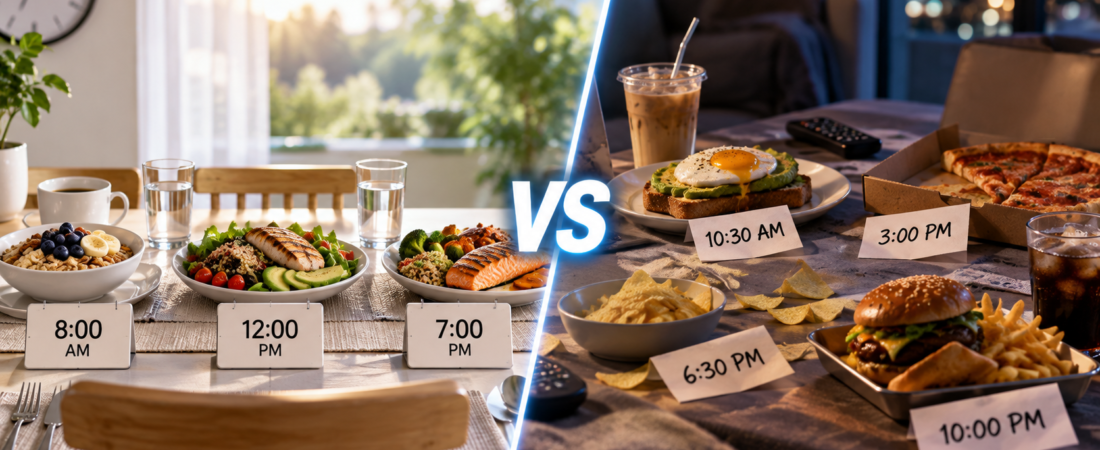
Most nutrition advice focuses on what you eat.
Eat more vegetables.
Get enough protein.
Limit highly processed foods.
Watch portion sizes.
But researchers are increasingly asking another question:
Does it matter when you eat?
Consider two people who eat roughly the same amount of food and have similar diets.
One eats breakfast around 8 a.m., lunch around noon, and dinner around 7 p.m. most days.
The other might eat breakfast at 7 a.m. on Monday, skip it Tuesday, have brunch at 11 a.m. Saturday, eat dinner at 6 p.m. one night, and order food at 10 p.m. the next.
The calories might be similar.
The foods might even be similar.
But the timing is completely different.
Recent research suggests that our bodies may notice that difference.
So which approach makes more sense?
Eating at roughly the same time every day?
Or simply eating whenever your schedule — and hunger — tells you to?
Let’s compare.
Quick Comparison
| Consistent Meal Times | Eat Whenever You Want | |
|---|---|---|
| Convenience | Moderate | Excellent |
| Fits Busy Schedules | Less Flexible | Excellent |
| Circadian Consistency | Better | More Variable |
| Hunger Predictability | Often Better | Can Vary |
| Weekend Freedom | Lower | Higher |
| Social Flexibility | Lower | Better |
| Heart-Health Evidence | Promising, not conclusive | Less favorable in some observational research |
| Weight Control | May Help Some People | Depends More on Overall Intake |
| Sustainability | Depends on Lifestyle | Easy for Many |
| Best Approach | Consistent but Flexible | Avoid Extreme Irregularity |
The key word here is not necessarily early.
It’s consistent.
What Is “Eating Jetlag”?
Most people understand jet lag.
You fly across several time zones, but your body’s internal clock hasn’t caught up.
Researchers have begun using a similar concept for eating patterns:
Eating jetlag.
It describes differences between when someone eats on workdays and when they eat on weekends or days off.
For example:
Weekdays
First meal: 7:30 a.m.
Last meal: 7:00 p.m.
Weekend
First meal: 11:00 a.m.
Last meal: 10:30 p.m.
Your location hasn’t changed.
But your eating schedule has shifted several hours.
A 2026 prospective study using the French NutriNet-Santé cohort examined this phenomenon in 104,806 adults. Researchers calculated eating jetlag using differences in the timing of participants’ first and last caloric intake between weekdays and weekends.
During a median follow-up of 8.1 years, greater eating-time differences were associated with higher cardiovascular and coronary-heart-disease risk specifically among male participants. The researchers did not detect the same association among women.
That’s interesting.
But it doesn’t mean irregular meals cause heart disease.
We’ll come back to that.
Round 1: Convenience
Winner: Eating Whenever You Want
Modern life doesn’t run on a perfect schedule.
Work meetings move.
Kids have activities.
Flights get delayed.
Restaurants get busy.
Friends invite you to dinner.
Sometimes you’re hungry at noon.
Sometimes you’re not.
Eating whenever you want gives you maximum flexibility.
There’s also something appealing about simply listening to hunger cues rather than watching the clock.
If your family wants dinner at 8:30 instead of 7:00, nothing is ruined.
If you sleep late Sunday morning, you don’t need to wake up just because your breakfast schedule says 8:00.
From a lifestyle standpoint, flexibility wins easily.
Winner: Eating Whenever You Want
Round 2: Circadian Rhythm
Winner: Consistent Meal Times
Our bodies operate on biological rhythms.
Sleep is the most obvious example.
But food also interacts with the body’s internal timing systems.
The 2026 NutriNet-Santé researchers noted that food intake can act as a timing signal for internal clocks involved in metabolic regulation.
That doesn’t mean your body requires lunch at exactly 12:03 every afternoon.
But constantly moving meals several hours forward and backward may create another source of circadian irregularity.
Think of consistency as a signal:
Morning arrives.
You wake.
You become active.
You eat.
Evening arrives.
Activity slows.
Eating stops.
Sleep begins.
A reasonably stable pattern gives the body repeated cues.
Winner: Consistent Meal Times
Round 3: Heart Health
Winner: Consistent Meal Times — Based on Emerging Evidence
This is where the recent research becomes especially interesting.
The NutriNet-Santé study included 104,806 adults, 79% of whom were women, with an average baseline age of about 43. Participants were followed for a median of 8.1 years.
Among men, each additional hour of eating-jetlag intensity was associated with a 14% higher relative risk of cardiovascular disease and a 21% higher relative risk of coronary heart disease in the primary adjusted model.
But there are two very important qualifications.
First:
Those associations were specific to male participants.
Researchers did not observe corresponding significant associations in women.
Second:
This was an observational cohort study.
It can identify associations.
It cannot prove that changing meal times caused cardiovascular disease.
People with irregular eating schedules may differ in many other ways from people with regular schedules.
The researchers adjusted for numerous factors, including diet quality and sleep-related variables, but residual confounding is always possible.
So the responsible conclusion is:
Consistent meal timing may be associated with cardiovascular benefits, but we don’t yet know that it directly prevents heart disease.
Winner: Consistent Meal Times — with an asterisk
Round 4: Weight Control
Winner: Tie
This one is easy to oversimplify.
You might hear:
“Eating late makes you fat.”
Or:
“Never eat after 7 p.m.”
Nutrition doesn’t work that simply.
Total energy intake, food quality, physical activity, sleep, metabolism, medications, and many other factors can influence body weight.
Meal timing may matter too, but it isn’t a magic switch.
A review of randomized trials cited by the 2026 researchers found that approaches such as time-restricted eating, reduced meal frequency, and shifting more calories earlier in the day may produce modest weight reductions, but the researchers noted substantial variation between studies and uncertainty about the clinical importance of those effects.
So if one person eats consistently at 8, 12 and 7 but consumes substantially more energy than needed, the clock isn’t going to rescue the diet.
Likewise, someone with a somewhat flexible eating schedule can still maintain a healthy weight.
Winner: Tie
Round 5: Hunger and Snacking
Winner: Consistent Meal Times — Slightly
Many people find that a predictable meal routine makes hunger easier to manage.
If you know lunch is usually around noon, you may be less likely to arrive at 3 p.m. starving and grab whatever is available.
Regular meals can create structure.
And structure can make food decisions easier.
But this varies enormously from person to person.
Some people naturally prefer two larger meals.
Others function better with three meals.
Some like breakfast.
Others genuinely aren’t hungry in the morning.
The important point isn’t that everyone needs the same schedule.
It’s that your own pattern can be relatively predictable.
Winner: Consistent Meal Times — slightly
Round 6: Weekends
Winner: Eating Whenever You Want
Saturday morning is where perfect nutrition schedules go to die.
You sleep later.
Breakfast becomes brunch.
Lunch disappears.
Dinner moves later because you’re meeting friends.
That’s normal life.
And enjoying a late Saturday dinner isn’t something most healthy people need to fear.
The interesting question is whether large, repeated shifts every weekend matter over many years.
In the recent study, about 71% of participants maintained similar eating rhythms between weekdays and weekends, while roughly 24% shifted their eating later on weekends.
The study suggests regularity deserves further investigation.
It does not suggest that one late brunch damages your heart.
Winner: Eating Whenever You Want
Round 7: Social Life
Winner: Eating Whenever You Want
Food isn’t merely nutrition.
It’s social.
Birthdays.
Vacations.
Dinner with friends.
Holiday meals.
Date nights.
Family gatherings.
Trying to maintain an exact eating schedule can become counterproductive if it makes normal life unnecessarily stressful.
Imagine telling friends:
“I can’t eat with you because my dinner time is 6:30.”
For most people, that’s unnecessary.
Healthy routines should support life.
Life shouldn’t exist to support the routine.
Winner: Eating Whenever You Want
Round 8: Long-Term Routine
Winner: Consistent Meal Times
Here’s where consistency becomes attractive again.
Healthy habits are easier when they require fewer daily decisions.
You don’t debate every night when to sleep.
You develop a general bedtime.
You don’t decide every morning whether to brush your teeth.
You simply do it.
Meals can work similarly.
A loose structure like:
Breakfast: 7–9 a.m.
Lunch: 12–2 p.m.
Dinner: 6–8 p.m.
can be easier to maintain than completely unpredictable eating.
Notice those are windows, not exact times.
That’s probably a more realistic interpretation of meal consistency for everyday life.
Winner: Consistent Meal Times
Does Eating Earlier Matter Too?
Consistency isn’t the only question researchers are studying.
Timing itself may matter.
Another 2026 cohort study analyzed 31,044 U.S. adults aged 40 and older using NHANES data and examined associations between first and last meal timing and mortality.
Later first meals and very late last meals were associated with higher mortality risks in that analysis. For example, compared with a first meal between 7 and 8 a.m., progressively later first meals were associated with higher all-cause mortality. Eating the last meal after midnight was also associated with higher mortality compared with a 7–8 p.m. reference period.
Again:
Association is not causation.
These findings do not prove that moving breakfast earlier will make someone live longer.
People who eat very late may differ in work schedules, health, sleep, socioeconomic factors, lifestyle, or many other characteristics.
But when combined with growing research on circadian biology, meal timing is becoming an interesting area of nutrition research.
What About Intermittent Fasting?
This is where people often confuse two different ideas.
Meal consistency asks:
Do you eat at roughly similar times from day to day?
Intermittent fasting or time-restricted eating asks:
How many hours of the day do you eat?
Those aren’t the same thing.
You could eat within an eight-hour window but move that window dramatically every day.
Monday:
8 a.m.–4 p.m.
Tuesday:
1 p.m.–9 p.m.
Saturday:
3 p.m.–11 p.m.
That’s time-restricted eating — but not consistent timing.
Or you could eat over 12 hours every day at nearly identical times.
That’s consistent — but not time-restricted.
So this comparison isn’t really about fasting.
It’s about regularity.
You Probably Don’t Need to Eat by the Clock
This is important.
None of this means you need alarms telling you:
12:00 — EAT LUNCH NOW.
Human biology isn’t a train schedule.
If you’re not hungry, waiting is reasonable.
If you’re hungry earlier, eating earlier can be reasonable.
If dinner moves an hour because of your schedule, that’s normal.
The potentially interesting issue is chronic large shifts, not minor daily variation.
A practical goal might simply be:
Keep most meals in roughly the same part of the day.
Not:
Eat every meal at exactly the same minute.
A Better Middle Ground
The comparison doesn’t need to end with rigid scheduling versus total freedom.
There’s a much more realistic option:
Consistent flexibility.
For example:
Weekday breakfast: 7:30 a.m.
Weekend breakfast: 8:30 or 9:00 a.m.
That’s still flexible.
Compare it with:
Weekday breakfast: 7:00 a.m.
Weekend first meal: 1:00 p.m.
That’s a much larger shift.
The same principle applies to dinner.
You don’t need perfect consistency.
Just avoid turning every weekend into a completely different time zone for your body.
Our Pick: Consistent Meal Times — Without Being Obsessive
For most people, our pick is Consistent Meal Times.
Not because everyone should eat breakfast at 8 a.m.
Not because eating dinner late once is dangerous.
And definitely not because current research proves that an irregular schedule causes heart disease.
It doesn’t.
Instead, the emerging evidence suggests that regularity may be another useful piece of the health puzzle, alongside diet quality, exercise, sleep, smoking, alcohol use, and other established factors. The strongest recent eating-jetlag findings were observed specifically in men and still need confirmation in other populations.
So don’t obsess over the clock.
Don’t skip dinner with friends because it’s an hour later than usual.
And don’t assume that perfectly timed meals can compensate for a poor diet.
Instead, aim for a pattern your body — and your life — can recognize.
Same general times.
Good food.
Enough flexibility to enjoy life.
That may be the better balance.
Compare with Reason.