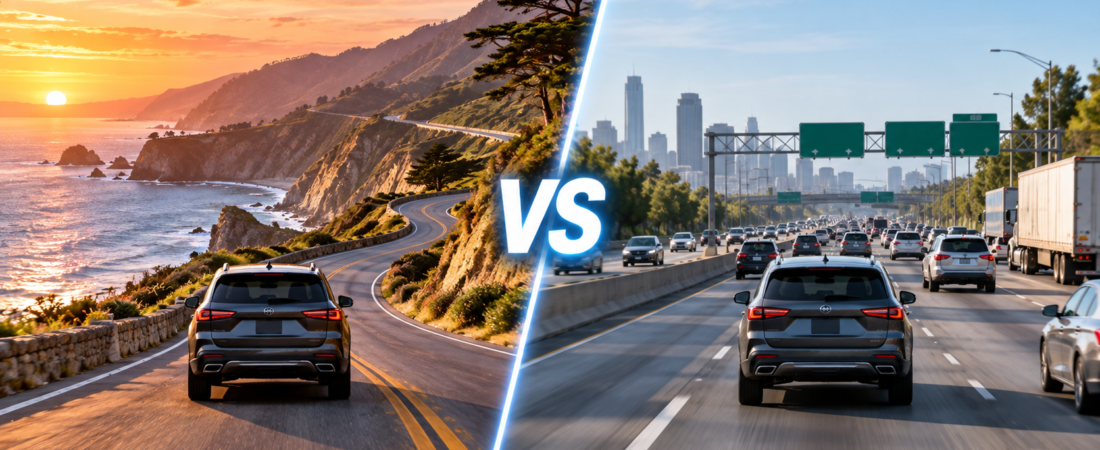
Open a navigation app and enter a destination.
Within seconds, it gives you an answer:
Fastest route: 4 hours 12 minutes.
Another route might take 4 hours 48 minutes.
Maybe there’s even a third option that winds through mountains, follows a coastline, passes small towns, or avoids the interstate entirely.
Most of us choose the first one.
Why wouldn’t we?
Forty minutes saved is forty minutes gained.
Or is it?
Modern navigation has made road travel incredibly efficient. We can avoid traffic, predict arrival times, find gas stations, reroute around accidents, and travel hundreds of miles with almost no uncertainty.
But something may have been lost along the way.
The traditional American road trip wasn’t always about reaching the destination as quickly as possible.
Sometimes the road was part of the destination.
So when you’re planning your next drive, which is actually better?
The scenic route or the fastest route?
Let’s compare.
Quick Comparison
| Scenic Route | Fastest Route | |
|---|---|---|
| Travel Time | Longer | Shorter |
| Fuel Efficiency | Usually Lower | Usually Better |
| Scenery | Excellent | Depends |
| Small Towns | More | Fewer |
| Restaurants & Local Stops | More Interesting | More Predictable |
| Stress | Can Be Lower | Can Be Higher in Traffic |
| Navigation | Requires More Planning | Easy |
| Family Convenience | Depends | Usually Better |
| Road Trip Experience | Excellent | Functional |
| Best For | Leisure Travel | Getting Somewhere |
The difference comes down to one question:
Are you driving to the trip, or is the drive part of the trip?
Round 1: Time
Winner: Fastest Route
No debate here.
If you need to arrive by 3 p.m., the scenic route isn’t automatically better simply because it’s prettier.
Navigation apps are exceptionally good at optimizing travel time.
They account for:
Traffic.
Construction.
Accidents.
Road closures.
Speed limits.
Alternative routes.
When you’re driving to catch a flight, attend a meeting, reach a hotel before check-in closes, or get home after a long trip, efficiency matters.
Sometimes a road is transportation.
It doesn’t need to become an adventure.
Winner: Fastest Route
Round 2: The Actual Experience
Winner: Scenic Route
Interstate highways are extremely good at one thing:
Moving large numbers of vehicles efficiently.
They’re not always particularly memorable.
Drive hundreds of miles and much of the experience can become:
Highway.
Exit.
Gas station.
Fast food.
Highway.
Rest area.
Highway again.
A scenic route changes the rhythm.
You might drive through:
Small towns.
Mountains.
Forests.
Farmland.
Historic districts.
Coastal roads.
Lakes.
Local neighborhoods.
Suddenly you’re seeing the place you’re traveling through instead of bypassing it.
Winner: Scenic Route
Round 3: Stress
Winner: Scenic Route — Sometimes
This sounds counterintuitive.
A longer trip should be more stressful, right?
Not necessarily.
Imagine two options.
Route A
Three hours on a crowded interstate.
Multiple lanes.
Heavy trucks.
Constant merging.
Stop-and-go traffic.
Aggressive drivers.
Route B
Three hours and forty minutes on a quieter two-lane road through the countryside.
Which feels longer?
For some drivers, Route B may actually feel easier.
Time isn’t the only form of travel cost.
Mental fatigue matters too.
That said, scenic roads can introduce their own challenges: sharp curves, mountain grades, poor lighting, wildlife, limited services, or difficult weather.
So this isn’t universal.
But when conditions are good, a slightly longer quiet drive can sometimes feel considerably less exhausting than a shorter congested one.
Winner: Scenic Route — depending on the road
Round 4: Fuel and Cost
Winner: Fastest Route
Usually.
Highway driving at relatively steady speeds is often more fuel-efficient than repeatedly accelerating, braking, climbing hills, and traveling through towns.
The scenic route may also simply be longer.
More miles generally means:
More fuel.
More charging.
More vehicle wear.
Potentially more toll alternatives — although avoiding toll roads can occasionally make the slower route cheaper.
For EV drivers, the calculation becomes even more interesting.
The fastest route may have reliable fast-charging infrastructure.
A remote scenic road may not.
Navigation isn’t only about minutes anymore.
It can also be about energy availability.
Winner: Fastest Route
Round 5: Food
Winner: Scenic Route
This one isn’t close.
Highway travel makes eating incredibly predictable.
You know what you’re going to find near an exit:
Fast-food chains.
Gas stations.
Coffee chains.
Convenience stores.
That’s useful.
But memorable?
Usually not.
Take an older road through towns and suddenly you might find:
A family-owned diner.
A roadside barbecue stand.
A bakery.
A farm market.
A small coffee shop.
A restaurant that’s been serving the same local specialty for decades.
The fastest route optimizes arrival time.
The scenic route gives you reasons to stop.
Winner: Scenic Route
Round 6: Traveling With Kids
Winner: Fastest Route
This category changes quickly when children are involved.
Adults might appreciate:
“Look at that beautiful mountain!”
A child in the back seat may respond:
“How much longer?”
Every additional hour can mean another hour of:
Bathroom stops.
Snacks.
Questions.
Arguments.
Screen time.
Restlessness.
For families with young children, predictable highways can also make bathrooms, food, gas, and emergency stops easier.
Sometimes the best family road trip is simply the one that ends sooner.
Winner: Fastest Route
Round 7: Discovering Something Unexpected
Winner: Scenic Route
Navigation has removed much of the uncertainty from travel.
That’s mostly good.
But uncertainty used to create discovery.
You’d see a sign:
Scenic Overlook — 2 Miles
And stop.
Or drive through a town you had never heard of.
Or notice a restaurant with a full parking lot and decide to try it.
Or find a lake, antique store, hiking trail, farm stand, or historic building that wasn’t part of the plan.
Those moments rarely appear on an itinerary.
But they often become the part of the trip people remember.
Winner: Scenic Route
Round 8: Reliability
Winner: Fastest Route
There’s a reason major highways exist.
They’re generally easier to navigate and better supported.
Services are frequent.
Cellular coverage is often better.
Fuel is easier to find.
Road conditions may be more predictable.
If something goes wrong, assistance may be closer.
A scenic road can be spectacular during the day and uncomfortable after dark.
Mountain roads can change dramatically with weather.
Remote roads may have long distances between services.
A beautiful route isn’t automatically the safest or smartest route under every condition.
Winner: Fastest Route
Round 9: Photography
Winner: Scenic Route
There’s only so much excitement you can photograph from an interstate rest stop.
Scenic roads naturally create opportunities for:
Landscape photography.
Family pictures.
Sunsets.
Mountain overlooks.
Historic towns.
Ocean views.
Interesting architecture.
Wildlife.
Even the car itself can become part of the experience.
For travelers who enjoy documenting trips, this difference matters.
The fastest route gives you an arrival photo.
The scenic route gives you a story.
Winner: Scenic Route
Round 10: Short Trips
Winner: Scenic Route
Here’s where scenic routes become particularly attractive.
Suppose the fastest drive is:
2 hours 30 minutes
and the scenic route is:
3 hours 5 minutes.
Thirty-five extra minutes isn’t much.
If those 35 minutes transform the trip from monotonous highway driving into a beautiful road through mountains or along the coast, that’s often an easy trade.
Now change the numbers:
Fastest route:
7 hours
Scenic route:
10 hours
That’s a different decision.
The value of scenery decreases as the time penalty becomes extreme.
So the real question isn’t:
Scenic or fast?
It’s:
How much extra time does scenic cost?
The 20% Rule
Here’s a simple strategy.
If the scenic route adds roughly 20% or less to your drive, seriously consider it when you’re traveling for leisure.
For example:
Fastest: 2 hours
Scenic: 2 hours 20 minutes
Take the scenic route.
Fastest: 4 hours
Scenic: 4 hours 45 minutes
Still worth considering.
Fastest: 6 hours
Scenic: 9 hours
Now the extra time may require treating the scenic route as a separate travel day.
This isn’t a scientific rule.
It’s simply a useful way to think about the tradeoff.
Navigation Apps Have Changed How We See Roads
Before GPS navigation, drivers often thought geographically.
You knew:
Which highway went north.
Which road followed the coast.
Which towns were along the way.
Which mountain pass you were crossing.
Navigation apps changed that.
Now many drivers follow:
Turn left in 800 feet.
Then:
Continue for 17 miles.
Then:
Take Exit 23.
We arrive efficiently without necessarily understanding where we traveled.
That’s incredibly convenient.
But it can also turn the landscape into something happening outside the windshield while we follow a blue line.
The Better Strategy: Fast One Way, Scenic the Other
There is a surprisingly simple solution.
You don’t always have to choose.
Suppose you’re driving somewhere for a weekend.
Friday
Leave after work.
Take the fastest route.
Arrive at the hotel.
Eat dinner.
Relax.
Sunday
You’re not rushing.
Take the scenic route home.
Stop for lunch.
Visit a small town.
Find an overlook.
Turn the return drive into another part of the vacation.
This gives you the best of both worlds.
Efficiency when you need it.
Experience when you have time.
What About EVs?
Electric vehicles add another dimension.
The fastest route isn’t always simply the shortest route.
Charging matters.
A slightly longer highway route with several reliable high-speed chargers may actually be faster overall than a remote scenic route with limited charging options.
On the other hand, slower roads can sometimes improve EV efficiency because aerodynamic drag increases substantially at higher speeds.
So EV road trips require thinking about:
Distance.
Speed.
Elevation.
Weather.
Charger availability.
Charging speed.
Battery level.
The best route may not be the one with the fewest miles.
It’s the one that gets you and the battery there comfortably.
When You Should Definitely Take the Fastest Route
Choose efficiency when:
You have a flight.
You’re traveling for work.
You’re arriving late.
Weather is deteriorating.
You’re exhausted.
Children have already had enough.
You’re driving at night.
Charging or fuel availability is uncertain.
You simply want to get home.
There’s nothing wrong with using a road as transportation.
That’s what roads are for.
When You Should Take the Scenic Route
Consider slowing down when:
You’re on vacation.
The weather is beautiful.
The extra time is modest.
You’re traveling somewhere new.
There’s a famous scenic road nearby.
You enjoy photography.
You want to explore small towns.
You’re not operating on a strict schedule.
Or simply:
You have nowhere you urgently need to be.
That’s a luxury worth using.
Our Pick: Scenic Route — When the Drive Is Part of the Trip
For leisure travel, our pick is the Scenic Route.
Not every time.
Not when it adds hours.
And definitely not when weather, darkness, fatigue, or safety makes the faster road the better choice.
But modern life is already optimized for speed.
We order food faster.
Communicate faster.
Shop faster.
Search faster.
Travel faster.
Road trips offer one of the rare opportunities where taking longer can actually be part of the point.
The fastest route answers:
“How quickly can I get there?”
The scenic route asks:
“What might I see along the way?”
If you’re commuting, choose the first question.
If you’re traveling for pleasure, occasionally choose the second.
Because sometimes the best part of a road trip isn’t where you stop.
It’s everything you passed before you got there.
Compare with Reason.