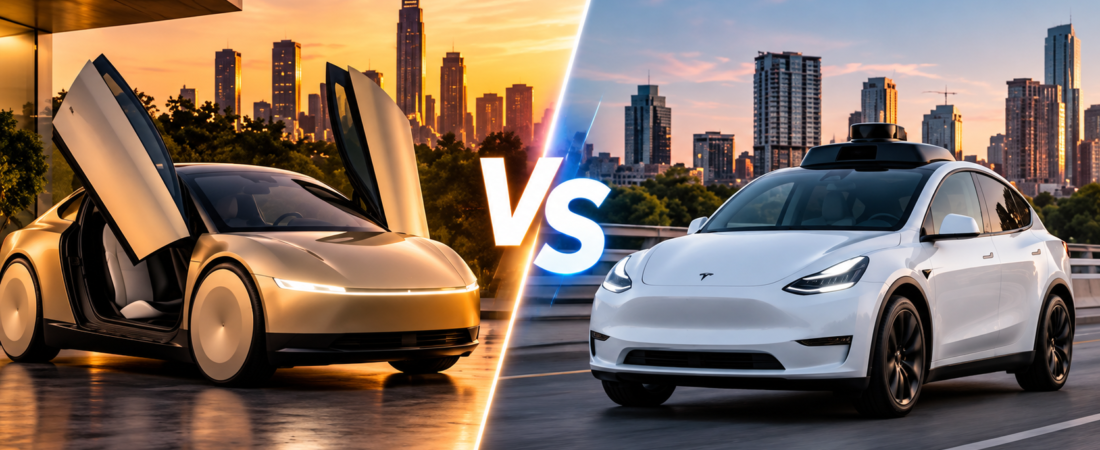
Tesla Cybercab vs Model Y is becoming an important comparison as Tesla expands its Robotaxi service.
Tesla’s Robotaxi service is entering a new phase.
Until recently, Tesla’s autonomous ride-hailing service relied primarily on the familiar Model Y. But Tesla has now begun putting its purpose-built Cybercab into service, giving riders a very different vision of what a robotaxi can be.
The two vehicles may use the same Robotaxi network, but they take very different approaches.
The Model Y Robotaxi is based on a conventional passenger SUV and can transport up to four passengers.
The Cybercab, meanwhile, was designed specifically for autonomous transportation. It seats only two people and has no steering wheel, accelerator pedal, or brake pedal.
So which one actually makes the better robotaxi?
The answer depends on whether you value futuristic design and purpose-built autonomy—or everyday practicality.
Quick Comparison
| Tesla Cybercab | Model Y Robotaxi | |
|---|---|---|
| Passenger Capacity | 2 | Up to 4 |
| Purpose-Built Robotaxi | ★★★★★ | ★★★☆☆ |
| Passenger Space | ★★★★☆ | ★★★★★ |
| Cargo Practicality | ★★★★☆ | ★★★★★ |
| Futuristic Experience | ★★★★★ | ★★★☆☆ |
| Family/Group Use | ★★☆☆☆ | ★★★★★ |
| Conventional Controls | None | Yes |
| Overall Practicality | ★★★★☆ | ★★★★★ |
Tesla itself describes Cybercab as a two-passenger autonomous vehicle, while its Robotaxi Model Y can transport up to four passengers and their gear.
When comparing Tesla Cybercab vs Model Y, the biggest difference is their purpose: one was designed specifically for autonomy, while the other began as a conventional passenger vehicle.
Cybercab: A Car Designed Around Autonomy
The biggest difference between the two vehicles is not simply their appearance.
It is their purpose.
The Model Y was originally designed as a conventional passenger vehicle and later adapted for Tesla’s Robotaxi service.
Cybercab starts with a completely different idea:
What if a car never needed a human driver at all?
That changes the interior dramatically.
There is no steering wheel.
There are no accelerator or brake pedals.
Instead, both occupants are simply passengers.
Cybercab uses two seats, a large central touchscreen, and Tesla’s autonomous-driving technology to create an experience designed around riding rather than driving.
Cybercab Wins the Futuristic Experience
If you order a Robotaxi because you want to experience the future of transportation, Cybercab is clearly the more interesting vehicle.
Even getting into one feels different.
Its distinctive butterfly-style doors can open automatically, and the ride is controlled through the touchscreen and Robotaxi app. Once the passengers are seated, buckled in, and the doors are closed, the ride can be started from the touchscreen.
There is no empty driver’s seat with a steering wheel sitting in front of it.
The entire cabin communicates one idea:
Nobody is supposed to drive this car.
That makes Cybercab feel less like a self-driving version of an existing vehicle and more like a completely new transportation product.
But Two Seats Are a Major Limitation
Cybercab’s biggest weakness is equally obvious.
It only carries two passengers.
For a single commuter or a couple going to dinner, that may be perfectly adequate.
But imagine a family of four heading to the airport.
Cybercab immediately becomes impractical.
The Model Y Robotaxi can transport up to four passengers, giving it a significant advantage for families, friends traveling together, and other small groups.
This may be the most important real-world difference between the two.
A futuristic vehicle isn’t necessarily the more useful vehicle.
What About Luggage?
Cybercab is surprisingly practical for a two-seater.
Tesla says its trunk provides 20.2 cubic feet of cargo space, with enough room for two standard checked suitcases and two carry-on bags. Tesla also specifically lists items such as golf clubs and scooters among the things its trunk can accommodate.
That makes it much more useful for airport trips and everyday errands than its small two-seat cabin might suggest.
But the Model Y remains the more flexible vehicle overall.
Its larger passenger layout makes it better suited to situations where you need to carry both people and their belongings.
Model Y Robotaxi: Familiarity Is an Advantage
Cybercab gets most of the attention because it looks new.
But there is something appealing about the Model Y Robotaxi being relatively ordinary.
Millions of people already understand what a Model Y is.
It looks like a normal SUV.
It has conventional seating and familiar doors, and there is more room for passengers.
For someone using autonomous transportation for the first time, that familiarity could actually be reassuring.
The strange part is not the car.
It is simply that the car is driving itself.
Model Y Is the Better Choice for Groups
This category isn’t particularly close.
🏆 Winner: Model Y Robotaxi
If you’re traveling alone:
Either vehicle works.
If you’re traveling as a couple:
Cybercab may actually be the more interesting experience.
But once you have three or four passengers, Model Y becomes the obvious choice.
That additional capacity could make the Model Y particularly useful for:
- families
- airport trips
- groups of friends
- passengers carrying additional gear
In everyday ride-hailing, flexibility matters.
Cybercab Is the Better Dedicated Robotaxi
Now reverse the question.
Instead of asking which vehicle is more practical for passengers, ask:
Which vehicle better represents the idea of a true robotaxi?
Here, Cybercab wins easily.
🏆 Winner: Cybercab
It wasn’t designed around the possibility that a human might occasionally drive.
The absence of a steering wheel and pedals fundamentally changes the vehicle.
Every major part of the passenger experience can therefore be designed around autonomous transportation.
That is ultimately what makes Cybercab so significant.
Can You Choose Which One Picks You Up?
Not necessarily.
Tesla currently says that the Robotaxi vehicle assigned to a ride is based on vehicle availability and the number of people in the group.
So even though we’re comparing Cybercab and Model Y, riders shouldn’t assume they’ll always be able to select one or the other when requesting a trip.
That may change as the fleet grows.
Where Can You Actually Ride a Cybercab?
This is another major difference—at least for now.
Tesla currently operates Robotaxi service with Model Y vehicles in several U.S. cities, while Cybercab rides are limited to certain areas of Austin, Texas.
Cybercab only entered public service in Austin in early September 2026.
So today, Model Y remains the much more established vehicle in Tesla’s Robotaxi network.
Tesla, however, has said that it expects Cybercab to eventually become the primary high-volume vehicle in the fleet.
There Is Still a Big Question: Regulation
Cybercab’s most futuristic feature also creates its biggest challenge.
A vehicle without conventional driver controls does not fit neatly into safety regulations originally written for human-driven cars.
Following the Cybercab rollout, the National Highway Traffic Safety Administration opened an investigation into Tesla’s certification of the vehicles and how they comply with federal motor-vehicle safety standards.
That means Cybercab may represent Tesla’s future, but its path toward large-scale deployment is not yet completely settled.
The Model Y has a simpler advantage here: it retains conventional vehicle controls.
Which Would You Rather Get When You Order a Robotaxi?
This is where the comparison gets interesting.
If I were traveling alone or with one other person, I would want the Cybercab.
Why?
Because if I’m ordering a fully autonomous taxi, I want to experience a vehicle actually designed around autonomy.
But if I’m traveling with family, carrying lots of gear, or simply want more flexibility, I would rather have the Model Y Robotaxi.
That leads to an unusual verdict.
Neither vehicle completely replaces the other—at least not yet.
The Verdict: Model Y Wins Today, Cybercab May Win Tomorrow
🏆 Overall Winner Today: Model Y Robotaxi
The Model Y wins this comparison because it is simply more practical.
It carries more passengers, works for a wider variety of trips, and uses a familiar vehicle layout.
But Cybercab is the more important vehicle for Tesla’s future.
It shows what happens when an automobile is designed without assuming that a human will ever drive it.
For one or two passengers, Cybercab could eventually become the ideal Robotaxi.
For families and groups, however, the Model Y’s extra capacity is difficult to beat.
So our verdict is:
Model Y is the better Robotaxi today.
Cybercab is the more interesting vision of tomorrow.
Compareason Verdict
Tesla Cybercab: ★★★★☆
Model Y Robotaxi: ★★★★★
Best for 1–2 passengers: Cybercab
Best for families and groups: Model Y
Best futuristic experience: Cybercab
Best overall practicality: Model Y
Best choice today: Model Y Robotaxi
Most interesting long-term concept: Cybercab
Compare with Reason.