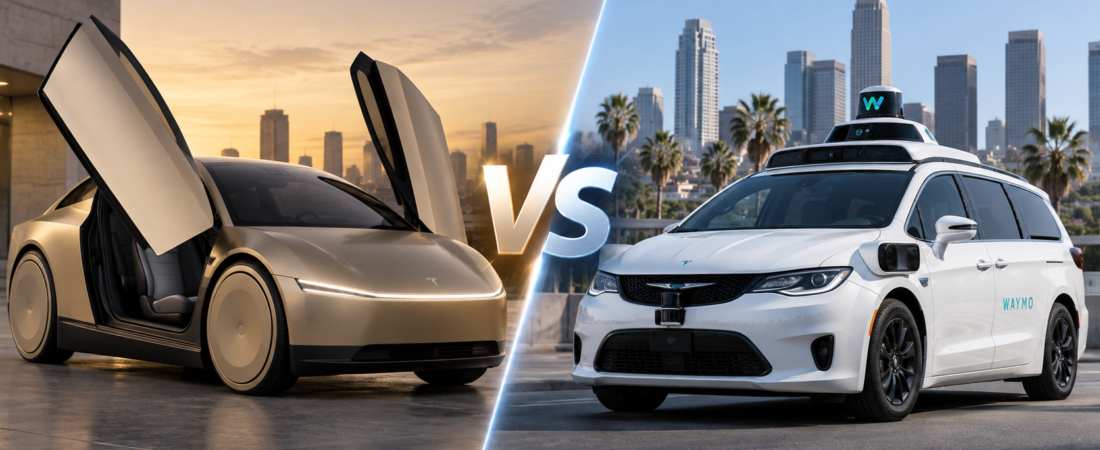
The robotaxi race just became much more interesting.
Tesla has begun offering limited rides in its purpose-built Cybercab in Austin, Texas, bringing Elon Musk’s long-promised vision of a steering-wheel-free Tesla one step closer to reality.
But Tesla isn’t entering an empty market.
Waymo has already spent years operating fully autonomous vehicles on public roads and is now providing rider service across a growing list of U.S. cities.
So the question is no longer whether robotaxis are coming.
They’re already here.
The more interesting question is:
Tesla Cybercab vs. Waymo — which approach is actually better?
Let’s compare them.
Quick Comparison
| Tesla Cybercab | Waymo | |
|---|---|---|
| Vehicle Type | Purpose-built 2-seat robotaxi | Multi-passenger autonomous vehicles |
| Driver Controls | No steering wheel or pedals | Fully autonomous rider service |
| Autonomous Approach | Camera-based Tesla AI/FSD strategy | Cameras + radar + lidar |
| Current Strength | Simpler, potentially lower-cost platform | Real-world experience and scale |
| Passenger Capacity | 2 | Generally more practical for groups |
| Public Service | Limited Cybercab deployment | Commercial service in multiple U.S. cities |
| Biggest Advantage | Cost and scalability potential | Proven autonomous operation |
| Biggest Question | Regulation and large-scale reliability | Cost and hardware complexity |
Design: Cybercab Looks Like the Future
There’s no question which vehicle makes the stronger first impression.
The Tesla Cybercab looks like something designed specifically for an autonomous future.
It has two seats, two doors, no steering wheel, no pedals, and no traditional driver controls.
That simplicity is intentional.
Tesla isn’t trying to convert a normal passenger vehicle into a robotaxi. Cybercab was designed from the beginning around the idea that nobody needs to drive it.
Waymo takes a more practical approach.
Instead of making the vehicle itself the star, Waymo integrates its autonomous-driving technology into passenger vehicles designed to carry people comfortably.
That makes Waymo less dramatic visually, but potentially more useful for families, airport trips, or groups carrying luggage.
For pure futuristic design, however, Tesla wins easily.
Winner: Tesla Cybercab
Autonomous Technology: Two Very Different Philosophies
This is where the comparison becomes much more important.
Tesla has long emphasized a vision-based approach to autonomous driving, relying heavily on cameras, neural networks, and massive amounts of driving data.
The goal is eventually to create autonomous vehicles without requiring expensive arrays of specialized sensors.
Waymo takes a different approach.
The Waymo Driver uses multiple sensor technologies, including cameras, radar, and lidar, to build a detailed understanding of its surroundings.
That hardware is more complicated.
It may also be more expensive.
But Waymo has something Tesla cannot yet match with Cybercab:
enormous amounts of fully autonomous real-world operating experience.
Waymo says its Driver has accumulated more than 200 million fully autonomous miles on public roads.
Tesla’s Cybercab, by comparison, is just beginning its public-service life.
Winner: Waymo
Real-World Availability: Waymo Is Far Ahead
This category isn’t particularly close today.
Waymo already offers fully autonomous rides to the public across numerous U.S. markets, including Los Angeles, Phoenix, San Francisco, Miami, Dallas and others. Austin is served through its partnership with Uber.
On September 1, Waymo also began welcoming public riders in Denver, San Diego and Tampa, bringing its public fully autonomous operations to even more cities.
Tesla’s Cybercab rollout is much smaller.
The Cybercab has recently begun offering limited rides in selected areas of Austin as Tesla gradually expands its robotaxi program.
Tesla may eventually scale quickly.
But we’re comparing what exists today, not what might exist several years from now.
Winner: Waymo — easily
Passenger Experience: It Depends on the Trip
Cybercab’s two-seat layout makes sense when you consider how many taxi and rideshare trips involve only one or two passengers.
Removing unnecessary seats can potentially reduce vehicle size, weight, energy consumption, and manufacturing cost.
For a single commuter going across town?
Cybercab could be ideal.
But imagine going to the airport with your spouse, two children, and luggage.
Now the two-seat design becomes a limitation.
Waymo’s current vehicle platforms provide a more conventional passenger experience and are better suited to a wider variety of trips.
So Tesla may have designed the more efficient robotaxi.
Waymo currently has the more versatile one.
Winner: Waymo
Cost and Scalability: This Could Be Tesla’s Secret Weapon
This is the category that could eventually change the entire competition.
Waymo’s autonomous system is sophisticated, but that sophistication requires substantial sensor and computing hardware.
Tesla’s strategy is fundamentally different.
If Tesla can achieve reliable unsupervised autonomous driving using a simpler sensor architecture and manufacture Cybercab at very large scale, the economics could become extremely compelling.
A purpose-built two-seat robotaxi doesn’t need many of the components found in conventional cars.
No steering wheel.
No pedals.
No driver-oriented cockpit.
Potentially fewer expensive autonomous sensors.
That could eventually make Cybercab cheaper to manufacture and operate.
The important word, however, is could.
Tesla still needs to prove that the technology can operate safely and reliably at Waymo-like scale.
Winner: Tesla Cybercab — on potential
Safety: Waymo Has the Stronger Case Today
Autonomous-driving safety should not be judged by which vehicle looks more futuristic.
It should be judged by real-world operation.
And right now, Waymo has considerably more fully autonomous experience.
Its vehicles have accumulated more than 200 million fully autonomous public-road miles, giving the company a substantial amount of real-world data across different traffic conditions and cities.
Cybercab is only now beginning to accumulate comparable public-service experience.
There is another issue as well.
Because Cybercab has no steering wheel, pedals or mirrors, its rollout has attracted attention from U.S. regulators. NHTSA is examining Tesla’s certification of Cybercab vehicles and how they comply with federal safety requirements written largely around conventional vehicles with human controls.
That doesn’t mean Cybercab is unsafe.
It means Tesla still has considerably more to prove.
Winner: Waymo
Regulation: Tesla Faces the Bigger Challenge
Cybercab’s most innovative feature may also create one of its biggest obstacles.
U.S. vehicle regulations were largely created around cars driven by humans.
Cybercab removes many of those traditional controls entirely.
That creates regulatory questions that conventional autonomous vehicles may not face in exactly the same way.
NHTSA is currently examining Tesla’s certification approach for nearly 1,000 Cybercabs, according to Reuters.
Waymo isn’t free from regulation either, of course.
But it has already spent years navigating city, state and federal requirements while expanding its commercial service.
For Tesla, regulation could determine how quickly Cybercab can move from a limited Austin deployment to a truly nationwide network.
Winner: Waymo
Which One Has the Bigger Long-Term Potential?
Now the comparison flips.
Waymo is clearly ahead today.
But Tesla has one enormous advantage:
manufacturing scale.
Tesla already knows how to build electric vehicles in very large numbers.
If its autonomous-driving technology reaches the necessary reliability level, Cybercab could potentially be manufactured and deployed far faster than a specialized autonomous fleet.
That’s why Tesla remains such an important competitor even though Waymo currently has a large operational lead.
Waymo’s challenge is proving it can scale its technology economically.
Tesla’s challenge is proving its technology can perform safely and reliably enough to deserve that scale.
Those are two very different problems.
Winner: Tesla Cybercab — for long-term upside
Compareason Verdict
If you could choose between the two today, the winner is clear.
Our Pick: Waymo — for now.
Waymo already has what Tesla is still trying to build: a large body of fully autonomous driving experience, commercial operations across multiple cities, and a service that real passengers can use today.
But Cybercab may ultimately be the more disruptive idea.
Tesla’s two-seat purpose-built design is simpler, potentially cheaper, and specifically engineered for a world where nobody drives the vehicle.
If Tesla can prove that its autonomous technology is safe and reliable at massive scale, the economics of Cybercab could become extremely difficult for competitors to ignore.
So our verdict is unusual:
Waymo is the better robotaxi today.
Cybercab may have the bigger opportunity tomorrow.
And with Tesla’s Cybercab now carrying riders in Austin, we may finally be entering the period where that prediction can be tested in the real world.
Compare with Reason.