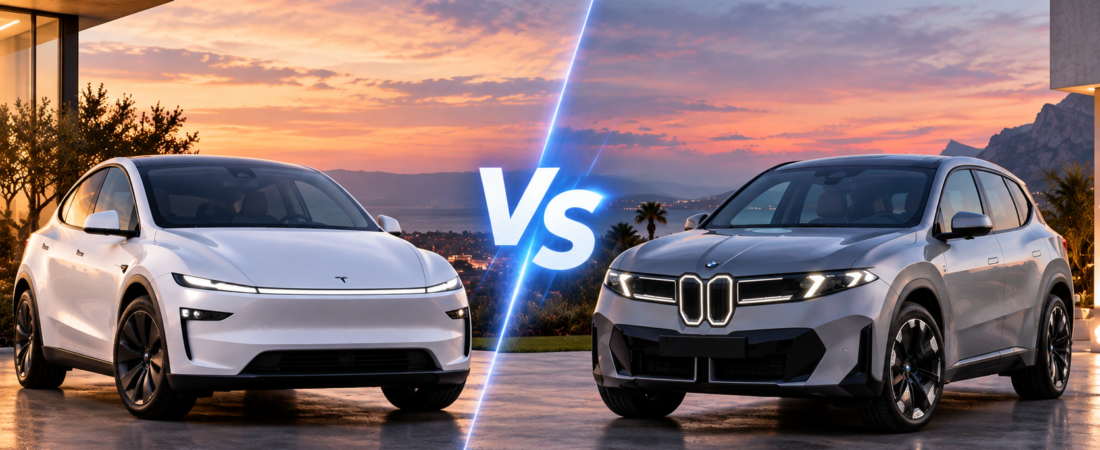
Tesla Model Y vs BMW iX3 is no longer simply a comparison between an established electric SUV and another premium German alternative.
The new BMW iX3 introduces Neue Klasse, BMW’s next-generation electric vehicle platform, with an estimated driving range of up to 434 miles and charging capability of up to 400 kW.
Those are impressive numbers.
The Tesla Model Y, meanwhile, remains one of the most practical electric SUVs available, offering competitive pricing, strong efficiency, an established charging ecosystem, and a spacious interior.
But the BMW brings something that could genuinely challenge Tesla: a combination of longer advertised range, faster peak charging, new driving technology, and traditional premium-car appeal.
There’s just one problem.
The BMW costs considerably more.
So does the iX3 offer enough additional value to justify its price, or is the Model Y still the smarter purchase?
Comparison Outline
- Quick specifications and key differences
- Purchase price and value
- Driving range and efficiency
- Charging and road-trip convenience
- Performance and driving experience
- Interior design and technology
- Family practicality and cargo space
- Real-world ownership cost comparison
- The decision point: when BMW becomes worth it
- Who should buy each SUV
- Frequently asked questions
- The Compareason Verdict
1. Tesla Model Y vs BMW iX3: Quick Comparison
To make this comparison meaningful, we’ll focus on the Tesla Model Y Premium All-Wheel Drive and BMW iX3 50 xDrive.
Both use dual-motor all-wheel-drive systems and target buyers who want a versatile electric SUV.
| Specification | Tesla Model Y Premium AWD | BMW iX3 50 xDrive |
|---|---|---|
| Starting U.S. MSRP | $49,990 | $61,500 |
| Drivetrain | Dual-motor AWD | Dual-motor AWD |
| Driving range | 327 miles EPA-estimated | 383–434 miles, BMW preliminary estimate |
| Peak DC charging | 250 kW | 400 kW |
| Charging claim | Up to 169 miles in 15 minutes | Up to 170–185 miles in 10 minutes |
| 0–60 mph | Approximately 4.3 seconds | Approximately 4.7 seconds |
| Interior interface | Central touchscreen | Panoramic iDrive and BMW Operating System X |
| Main advantage | Affordability and established ecosystem | Range and next-generation EV technology |
Prices exclude applicable destination charges, taxes, registration, and options. BMW’s range estimates are preliminary and may not yet represent final EPA certification. Charging results depend on equipment and conditions.
The most interesting difference is that BMW is not merely charging more for a premium badge.
It is offering substantial technical advantages on paper.
The question is whether those advantages justify the additional cost.
2. Price: Is the BMW Worth Approximately $11,500 More?
The Tesla Model Y Premium AWD starts at approximately $49,990.
The BMW iX3 50 xDrive starts at $61,500.
That creates an MSRP difference of:
$11,510.
And that’s before BMW options, destination charges, and taxes.
For a buyer considering a $50,000 vehicle, an additional $11,500 is a meaningful financial commitment.
It could cover several years of electricity, insurance, or maintenance.
But a higher purchase price does not automatically mean poor value.
The BMW offers technology and features that may matter enough to certain buyers.
What Does the Extra Money Buy?
The iX3 brings:
- BMW’s Neue Klasse electric platform
- Up to 434 miles of preliminary estimated range
- 800-volt electrical architecture
- Up to 400 kW DC fast charging
- BMW Panoramic Vision
- Heart of Joy vehicle dynamics control
- A premium-oriented cabin and driving experience
The Tesla counters with:
- Lower purchase price
- Established Supercharger integration
- Proven everyday practicality
- Strong acceleration
- Extensive software functionality
- A familiar EV ownership ecosystem
The important distinction: Tesla focuses on providing excellent everyday value. BMW is charging a premium for a newer generation of electric technology and a different driving experience.
3. Range: BMW Has a Significant Advantage on Paper
The Tesla Model Y Premium AWD offers an EPA-estimated 327 miles of driving range.
BMW estimates the iX3 50 xDrive will achieve between 383 and 434 miles, depending on configuration.
At the highest advertised figure, that’s a difference of:
107 miles.
Or approximately 33% more rated range than the Tesla.
That sounds enormous.
And for some drivers, it could be.
Why Longer Range Matters
Longer range provides more flexibility when:
- Driving long distances
- Traveling in cold weather
- Using highways at sustained speeds
- Visiting areas with limited charging infrastructure
- Taking trips where charging stops are inconvenient
But there’s an important qualification.
BMW’s figures are preliminary estimates based on EPA testing procedures, while Tesla’s 327-mile figure is an EPA estimate.
They should not be treated as perfectly equivalent final certified results.
The Daily Commuter Test
Imagine driving 45 miles per day.
The Tesla’s 327-mile rating already represents more than seven days of that hypothetical daily mileage.
The BMW’s additional range may rarely matter if you charge at home.
But imagine regularly driving 250 to 300 miles in one day.
Now the BMW’s larger range reserve becomes more valuable.
Our take: BMW has the stronger range proposition, but the practical value depends on how frequently you drive beyond the Tesla’s comfortable daily range.
4. Charging: 400 kW vs 250 kW
BMW’s new charging architecture is one of the iX3’s biggest selling points.
The iX3 supports DC fast charging at up to 400 kW.
Tesla’s Model Y Premium AWD supports up to 250 kW.
That gives BMW a substantial peak charging-power advantage.
However, peak charging power does not tell the entire story.
The charging curve, battery temperature, starting state of charge, and station capability determine how quickly a vehicle actually charges.
BMW’s Charging Advantage
BMW advertises approximately 170 to 185 miles of added range in 10 minutes under ideal high-power charging conditions.
It also quotes approximately 21 minutes for a 10% to 80% charge.
That’s impressive.
But accessing the maximum charging capability requires compatible high-power infrastructure.
Not every public charger can deliver 400 kW.
Tesla’s Charging Advantage
Tesla advertises up to 169 miles of added range in 15 minutes for the Model Y Premium AWD.
Its biggest advantage is the integrated ownership experience.
Tesla’s navigation, charging stops, battery preparation, and Supercharger network are designed to work together.
That reduces uncertainty on long-distance trips.
Which Is Better for Road Trips?
BMW has the more impressive charging specifications.
Tesla has the advantage of a mature, highly integrated charging ecosystem.
For buyers who frequently use high-power public charging stations, BMW’s technology could provide meaningful benefits.
For buyers who prioritize simple charging logistics, Tesla remains extremely compelling.
Our take: BMW wins on peak charging technology. Tesla remains a strong choice for charging convenience.
5. Performance: Tesla Is Still Surprisingly Quick
It’s easy to assume the more expensive BMW must be faster.
But that’s not necessarily true.
Tesla lists the Model Y Premium AWD at approximately 4.3 seconds from 0 to 60 mph.
BMW’s iX3 50 xDrive is expected to reach 60 mph in approximately 4.7 seconds.
That gives Tesla a slight acceleration advantage on paper.
However, acceleration is only one part of driving performance.
Tesla Model Y
The Model Y emphasizes responsive electric acceleration, efficient power delivery, and straightforward handling.
Its relatively compact dimensions make it practical for commuting and urban driving.
BMW iX3
BMW’s Neue Klasse introduces its Heart of Joy control system.
This integrates key driving functions, including propulsion, braking, and energy recuperation.
BMW’s goal is to make the electric driving experience more precise, responsive, and natural.
That’s especially important for a brand whose identity has traditionally centered on driving dynamics.
Which Drives Better?
Tesla appears stronger in straight-line acceleration for the money.
BMW’s integrated chassis and drivetrain technology is promising, but its real-world advantage needs to be evaluated through independent road tests.
Our take: Tesla offers outstanding acceleration value. BMW may appeal more to drivers seeking a premium, driver-focused experience.
6. Interior and Technology: Two Different Futures
This is one of the most interesting parts of the comparison.
Tesla and BMW are both moving toward digital vehicle interiors.
But they are taking very different approaches.
Tesla’s Minimalist Philosophy
The refreshed Model Y uses a large central touchscreen for most vehicle functions.
The Premium model also offers a rear passenger touchscreen.
Tesla’s interface is designed around software integration, simplified controls, and a clean dashboard.
Some buyers love the minimalist environment.
Others miss a conventional instrument cluster and more physical controls.
BMW’s Neue Klasse Interior
BMW’s new Panoramic iDrive system changes how information is displayed.
BMW Panoramic Vision places information across the lower windshield area, closer to the driver’s normal line of sight.
The system works alongside a central display and BMW Operating System X.
This creates a more layered digital interface than Tesla’s primarily screen-centered approach.
BMW also emphasizes a premium cabin atmosphere through its design, materials, and available equipment.
Which Interior Is Better?
Tesla offers a simpler, software-centered environment.
BMW offers a more distinctive interface that attempts to combine digital technology with driver-focused presentation.
Neither approach is automatically superior.
Our take: BMW has the more ambitious new interface, while Tesla offers a mature, familiar digital experience.
7. Practicality: Which SUV Works Better for Families?
A great electric SUV must be practical.
Cargo space, rear-seat comfort, visibility, and ease of loading matter more to many families than horsepower.
Tesla Model Y
Tesla lists up to 76 cubic feet of cargo space for the Model Y Premium under its published measurement convention.
The vehicle also provides front storage and a flexible rear cargo area.
Its combination of interior space and manageable exterior dimensions makes it well suited to daily family use.
BMW iX3
The new iX3 has an upright SUV shape and a practical rear cargo area.
Its design emphasizes a more traditional SUV appearance than Tesla’s aerodynamic crossover profile.
BMW also incorporates storage and flexibility into the Neue Klasse platform.
However, cargo figures should be compared using consistent measurement methods rather than assuming manufacturer-published numbers are directly equivalent.
Which Is More Practical?
Tesla has an established reputation for efficient packaging and useful storage.
BMW’s new iX3 looks promising, but buyers should compare actual luggage space, rear-seat access, and loading height in person.
Our take: Tesla is the safer practical-value recommendation until the BMW’s everyday usability can be assessed through direct comparison.
8. Real-World Ownership Math: What Does the BMW Premium Cost?
Let’s compare the financial impact of choosing the BMW over the Tesla.
Assume the following hypothetical financing scenario:
- Tesla Model Y Premium AWD: $49,990
- BMW iX3 50 xDrive: $61,500
- Down payment: 20%
- Loan term: 60 months
- Interest rate: 6% APR for both
- No trade-in, taxes, destination charges, or optional equipment
The purchase-price difference is $11,510.
With 20% down, the BMW requires an additional $2,302 upfront.
The remaining additional amount financed is $9,208.
At 6% APR over 60 months, that adds approximately:
$178 per month.
Over five years, the additional loan payments total approximately $10,680.
Including the extra down payment, the BMW requires roughly:
$12,980 more in purchase-related cash outflow over five years.
That includes the additional financing interest.
This is not a complete five-year ownership-cost comparison. It excludes insurance, energy, maintenance, taxes, resale value, and any differences in actual financing offers.
But it illustrates the financial commitment clearly.
The More Important Question
Would you pay approximately $178 more every month, plus the additional down payment, for:
- Longer estimated range
- Faster peak charging
- BMW’s premium interior
- Neue Klasse driving technology
- A more traditional luxury-car experience
Some buyers absolutely would.
Others would prefer to keep the money.
Neither answer is wrong.
The mistake is paying the premium without knowing what you actually receive.
9. The Decision Point: When Does BMW Become Worth It?
This is where the comparison becomes more useful than simply declaring a winner.
Scenario A: Daily Commuting and Home Charging
You drive 40 miles per day.
You charge at home every night.
You rarely take long road trips.
Better choice: Tesla Model Y.
The BMW’s additional range and charging capability may provide little everyday benefit.
Scenario B: Frequent Long-Distance Driving
You regularly travel hundreds of miles.
You value reducing charging stops.
You have access to compatible high-power chargers.
Better choice: BMW iX3 may be worth the premium.
Its larger estimated range and advanced charging system become more meaningful.
Scenario C: Premium Comfort Matters Most
You enjoy BMW interiors, driving characteristics, and luxury features.
You are comfortable spending more for a premium experience.
Better choice: BMW iX3.
The additional cost may be justified by your personal priorities.
Scenario D: Maximum Value for a Family
You want a spacious electric SUV.
You need reliable transportation, useful storage, and straightforward charging.
You prefer minimizing vehicle expenses.
Better choice: Tesla Model Y.
The Model Y already delivers the core capabilities most families need.
10. Who Should Buy Which Electric SUV?
Buy the Tesla Model Y If You:
- Want the stronger value proposition
- Prioritize lower purchase costs
- Charge primarily at home
- Value integrated charging and navigation
- Want strong acceleration
- Need practical family transportation
- Prefer established software and ownership systems
Buy the BMW iX3 If You:
- Want BMW’s newest EV platform
- Frequently drive long distances
- Value maximum driving range
- Want access to ultra-fast charging capability
- Prefer a premium cabin
- Enjoy BMW’s driver-focused approach
- Are comfortable paying more for advanced technology
11. Frequently Asked Questions
Is the BMW iX3 better than the Tesla Model Y?
The BMW iX3 offers more advertised range and higher peak charging capability, while the Tesla Model Y offers substantially better purchase value and an established charging ecosystem. The better choice depends on priorities.
How much more expensive is the BMW iX3?
Comparing the Tesla Model Y Premium AWD at $49,990 with the BMW iX3 50 xDrive at $61,500 produces an MSRP difference of approximately $11,510 before fees and options.
Which has longer range?
The BMW iX3 50 xDrive has a preliminary estimated range of 383–434 miles. The Tesla Model Y Premium AWD has an EPA-estimated range of 327 miles.
Which charges faster?
The BMW iX3 supports up to 400 kW DC charging, compared with up to 250 kW for the Tesla Model Y Premium AWD. Actual charging speed depends on charger capability and battery conditions.
Is the BMW iX3 a replacement for the BMW iX?
No. The iX3 and iX are different vehicle lines. The iX3 introduces BMW’s Neue Klasse platform, while the iX belongs to BMW’s larger luxury electric SUV range.
Is Tesla Full Self-Driving better than BMW’s driver assistance?
The systems have different features, limitations, and operating conditions. Tesla’s Full Self-Driving (Supervised) still requires an attentive driver and does not make the vehicle autonomous. Buyers should evaluate available features and safety requirements rather than rely on marketing names.
Which electric SUV is better for families?
The Tesla Model Y is the stronger value choice for most families. The BMW iX3 may appeal to families who prioritize premium comfort and longer driving range.
Should I wait for the BMW iX3?
If you are specifically interested in Neue Klasse technology, extended range, and premium driving features, waiting for the desired configuration and comparing actual dealer offers can make sense. If you need an EV immediately and prioritize affordability, the Model Y is a compelling option.
12. The Compareason Verdict: Which Should You Actually Buy?
Overall Winner for Most Buyers: Tesla Model Y
The Tesla Model Y remains the smarter financial decision for most electric SUV buyers.
It offers more than enough range for typical daily driving, strong performance, practical interior space, and a mature charging ecosystem.
Its lower price is difficult to ignore.
For drivers who primarily commute, charge at home, and take occasional road trips, spending another $11,500 or more may not provide a proportional improvement in everyday usefulness.
Best Premium Alternative: BMW iX3
The BMW iX3 is the more exciting choice for buyers who want next-generation EV technology.
Its preliminary range figures, 800-volt architecture, 400 kW charging capability, and new BMW interface represent meaningful technical advances.
For drivers who frequently travel long distances or value a premium driving environment, the additional cost may be justified.
Our Final Recommendation
Choose the Tesla Model Y if you want the best combination of affordability, practicality, and established EV convenience.
Choose the BMW iX3 if you are willing to pay more for longer range, advanced charging technology, and BMW’s premium driving experience.
The BMW may be the more technically ambitious vehicle.
But the Tesla remains the stronger value for most households.
And that is what makes this comparison interesting.
The more expensive electric SUV may offer better specifications.
The smarter purchase is still the one whose advantages you will actually use.
Compare with Reason.