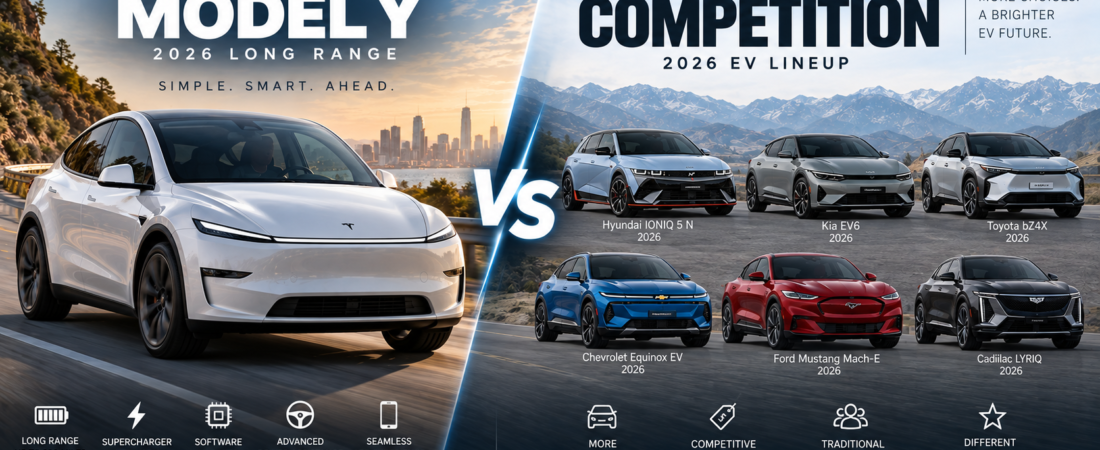
For the past few years, the story surrounding Tesla has often been about increasing competition.
Traditional automakers were launching new electric vehicles. Hyundai and Kia were gaining attention. General Motors was expanding its EV lineup. Toyota was finally becoming more aggressive in the electric market.
It looked like Tesla’s enormous lead in the United States might gradually disappear.
But in 2026, something unexpected is happening.
Tesla is gaining U.S. EV market share again.
Through August 2026, Tesla accounted for approximately 52% of U.S. EV sales, according to Motor Intelligence data reported by The Wall Street Journal. That’s up from roughly 43% a year earlier.
And one vehicle is doing much of the heavy lifting:
The Tesla Model Y.
So why is Tesla regaining ground while many competitors are struggling?
Let’s compare the Model Y with the broader EV competition and see what’s really happening.
Quick Comparison
| Tesla Model Y | Competing EVs | |
|---|---|---|
| U.S. Sales Volume | Exceptional | Much lower individually |
| Charging Network | Excellent | Improving |
| Software | Excellent | Varies |
| Driver Assistance | Strong | Varies |
| Interior Design | Minimalist | More traditional |
| Model Variety | Limited | Much broader |
| Service Network | Tesla-only | Traditional dealer networks |
| Price Competition | Strong | Often heavily incentivized |
| Brand Choice | Limited | Excellent |
| Current Market Momentum | Winner | Mixed |
Tesla Is Growing — But Not the Way You Might Think
This is the most important part of the story.
Tesla isn’t necessarily taking over because its sales are suddenly exploding.
Tesla’s estimated U.S. sales through August were approximately 325,351 vehicles, down about 16% from the previous year.
Normally, that wouldn’t sound like a comeback.
But the overall U.S. EV market declined even faster — roughly 30% over the same period.
That means Tesla is losing volume while simultaneously gaining market share.
In other words, Tesla isn’t necessarily running faster.
Many of its competitors are slowing down faster.
That’s an important distinction when looking at Tesla’s apparent resurgence.
The Model Y Is Tesla’s Biggest Weapon
The biggest reason Tesla remains so dominant is surprisingly simple.
Americans continue buying the Model Y.
In July, the Model Y represented roughly 37% of all new EV sales in the United States, according to Cox Automotive.
Think about that.
More than one out of every three new EVs sold that month was a Model Y.
Tesla sold an estimated 42,435 EVs in July, giving the company roughly 55% of the U.S. EV market for that month alone.
That level of concentration is unusual in the automotive industry.
And it gives Tesla an enormous advantage.
Sales: Model Y Wins Easily
During the first half of 2026, the Model Y was America’s best-selling EV by a huge margin.
Tesla sold an estimated 163,454 Model Ys in the U.S. during that period.
The next-highest non-Tesla EV?
The Hyundai IONIQ 5, with approximately 20,730 sales.
Toyota’s bZ followed at roughly 17,553, while Chevrolet sold about 16,249 Equinox EVs.
That’s not a close race.
The Model Y sold nearly eight times as many vehicles as the best-selling non-Tesla EV.
Winner: Tesla Model Y
Why Are Competitors Pulling Back?
This may be even more important than Tesla’s own performance.
Several traditional automakers invested billions of dollars expecting EV adoption to continue growing rapidly.
Instead, U.S. EV demand weakened.
The expiration of federal EV purchase incentives also changed the economics of the market.
Some manufacturers responded by reducing EV production, delaying programs, or shifting investment back toward hybrids and gasoline-powered vehicles.
That creates an unusual situation.
Tesla spent years building factories, charging infrastructure, software, and an EV-specific supply chain.
Traditional manufacturers are trying to balance EVs with gasoline vehicles, hybrids, dealerships, and existing manufacturing infrastructure.
When EV demand slows, those companies have more reasons to retreat.
Tesla doesn’t have that option.
Its business is built around electric vehicles.
And right now, that commitment is helping Tesla maintain scale while competitors reconsider their strategies. Activate $2.50 Cash Back
Charging: Tesla Still Has an Advantage
Charging used to be one of the biggest differences between Tesla and everyone else.
That’s changing.
Many competing EVs can now access Tesla Superchargers through NACS compatibility or adapters.
That’s good news for EV buyers.
But Tesla still offers one of the most integrated charging experiences.
A Model Y can automatically plan charging stops during a road trip.
The vehicle knows where chargers are located.
It can estimate battery levels upon arrival.
It can prepare the battery before charging.
Payment is integrated.
The experience feels like part of the car rather than a separate service.
Competitors are rapidly closing the gap, but Tesla’s ecosystem remains one of its strongest advantages.
Winner: Tesla Model Y
Software: Tesla Wins
Traditional automakers have become much better at EV hardware.
Software is another story.
Tesla designed its vehicles around software from the beginning.
Over-the-air updates can change vehicle functions without requiring a dealer visit.
The Tesla app is deeply integrated into the ownership experience.
Navigation, charging, climate controls, phone key functionality, vehicle cameras, and software updates all work within the same ecosystem.
Tesla’s Full Self-Driving (Supervised) system is also a major differentiator for buyers interested in advanced driver assistance.
That doesn’t mean FSD makes the car autonomous.
Drivers must remain attentive and responsible for the vehicle.
But as a consumer-facing technology platform, Tesla still has an advantage that many traditional manufacturers haven’t fully replicated.
Winner: Tesla Model Y
Interior and Physical Controls: Competition Wins
Tesla’s minimalism isn’t for everyone.
The Model Y eliminates many traditional buttons and controls.
Almost everything runs through the central touchscreen.
Some people love it.
Others don’t.
Competitors such as Hyundai, Kia, BMW, Cadillac, Toyota, and Chevrolet generally offer more traditional interiors with physical controls, dedicated instrument displays, or a combination of screens and buttons.
If you prefer conventional automotive ergonomics, the competition often feels more familiar.
Tesla’s interior can feel futuristic.
But futuristic doesn’t automatically mean better.
Winner: Competition
Variety: Competition Wins Easily
Tesla’s lineup is relatively small.
The Model Y dominates the crossover segment, while the Model 3 covers sedans.
But competing automakers collectively offer far more choices.
Small electric crossovers.
Three-row SUVs.
Luxury SUVs.
Pickup trucks.
Performance vehicles.
Budget-oriented EVs.
Traditional-looking vehicles.
Futuristic vehicles.
Buyers who don’t like the Model Y’s design or minimalist interior have plenty of alternatives.
Winner: Competition
Price: Much Closer Than It Used to Be
Tesla once carried a significant premium.
That’s no longer necessarily true.
In July 2026, Cox Automotive estimated the average transaction price of a Model Y at around $52,500.
The average new EV transaction price across the U.S. market was approximately $56,126.
That’s important.
Tesla isn’t simply competing as a premium EV brand anymore.
The Model Y sits near the heart of the EV market.
Traditional automakers frequently offer significant incentives, though, which can make individual competitors very attractive depending on the month.
So this category changes constantly.
Winner: Tie
Tesla Has Something Competitors Don’t: Scale
This might be Tesla’s biggest advantage.
Automotive manufacturing is extremely sensitive to scale.
The more vehicles a manufacturer builds on the same platform, the easier it becomes to spread development, factory, battery, software, and supply-chain costs across those vehicles.
Tesla has concentrated enormous volume into the Model Y and Model 3.
Traditional manufacturers divide their EV volume across many models.
That gives consumers more choice.
But it can make individual EV programs harder to make profitable.
The Model Y’s massive sales volume gives Tesla an advantage that is difficult to reproduce quickly.
But Tesla Still Has Problems
Tesla’s renewed market-share dominance doesn’t mean everything is going perfectly.
Model 3 sales have declined sharply.
During the first half of 2026, U.S. Model 3 sales were estimated at about 66,616 vehicles, down roughly 34% year over year.
The Cybertruck also hasn’t become a Model Y-sized volume product.
Tesla’s lineup remains relatively old compared with competitors constantly introducing new vehicles.
And outside the United States, Tesla faces intense competition — particularly from Chinese manufacturers.
In China, for example, Tesla’s battery-EV market share has fallen significantly from its earlier highs as companies such as BYD and other domestic manufacturers expand.
So this isn’t a story about Tesla suddenly becoming unbeatable everywhere.
It’s specifically about the unusual dynamics of the 2026 U.S. EV market.
Is the Model Y Actually Better Than Every Competitor?
No.
That’s probably the most interesting conclusion.
Some competitors have better interiors.
Others offer more physical controls.
Some have better ride quality.
Some offer three rows.
Others provide more distinctive styling.
And certain buyers simply don’t want a Tesla.
But automotive markets aren’t decided by which vehicle wins every individual category.
They’re decided by the complete package.
The Model Y combines:
Competitive pricing.
Excellent charging access.
Strong efficiency.
Useful range.
Mature software.
A simple buying process.
Large-scale manufacturing.
And enormous brand recognition.
No single feature explains its success.
The combination does.
What Should Buyers Watch Next?
The biggest question is whether Tesla’s renewed dominance can last when the EV market begins growing again.
Right now, Tesla benefits partly because competitors are retreating.
But several companies are still expanding.
Toyota’s U.S. EV sales grew rapidly during the first half of 2026.
Hyundai remains one of Tesla’s strongest non-Tesla competitors.
Rivian continues developing new mass-market vehicles.
And GM isn’t abandoning EVs entirely.
If EV demand accelerates again, competition could return quickly.
That will be the real test.
Compareason Verdict
Our Pick: Tesla Model Y — for most EV buyers right now.
The Model Y doesn’t win every category.
It doesn’t have the most luxurious interior.
It doesn’t offer the most conventional controls.
And it certainly isn’t the only good EV available.
But in the U.S. market today, the Model Y remains extremely difficult to beat as a complete package.
More importantly, the numbers tell us something bigger.
Tesla isn’t regaining EV market share because Americans suddenly started buying dramatically more Teslas.
Tesla is regaining share because it has maintained enormous scale while much of the broader U.S. EV market has contracted.
That’s why Tesla’s U.S. EV share has climbed back above 50%.
And that’s why the Model Y remains the vehicle every competing EV manufacturer has to beat.
For now, Tesla is still the leader.
But the next chapter will depend on what happens when the U.S. EV market starts growing again.
Compare with Reason.